Good Girls Don’t Act Up: Intimacy as a Tool of Subversion
In our current postmodern situation, it makes little sense to reaffirm the allegedly stable categories of human identity, whether they be based in race, ethnicity or gender. Despite the persistence of conservative thought, it is clear that the gradual dissolution of these categories is increasingly becoming a topic for public discussion. One of the spheres where these narratives are found is that of art, as such art forms may be subversive, liberal, radical or unpalatable.
The aim of this text is to find out what role Czech video art has played in the reflection of identity. Czech video art has always straddled the diverse spheres of performance, documentary, intimate confession, and other genres, but here I will focus on a sample of works stored at the VVP AVU Video Archive (maintained by the National Film Archive) which I had the opportunity to work with as part of the project Absences in the Videoarchive. My basic question is about the way gender and “women’s topics” are perceived and constructed by female artists who have at some point been confronted with the stereotypical category of “woman” ( .
What prompted this perspective? The original aim was to look at the collection through the lens of gender. But the very heterogeneous sample and the nebulosity of such an approach finally led me to focus only on the female artists themselves. Upon first analysis, it became clear that the select works often reflect the relationship between the personal and public spheres and the position of women in society, and this realization determined the direction of my subsequent analysis.
One may ask what basis there is for excluding the male gaze. The answer is that if we want to focus on the critique and reflection of gender relations, it would make sense to also listen to those artists who have not received as much attention and who are the most affected by gender categorization – i.e. the discursive minority. And if we analyze “women’s” experience, we must obviously focus on those people whom society treats as a “woman.”
Gayatri Spivak’s concept of strategic essentialism (1988) works with the concept of “woman” on similar terms. Her approach can be seen as a critique of white, western feminism and its attempts at deconstructing the female identity. Spivak notes that with the persistence of structures of education, politics, health or media which continue to distinguish and act based on the category of ‘woman,’ it is necessary to preserve the category and cultivate it; that is strategically, and with the full knowledge that it is, in fact, an empty construct. This position also allows us to adopt a second-wave perspective (which also includes the selected source literature) and focus on how the particular artists understood their position in the art world and their lived reality.
The personal is political. And the political personal
It must first be noted that all the discussed pieces are feminist works. I am not talking about whether their creators consider themselves to be feminists, but rather about the topics they address and the methods through which they do so. These are critical and subversive works which often employ irony and hyperbole. They mostly address second-wave feminism – a simple definition of second-wave feminism for the purposes of this paper is that it shows notable interest in the symbolic inequality between men and women. The studied art works were mostly created in the latter half of the 1990s and the 2000s, and they often address essential feminist topics of the 1970s and 80s: namely, the right of women to self-realization (both as persons and as artists), motherhood, the social pressure on women’s appearance and actions, and the importance of the relationship between private and public space.
It is in this sense helpful to remind ourselves of one slogan which was integral to second-wave feminism – “the personal is political.” The opinion of Kate Millett (1970) that the private and public spheres cannot be separated and that they influence each other is present in most works in the selected sample. It may at first sight seem like an intuitive gesture which lacks deeper understanding of its political-activist background, but that just makes it all the more .
This intuitive thematization of the personal as political (and the political as personal) is also surprising in that it appears in the context of an era in which political activism and social critique were rather subdued (or even actively persecuted). Most of the older videos come from the , an era which adopted a rather critical stance towards feminism. Although the Czechoslovak, and later Czech, society enthusiastically and non-critically adopted the ideas of neoliberal politics and capitalism, the exact opposite happened in the case of women’s rights and feminism. It was not just that society became flooded with images of female nudity and pornography and that the female body became an object “like in the West,” but the ideas of feminism, which was just inching towards its third wave, encountered disinterest or downright resistance. During this time – a time, when, paradoxically, women’s rights were quite strong – there was little interest in resolving certain deep-rooted stereotypes and problems. Quite the contrary – we can even say that along with the enthusiasm for the entrepreneurial ethos and a drive to machoism, many women started “receding” (some willingly, some not) into their gilded homes equipped with an automatic washing machine and a sports car in the garage, much like women in the West had receded into private space throughout the 1950s (Friedan, 1963).
Revolt from the bedroom
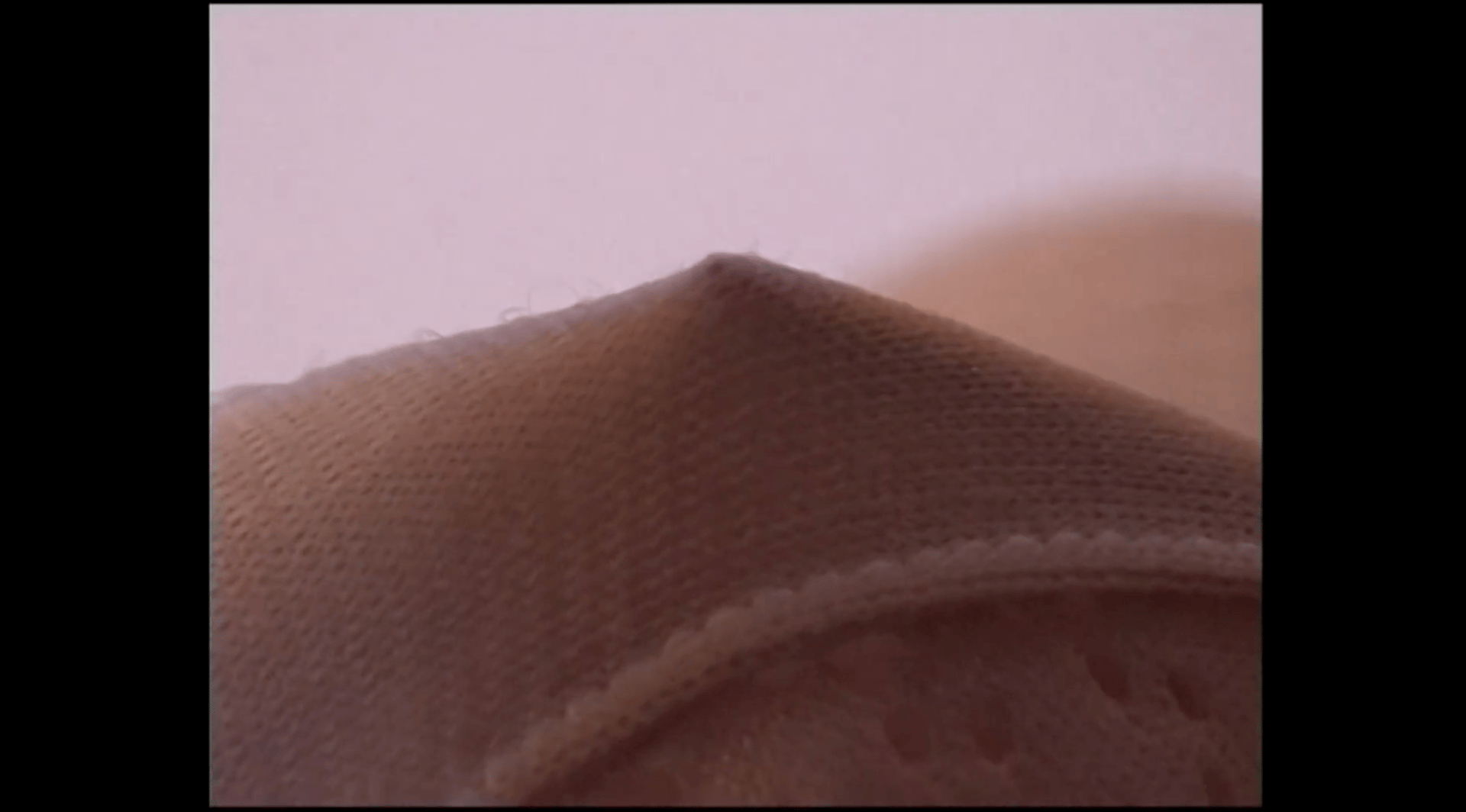
Home exercise - Anna Daučíková, 1997
Viewing the sample works focusing on gender relations, it soon became clear that their male and female creators approached the public and private spheres on different terms. The video works of male authors mostly took place in public, either featuring male figures confidently co-existing with their environments, or female figures being variously attacked by the males. Female artists preferred to produce the works within private space – and if they for some reason did exit it, it was as a form of short-term revolt with a clear message of rebellion.
Especially the works from the 1990s mostly take place in the private sphere – bedrooms, kitchens, perfectly tidy living rooms. They thematize typically feminine spaces and feminine activities – tidying, embroidery or cooking. But it is important to note that such environments and activities remain a tool of subversion in the way the artists portray them.
We can see this in the video Home Exercise (1996) by Anna Daučíková which shows the detail of a hand occupied with embroidery. But here, sewing is not a routine activity – the needle sumptuously pricks through the fabric, sliding in and out in what seems like erotic frenzy. We see a similar approach in Daučíková’s sensuous coitus of hands (Queen’s Finger, 1998) or the exciting touch of lips on glass (Kissing Hour, 1997). In these works, we are not observing a housewife who is merely embroidering or washing a glass – we are watching someone who is clearly deconstructing these activities. They suddenly transform into autoerotic activity which can be both subversive and empowering, providing a sense of personal agency and self-esteem.
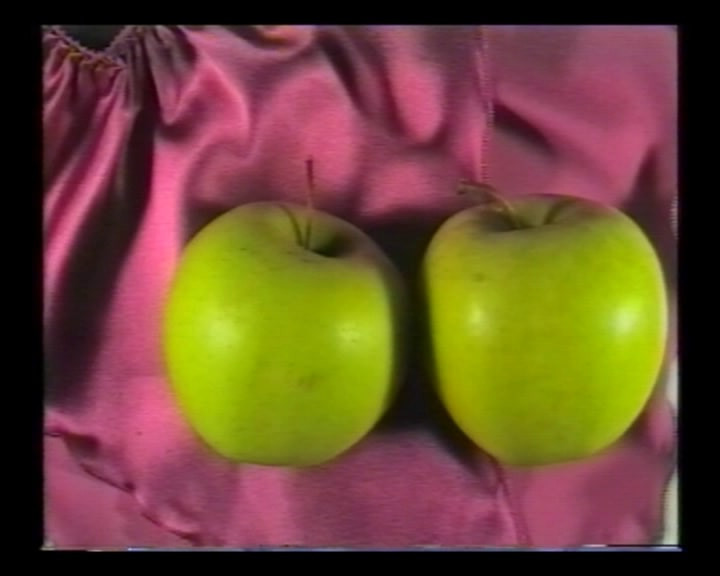
We see similar subversive potential in the film Wet Video (1993, Elen Řádová). At first sight, it may seem like a parody of pornography which shows two apples performing “coitus” on pink satin while lascivious 1980s music plays in the background. It reflects our voyeuristic expectations and the definition of eroticism and carnality. But this is not the only way it can be read – it is important that the video’s “sex” scene is taking place in the private sphere, a little girl’s bedroom, and is thus the outcome of her “play.” Just as the private sphere of women and the public sphere of men used to be symbolically separate, so too were the worlds of boys and girls separate during the era of second-wave feminism. While it was expected of boys to spend time outside – explore and experience adventure – girls were meant to stay at home, help their mothers or “unobtrusively” play in their bedrooms (Kocurek, 2016). Wet Video can be read through just such a perspective. Instead of a tea party with dolls, we see something which a well-behaved girl should not be doing. Much like in the previously discussed works, we are witnessing something akin to reprogramming, a recoding of the given activity into something with subversive potential.
Wet video - Elen Řádová, 1993
We see a similar taste for revolt in the newer work Den poté (2005, Sláva Sobotovičová) which shows a wholly normal and “natural” situation, and yet we see it from a different perspective. A hidden camera shows a scene in a kitchen – the traditional women’s sphere. A group of women is cleaning up, most likely after a family celebration, singing and placing the leftovers into boxes. Boxes are a notable female symbol and the protagonists of many memes, and here they represent female subjugation but also a hypothetical source of power. The video shows that certain delimitations can themselves become weapons of emancipation and provide a place in which women may feel dominant over men. Men do appear in the video – coming in, giving advice, bantering – but the video shows it as rather humorous. The hidden camera also invokes a certain voyeuristic glee in the viewer – we expect something shocking but instead we are treated to a seemingly banal scene.
Den poté - Sláva Sobotovičová, 2005
Public revolt
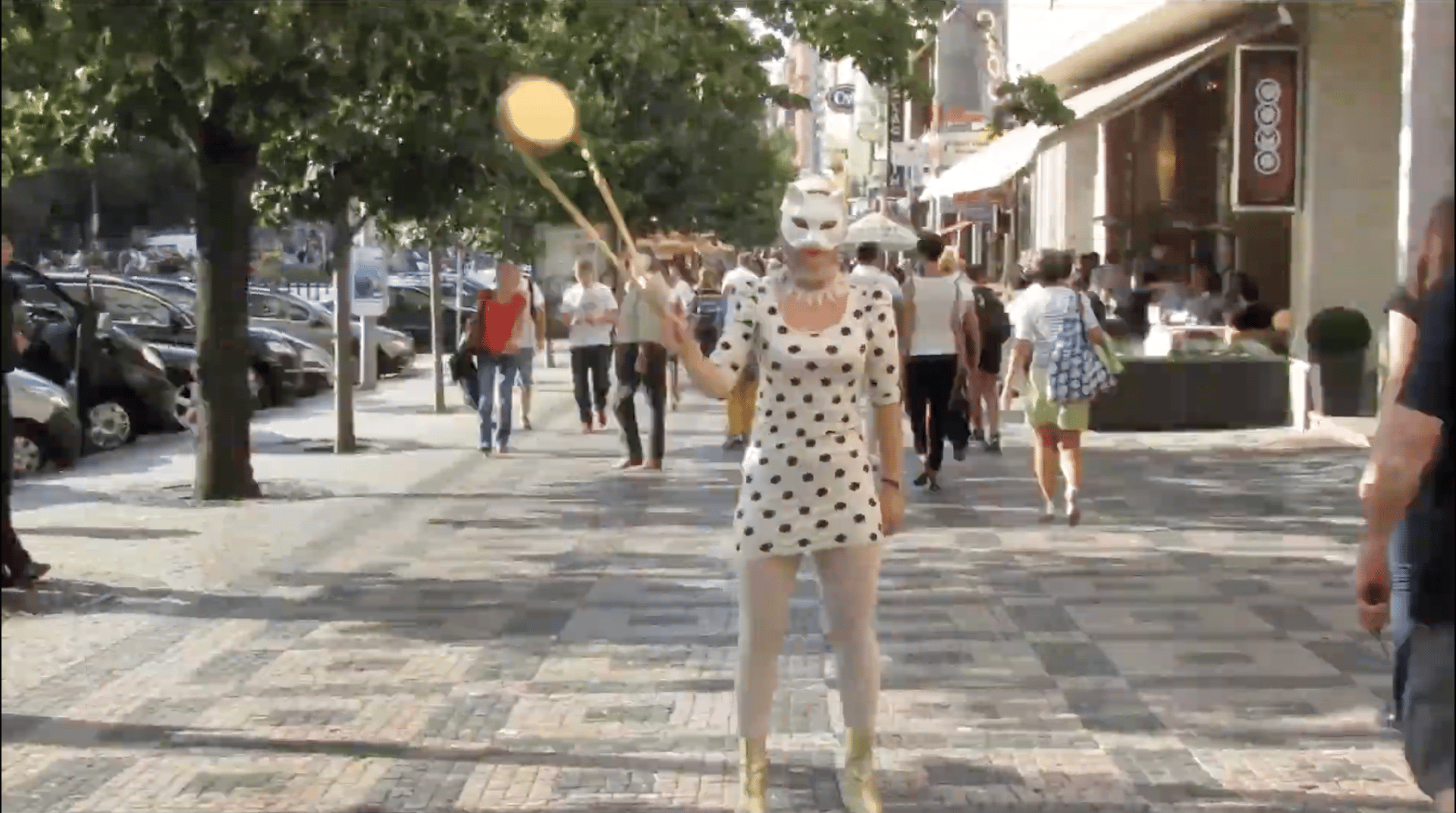
In later works made after the year 2000, it becomes obvious that the women artists are breaking free from their private space and starting to “act out” in public space. But the mapping of differences between generations must consist of an absolute, mechanical exercise, as even Irena Gosmanová’s film Pohádka pro šílence (1985), the oldest work in the analyzed sample, functioned as a form of revolt. This dadaist rebus mixed with surrealist scenes depicts a completely insane “woman” – part witch, part animal/wolf, part clown, who undermines the era’s grey environment of normalization. Ladislava Pachlová’s video performance Vymezení osobního prostoru kabelkou (2013) does very much the same in the wholly different socioeconomic context of the new millennium. This short provocative video shows the masked artist in a number of environments (street, metro) using her handbag to explicitly “delimit her personal space.” As if she was not able to set her boundaries without this specifically feminine accessory.
Vymezení osobního prostoru kabelkou - Ladislava Pachlová, 2013
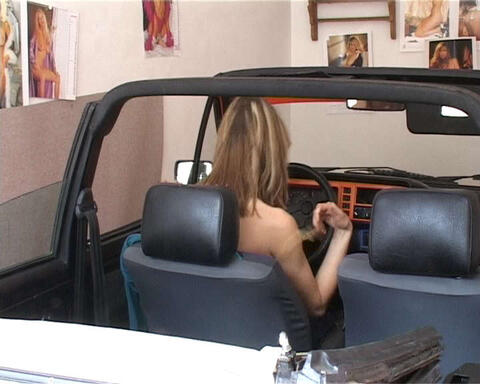
The older Jízda (2004) goes even further, showing the artist Eva Jiřička riding naked in a cabriolet car through the city and watching the reactions of the passersby. The video thus accents the 1990s fascination with the female body and erotica. In an era when the female body could be used to sell tooth paste or coal without any contextual relationship, and when pornography was still publicly accessible in every magazine shop, Jiřička tries to shift the perspective and the power hierarchy – she herself consciously decides to become an object and, as opposed to the lascivious girls on the posters who lack any sense of agency over themselves, she chooses to be naked and to shock. Her Jízda, or joyride, can also be seen in the context of entrepreneur and gangster Roman Jonák’s drives through the city in an open-top car surrounded by naked models. Eva Jiřička thus inverts the symbolism of 1990s machismo, turning it into a liberating act which works with and against the era’s zeitgeist. Although it is a video from 2004, it prefigures a contemporary form of feminism defined by the conscious reflection of women’s own corporeality and sexuality, and the self-confident transformation of the body into a sexual object in new contexts.
Jízda - Eva Jiřička, 2004
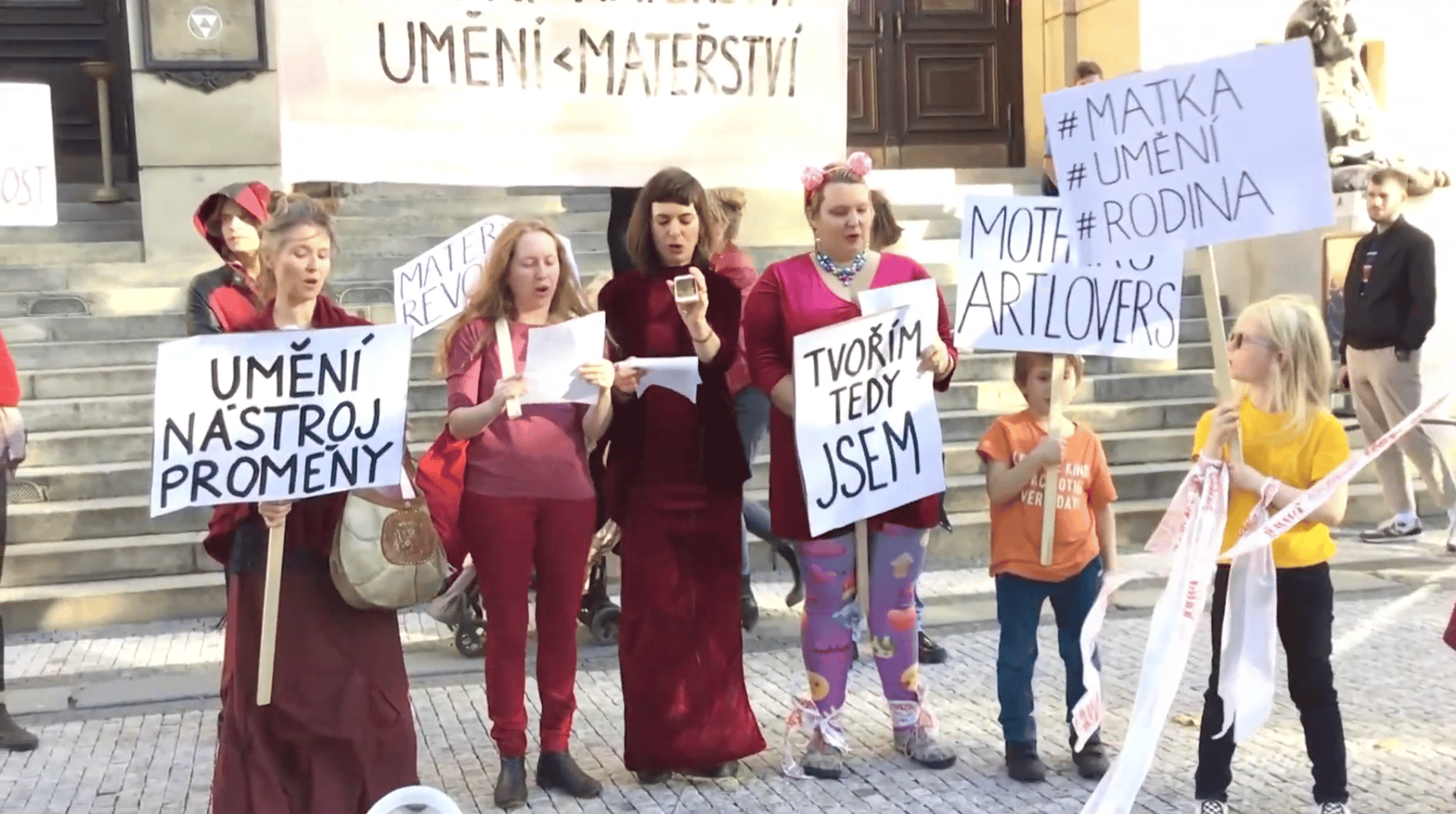
The most explicit “irruption” into the public sphere can be seen in the records of happenings where being disobedient is not only symbolic but actually tries to stir debate on the problem. An example of such an approach is the event of the Mothers Artlovers collective. Their video Manifest Mothers Artlovers (2019) sees the collective members – artists, curators, and theorists – standing in front of the Rudolfinum (a public institution) and “demonstrating” in order to “be heard.” The main motif is the question of motherhood and the role of the artist, which will also be discussed later on.
Manifest Mothers Artlovers, 2019
Mothers, lovers, artists
Apart from the spaces and environments themselves, many works also take the position of women in society as their main theme. Pavla Sceranková’s performance Milada (2019) asks what society really expects from women. The performance follows the artist in a sticky “suit” while she tries to climb a flight of stairs. The seemingly simple activity is depicted as being extremely complicated and challenging – we can imagine the glue to be anything: social pressures, stereotypes, one’s own self-esteem…
Certain videos also question the physical appearance women are expected to have. These unwritten norms are often peddled by magazines, films or television series (Wolf, 1990), and can be understood as symbolic expressions of violence. They show how limited, and often contradictory, the roles which society often expects of women can be – to be beautiful and trim, a satisfied mother and housewife, open to sexual advances but also chaste, etc. This cult of beauty is also thematized in the short video Jsem připravená (2005) by Tereza Velíková, where we see a woman putting on make-up as if it were a mask. Taneček (2008) by Ester Geislerová shows the pressures on perfection of the female body, placing the audience in an uncomfortable position – we see ourselves laughing at a body which is “not perfect,” as it does not correspond to our standards of a beautiful dancing female body.
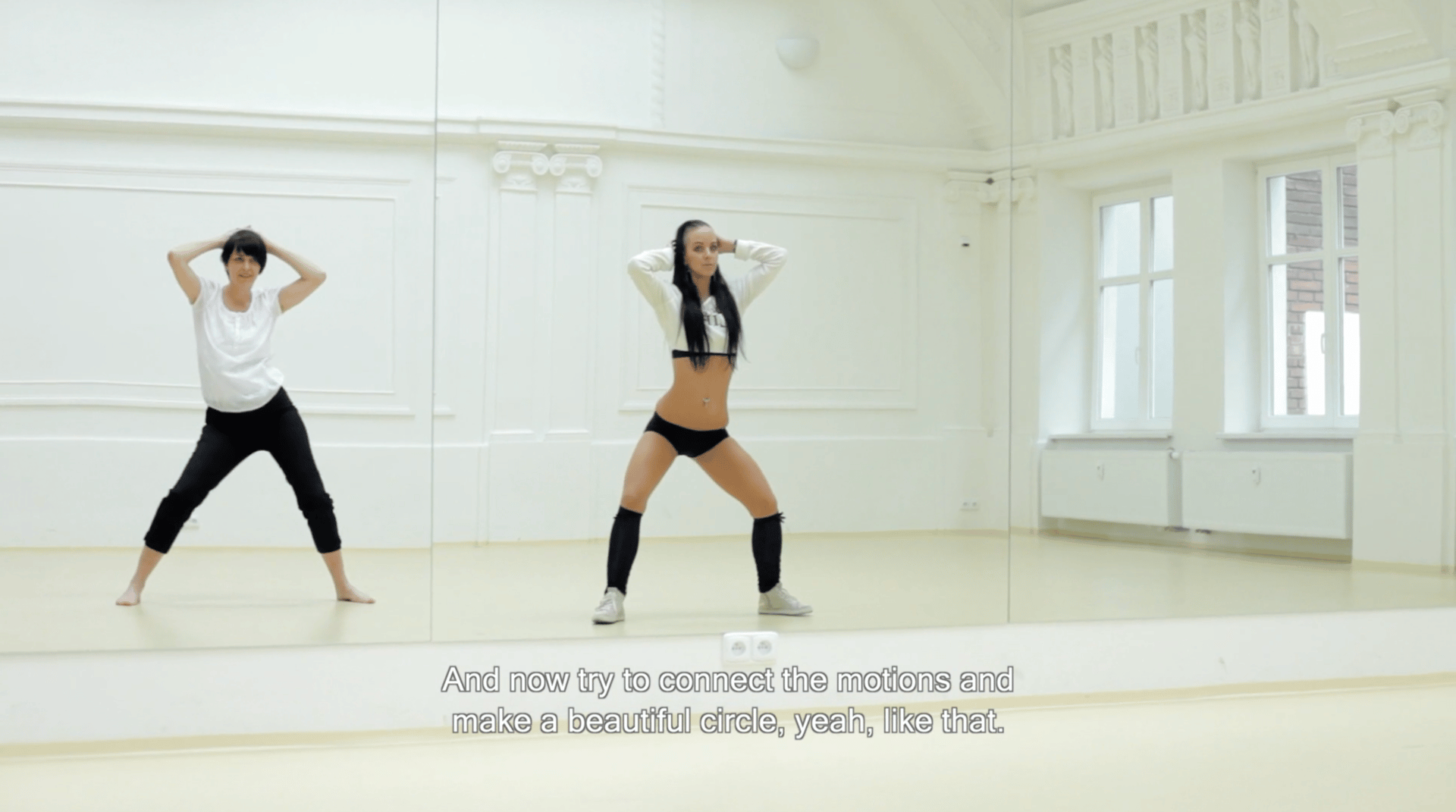
The question of the “beautiful” female body and the expectations of various, contradictory roles are also the topics of Talk and Twerk (2014) by Alžběta Bačíková. The film brings together a teacher of twerking and a teacher of rhetoric. Where one woman works with her body, the other works with her voice. Both of them at first seem to embody two “types of woman” – the beautiful but stupid woman, and the clever but ugly woman – but through the gradual encounter they explore the limits of these stereotypes in order to reach a mutual understanding. After all, many feminist authors including Simone de Beauvoir (1949), bel hooks (1981) or Adrienne Rich (1980) confirm that one of patriarchy’s greatest sins is the way it promotes competitiveness between individual women. Instead of forming alliances and sharing experience, they consider each other as enemies and threats.
Talk and Twerk - Alžběta Bačíková, 2014
The question of the limited role that women play in society also begs the question of motherhood as an essentially female situation – not in the sense that only women can give birth, but because motherhood is connected to many stereotypes and expectations of how a woman should feel. As Badinter (1981) notes, a mother’s love is, much like many other concepts (including love itself) a social construct – but motherhood is often expected to be a calling which a woman will naturally perform and enjoy, and one she will find fulfilling due to her biology.
A highly caricatured rendition of these expectations and their stark contrast with the lived reality are also addressed in the video Polednice (1999) by Niké Papadopulosová, which presents the character of the Mother from Erben’s classic horror tale in subversive style. For what is more hypocritical than to criticize a woman for her failing from the position of a respected artist?! The topic of motherhood is also addressed in the newer piece Dělohy a mozky (2023) by Lucie Rosenfeldová, which follows a soon-to-be-mother waiting for a doctor’s check-up in the waiting room. By means of a voiceover, it describes feelings of loss of agency – a woman ceases to be person, becoming a mere “baking dish” for new life.
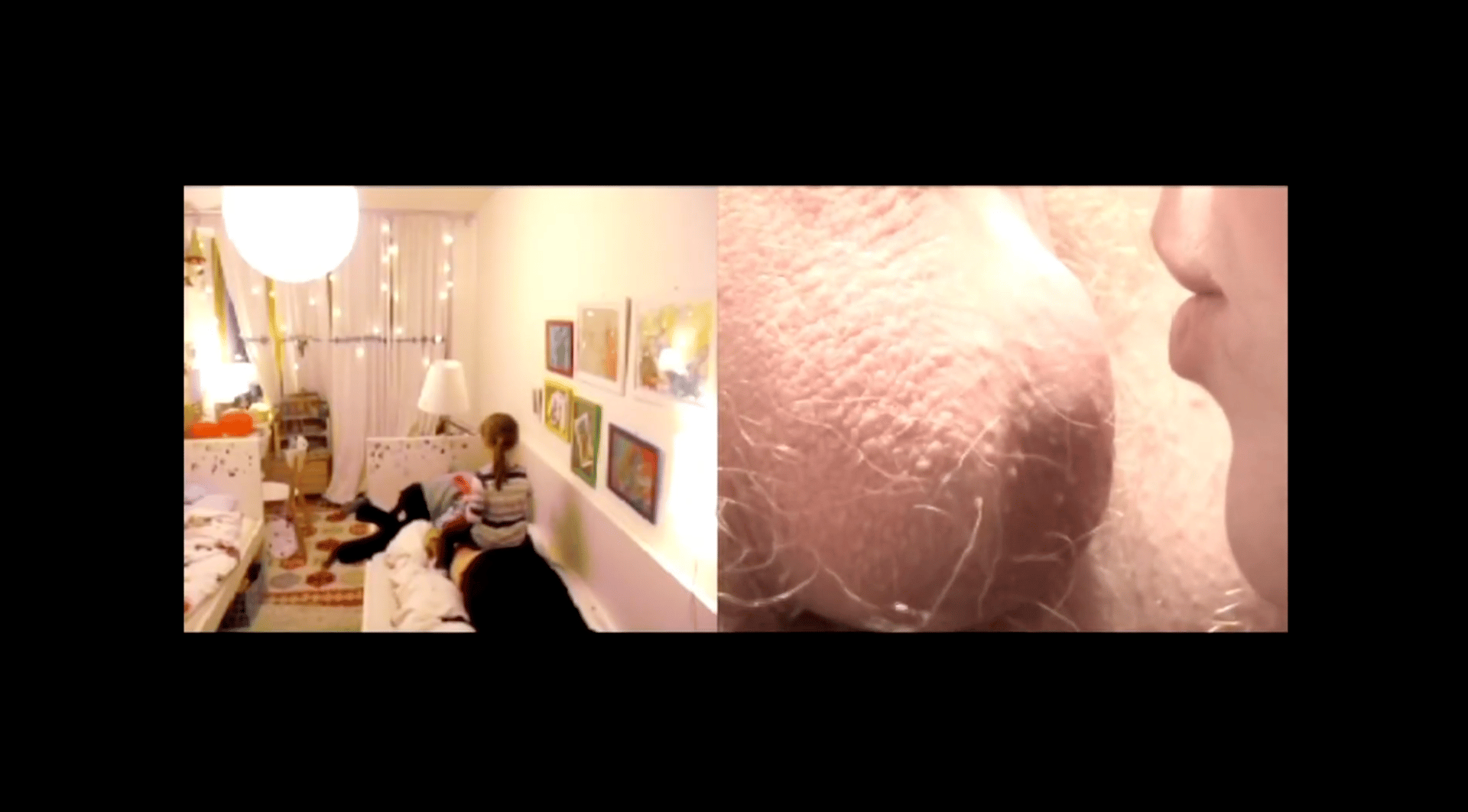
A mother failing in her motherly duties is also the main theme of the film Koule (2010) by Ester Geislerová, which provides a provocative pastiche of two different but also ironically complementary pieces. On the left, we see a distraught mother pretending to be dead, while her children are trying to wake her up. This is accompanied by an authentic discussion with the husband – while she unhappily explains to him that she is tired and lacks opportunity for self-realization, he unempathetically tells her how she should be feeling and what she should be doing. This video contrasts with the right side of the screen where we see the same woman (the artist herself) happily “playing” with male testicles. They quiver and move, reacting to her breath. While we see only the man’s testicles, we can see the woman’s face – and it is very different from what we usually see of the female body in pornography, or in fact in any audiovisual work. This antithesis to pornography inverts our scopophilia and can be read as an expression of the female gaze, i.e. a variation on the male gaze as defined by Laura Mulvey (1975). The male body becomes an object, a piece of meat, while the woman becomes the carrier of her own agency and self-confidence. The work can also be considered a critical reflection of those contradictory roles, as the two frames show a mother failing in her duties, as well as a femme fatale ready to please a man.
Koule - Ester Geislerová, 2010
We find a blatant inversion of perspective where a woman becomes a powerful actor who objectifies the male body and its attractiveness (albeit with a large dose of irony) in the work Porn Video (2005) by Anetta Mona Chisa and Lucia Tkáčová. We are watching a classic “porn video” with its characteristic camerawork, music, moaning, and sexual positions. However, both actors are women, and they are furthermore fully dressed. Instead of an active man and a passive woman, or two cuddling women who fulfill the porn trope of “hot lesbians” (Mulvey, 1975; Rich, 1980) so often depicted by traditional mainstream pornography, both women are obviously performing a heteronormative act which would otherwise include an active man and passive woman. This biting critique of pornography and our own voyeurism levels the positions between who is in power and who is subjugated.
In Seductive (2005), also by Anetta mona Chisa and Lucia Tkáčová, we see women in a bedroom dressed in lingerie. But they are not in any way sexualized, rather speaking candidly about men – particularly about artists and art critics, about their looks and whether they would like to have sex with them. This ironic game inverts the standing hierarchical positions, as well as offering a statement about the conscious reflection of one’s sexuality as a critical position for women and artists who are first and foremost regarded as an object, a body, a pleasant face, or a mother – and only then as an artist.
The position of women artists is also the focus of a few other works by Adéla Babanová – for example the chilling radio broadcast featuring a dead female poet and a prickly journalist entitled Rozhovor se Sylvií Plath (2006). All the works exhibit frustration with the position of female artists and the knowledge that male and female artists logically do not enjoy the same opportunities and nor the same social position.
A return to (one’s own) body
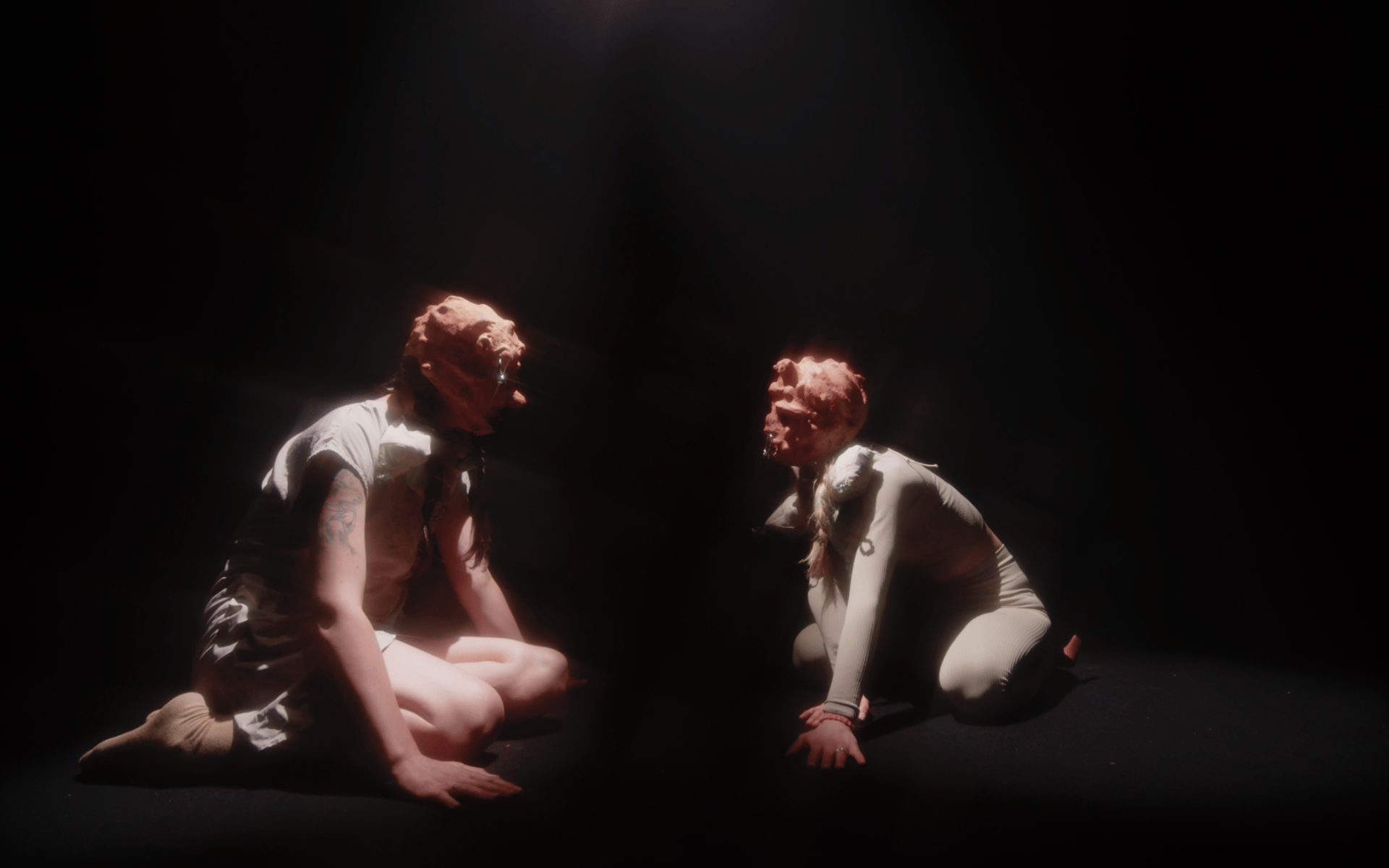
If we once again attempt to grasp the generational transformations as reflected in the analyzed sample, we might say that the works created after 2020 can be defined in their turning away from classic topics of second-wave feminism. That does not indicate that we should stop discussing them – their theses are rather still valid and most of them do not conflict with contemporary ideas. But we do see that rather than addressing the position of women and their right to work and sex, the “younger” artists increasingly play with the diversity of identities and question the binary understanding of gender and corporeality as such. This is notable in the aforementioned Dělohy a mozky or in Prolog (2023) by Tereza Vinklárková, where we see a strange creature with a female body and a horrific face whose alien movements and seemingly unrelated voiceover thematize not only questions of gender, but the human body as such.
Prolog - Tereza Vinklárková, 2023
If we were to reflect on older works in the context of the third-wave (or fourth-wave?) sensitivity to the intersectional aspects of human identity and their deconstruction, we may call many of them ‘queer’ (here used in the wider and more abstract sense) – particularly Wet Video or the works of Anna Daučíková. Whether eroticism is represented by fabric, fingers, or glassware, there is a significant element of queerness, especially considering the context of the era during which they were produced.
Absence?
The most recent works show that videoart’s relation to gender has perhaps “caught up” to the situation abroad. Czechoslovak society developed in a particular vacuum in which it was (more or less) enclosed and “protected” from western influence. Another point of lag then occurred in the early 1990s when the resistance to feminism and the turn to conservatism bogged down discussions on gender relations.
This lag can be clearly observed from the analyzed (and understandably partial) sample of the NFA Video Archive, where the works were reacting to a particular social climate. While in the 1990s and early 2000s they mostly reflected the difference between the private and public spheres – whose gendering was suddenly becoming obvious – after 2005, we find more works which confront the public space, whether through comic reflection or records of actual happenings. The video art from this period begs the question of the role of artists in the public sphere, and we can thus consider it a metaphor for a more general discussion on the position of women in society, their right to work (and better salary), opportunities of self-realization, and sexual life. In the context of the times during which they were produced, these works are certainly audacious, critical, and subversive. And all of them are implicitly, authentically, and intuitively feminist.
We are faced with the question of what is really missing from the works. First, we obviously don’t see antifeminism, but there is also a lack of any essentialism – a feature which was partly typical for second-wave feminism. Despite video art generally being a critical art form, certain works may celebrate “womanhood” or search for some “female” and “male” essence. But we see nothing of the sort in these works – they were as subversive as possible given the day and age when they were made.
Secondly, there is a marked absence of explicit reference to the LGBTQ+ community. As already mentioned, Prolog is the only work which can be judged to be queer due to its critique of binarity. Apart from Mulholland Drive / Malholandrajv (2003) by Anna Daučíková – which thematizes the lesbian scene from David Lynch’s film of the same name – we do not find a single work in the analyzed sample which would thematize second-wave questions of gays and lesbians. Granted, one would not rightly expect that from works made in the 1990s.
And thirdly – men are also predominantly absent from the works. If they are present, they are mere anonymous passersby, minor characters captured on “hidden camera” or just testicles – a stereotypical caricature we are rather used to seeing in the case of women and their nipples, crotches, and parted lips. But in these selected works, it is the women who become active protagonists rather than anonymous figures to whom “things happen.” They are heroines and self-confident movers of the narrative. And that in itself is a strong artistic and political statement.
Sources:
Badinter, E. (1981). Mother Love: Myth and Reality: Motherhood in Modern History. Macmillan.
Beauvoir, S. de, & Rowbotham, S. (2011). The Second Sex (C. Capisto-Borde & S. Malovany-Chevallier, Trans.). Vintage Books.
Friedan, B. (1963). The Feminine Mystique (1st publ. as a Norton paperback). W. W. Norton.
Hooks, B. (1998). Ain’t I a Woman: Black Women and Feminism (15th print). South End Pr.
Kocurek, C. A. (2016). Coin-Operated Americans: Rebooting Boyhood at the Video Game Arcade. University of Minnesota Press.
Millett, K. (1970). Sexual Politics (Columbia University Press).
Mulvey, L. (1975). Visual Pleasure and Narrative Cinema. Screen, 16(3), 6–18. https://doi.org/10.1093/screen/16.3.6
Rich, A. (1980). Compulsory Heterosexuality and Lesbian Existence. Signs: Journal of Women in Culture and Society, 5(4), 631–660. https://doi.org/10.1086/493756
Spivak, G. (1988). Can the Subaltern Speak? In C. Nelson & L. Grossberg (Eds.), Marxism and the Interpretation of Culture. University of Illinois Press.
Wolf, N. (1990). The Beauty Myth (London: Chatto&Windus). Chatto & Windus.
Collaboration
Production team: Alžběta Bačíková, Lujza Kotočová, Sylva Poláková
Text editing: Sylva Poláková, Tereza Špinková
Text proofreading: Jan Kovanda
Translation: Vít Bohal
Publication: June 9th 2025