
“What's the point of looking at art education right now, in all our possible roles - whether as learners, teachers, or as a curatorial duo?” This is the question posed by Michal Pěchouček and Pavlína Morganová, who are curating this year's diploma theses at AVU. A report from the 2025 diploma thesis exhibition, accompanied by an excerpt of the curatorial text (the full text can be found on the AVU website). We are also publishing a podcast with interviews with most of this year's diploma theses.
Reports
AVU Graduates - Moving Horizons
Moving Horizons
“How do you make an exhibition like this?” There are many possibilities. In 1997, the eminent Czech curators Jiří Ševčík and Jana Ševčíková responded to this question in a way that is still inspiring today: “You have to find a question, the most important one, which you may not ask yourself without being forced to, but which you feel within yourself. It’s like being with something called the present – now.” Their quote illustrates that curatorial work – and perhaps the creation of art in general – does not begin with an answer, but with uncertainty. What one rejects at the outset is of key importance, as it often contains discomfort, provocation, or the hidden absolute. The Ševčíks place the appeal to confront uncertainty firmly in the present moment. “Now” they suggest, continuously arises from discovering something authentic and urgent within oneself. This very urgency makes the present moment elusive and changeable, always in motion, never quite fixed in one meaning or response. In the 21st century, the driving force in this context is the daily dose of existential pessimism. It stems from the understanding that the world around us will no longer be as we have known it, leading us, among other things, to a fundamental question: what meaning should we seek in art education right now, in all our potential roles – whether as students, teachers or a curatorial duo?
How did we begin this exhibition? Together with fifty exhibiting graduates, for whom one important period of their lives is ending and a new one beginning, we have agreed on a metaphorical title – Obzory v pohybu / Moving Horizons. For the graduates of the Academy of Fine Arts, this title symbolises individual transformation – the culmination of their studies and entry into the uncertain realm of the present, as well as the question of one’s own identity at a moment that is both welcoming and daunting, as the framework of support in the art world changes. The horizons are not fixed but in a state of flux, both in the immediate space we inhabit and on a global scale. It is no coincidence that the international English version of the exhibition title was articulated first and this literally predetermined the local Czech title. It is not only horizons that are in motion, but also the language that defines us as human beings. Moving Horizons – Obzory v pohybu can therefore be seen as a metaphor for the dynamics of change, uncertainty and the constant reassessment of our own and society’s starting points today.
Our near and distant future is a fractured, distorted and disrupted structure. Boundaries – whether physical, cultural or ideological – are not fixed. There are constant political, environmental and technological upheavals. In both art and society, the roles of institutions, narratives and authorities are changing. Innocent people are dying – right now. The rest of us go on living our lives and are fortunate enough to pursue something as beautiful and exciting as art. Even in this time of escalating crises, the need for knowledge and creative self-development will eventually prevail.
The young generation of graduates from AVU in Prague is a Central European sample from which a receptive audience can gain concrete insights into what contemporary artists are doing today, what questions they are asking, what materials and forms they are experimenting with and what challenges they are encountering in their work. In this sense, we view the creation of the collective exhibition not only as care for this year’s graduating artists and their specific artworks but also as a manifesto of the continual search for a balance between personal expression in art and what emerges as universally relevant.
The Academy of Fine Arts in Prague has historically been a hub of public and professional debate about the values, continuity, and quality of artistic production. Terms such as tradition, craft and decline often arise in the context of criticism of contemporary art, an area in which the institution has long engaged and whose forms it has significantly influenced. Tradition is associated with a deeper understanding of an artistic discipline and, along with craft, is often seen as a lost element or as an opposition to experimental and conceptual approaches. Decline is a term that points to mediocrity, artlessness, commercialisation or the desire to provoke at any cost. At the opposite pole of contemporary art criticism, progressive voices argue that breaking down tradition and experimenting are the hallmarks of viable contemporary art and represent a necessary approach to art education. Unfortunately, the discourse between these differing perspectives often revolves around not just the art itself but also about which side of the barricade is deemed safe in the culture wars. This year’s exhibition of the graduating works offers more: a genuine and shared way to have this discussion – reflecting not only the presence of different approaches to art, but also the broader issues of values, the role of art in society, and the connection between historical consciousness and the needs of the present. Despite frequent claims about the decline of traditional craft at AVU, this year’s graduation exhibition demonstrates the opposite. It is not merely a formal showcase, but a testament to the persistence of the creative gesture – often quiet, laborious and unspectacular. The works present here show that contemporary art is not afraid to combine traditional media with experimentation, and that “craft” is not an anachronism but a means of finding expression that is both personal and topical.
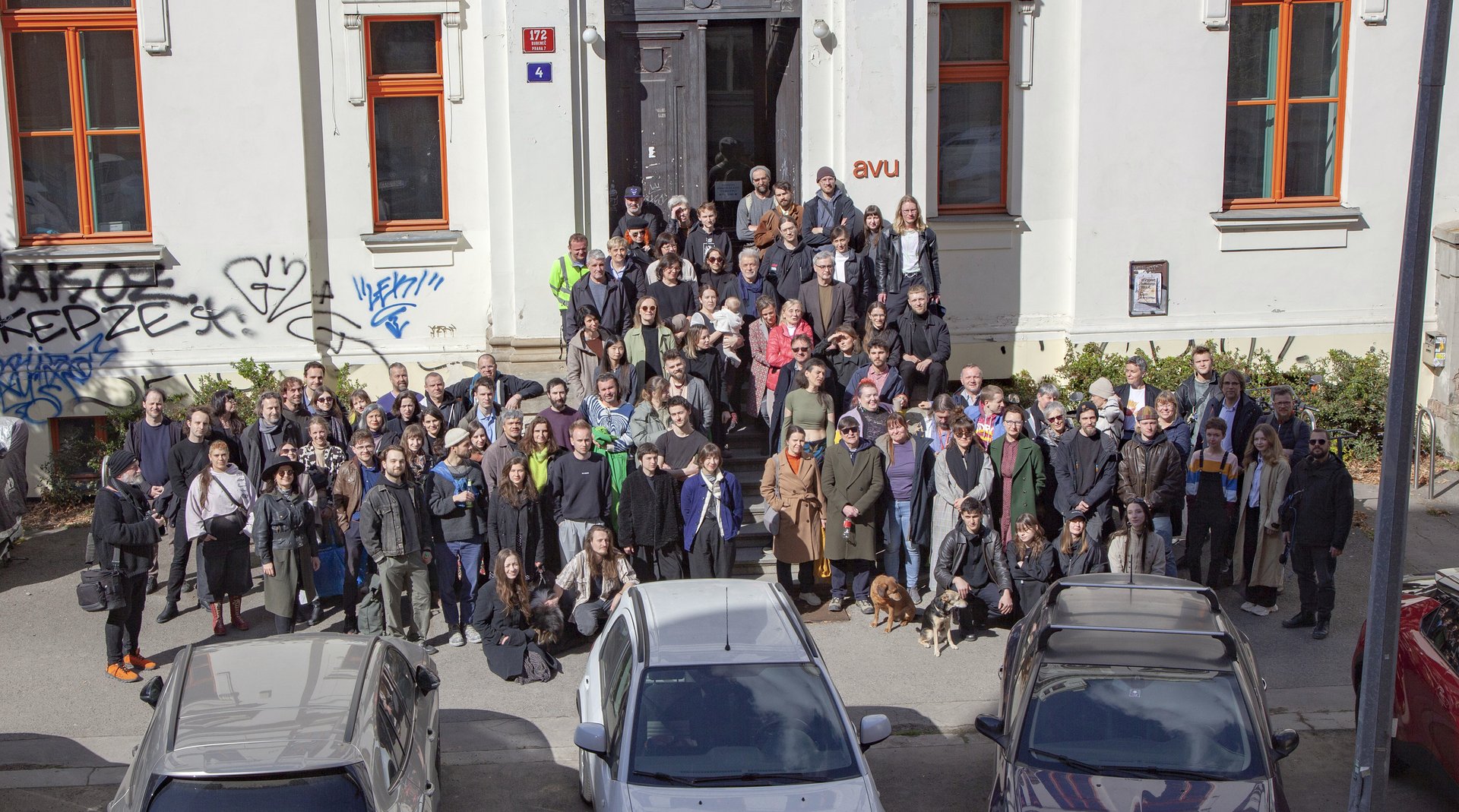
As the curators of previous graduation exhibitions have mentioned, this is primarily an “exercise in the area of care”, an activity that stems from the original meaning of curatorial work – curare (to care, to heal, to supervise, to administer, to ensure preparations). It has been a pleasure to participate in this process and to care for a while for the, in some cases already masterful and in others fragile, sprouts of contemporary art. This introductory text is written before the exhibition takes place and therefore cannot fully capture the complexity of the form of the individual thesis projects. It is a modest curatorial attempt to at least briefly outline the nature, themes, forms and materials of personal artistic statements in the process of their creation. Above all, we wanted this year’s graduates’ catalogue to reflect the contemporary atmosphere at AVU in 2025. Therefore, on 8 April, we invited all those involved inthe preparation of the theses to gather in front of the main building of the Academy – namely, the graduating students themselves, along with their teachers and other staff members (management, technical department, workshops, maintenance, economic, study, grant and exhibition departments, PR) – without whom this challenging exhibition project would not have been possible. We cannot but thank them all for their professionalism, willingness and considerable commitment accompanying the end of each academic year. Special thanks are due above all to the photographer Radek Dětinský, who sensitively captured our shared April afternoon and whose photographs determined the visuality of the catalogue.
It would be appropriate to conclude a text introducing several dozen young people to life after school and the art world of the future on a hopeful note. But where can we find optimism in these difficult and turbulent times, especially when we have lost faith that the world is automatically evolving for the better? The current generation of young people is entering a difficult situation: they must cope with many uncertainties, losses, but also opportunities and information that do not permit calm concentration.
We believe that, despite everything, these challenges will make them stronger and foster a new type of previously unknown resilience. After all, this is how humanity has always responded to its crises, of which there has been no shortage throughout history.
♥ Pavlína Morganová and Michal Pěchouček
Pavlína Morganová is an art historian and curator, head of the VVP AVU, and lectures at the Academy of Fine Arts in Prague on the history of Czech art in the 20th and 21st centuries in the context of Central and Eastern Europe. She is the co-author of the book Exhibition as a Medium.
Michal Pěchouček is an artist, teacher, scenographer and curator. Graduate of the Academy of Fine Arts, winner of the Jindřich Chalupecký Award 2003.
Introduced by: Dominik Gajarský
Camera, edit, sound: Jan Vidlička
Music in video: LilaTesla
Podcast: Dominik Gajarský