
Confrontations in public space are becoming more virulent. Protests gain traction, social tension is on the rise. Tension as a reaction to threat, an emotional roller coaster of strong convictions.
Tomáš Rafa: New Nationalism
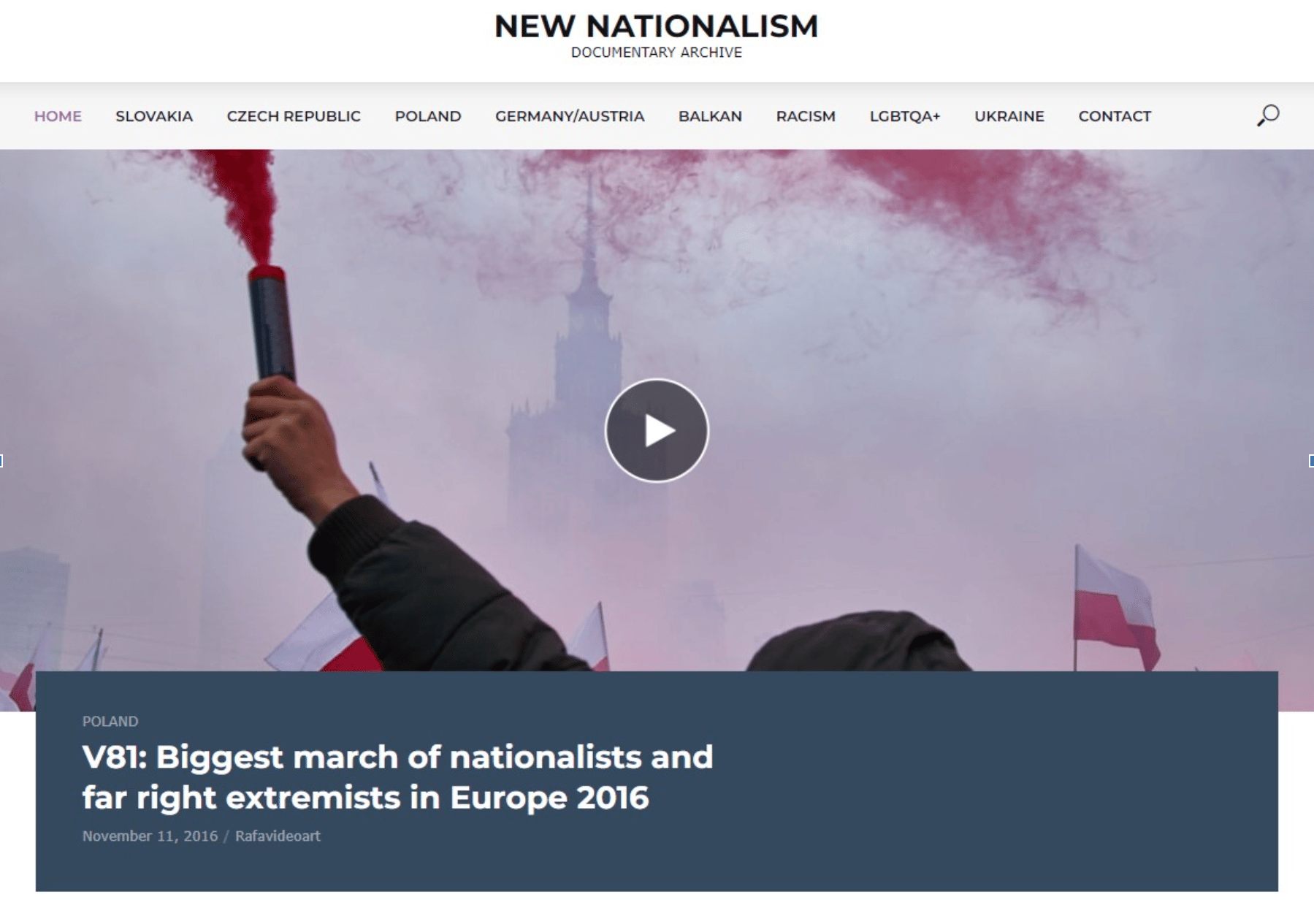
The truth of convictions is shored up by shared emotional experience. Anger, loss of hope, feelings of remorse, anxiety; the emotional ties of mutuality.
“Instead of engaging in a potentially more long-winded process of reflecting how one would react by putting oneself into the other person’s shoes, one feels a similar emotion, or spontaneously shares an opinion—and then passes it on to others, in the (maybe semi-conscious) expectation of experiencing the positive meta-emotion that comes from sharing.”
Lisa Herzog: Sympathy, Empathy, and Twitter: Reflections on Social Media Inspired by an Eighteenth-Century Debate
Anna Kryvenko: My Shadow is More Real than your Body
Closed communities communicate with each other by yelling. The adopted vocabularies resonate in echo chambers.
“According to group polarization theory, an echo chamber can act as a mechanism to reinforce an existing opinion within a group and, as a result, move the entire group toward more extreme positions. Echo chambers have been shown to exist in various forms of online media such as blogs, forums, and social media sites.”
Matteo Cinelli, Gianmarco De F. Morales, Alessandro Galeazzi, Walter Quattrociocchi, Michele Starnini: The echo chamber effect on social media
Dialog is reduced to preaching to the converted. Everyone is discussing, but no one is asking what such discussion might achieve.
“Have you ever thought you made a convincing case for a position only to have someone promptly reject your conclusion? This frequently occurs because people deliver messages and the recipient rejects the act of delivery. Nobody likes to be lectured. The research literature on effective conversations shows that delivering messages does not work. […] When a messenger delivers undesirable news or facts that contradict the recipient’s closely held beliefs, the hearer’s temptation is to be angry with (or historically, to kill) the messenger.”
Peter Boghossian, James Lindsay: How to Have Impossible Conversations: A Very Practical Guide
The idea of the internet as a global agora is replaced by the reality of commercial algorithms. The digital agora merges with the non-regulated marketplace.
Joshua Citarella: On Platforms
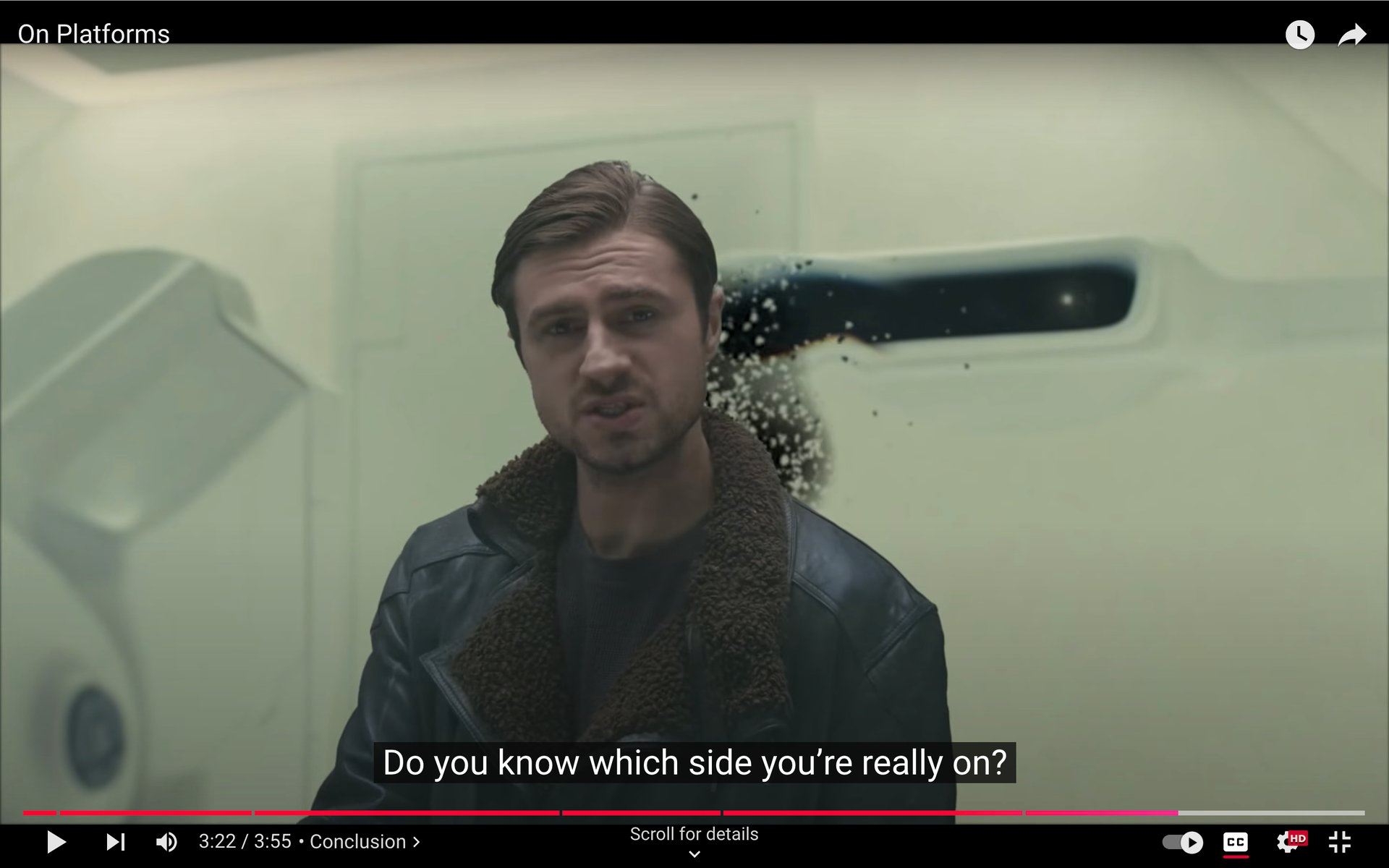
https://www.youtube.com/watch?v=Nm9xJrNPWqk
“‘Personalized recommender systems’ are predictive software tools that filter and prioritize information, items, and users. [...] By using historical data to anticipate “user wants,” they limit choice and amplify past trends in the name of efficiency and desire. The impact of these systems goes far beyond e-commerce: recommender systems, whose algorithms have been crucial to the evolution of search engines and the increasingly intrusive methods of data mining, as well as to the fracturing of the World Wide Web into poorly gated communities.”
Wendy H. K. Chun: Discriminating Data
Sharing is succumbed tothe lucrative principle of homophily, the love for the same. Algorithms of social networks make us isolated, confrontations in public space are becoming more escalated.
“If I were to think about a possible counterweight to homophily, in the previous century it was the democratic café – a place for an open exchange of ideas between various parts and classes of society, as Jurgen Habermas would have it. If we for a moment disregard that such an ideal never existed, and perhaps never could exist, what might it look like today?
The thought about debates in cafés is idyllic. Even during Habermas’ life, it came to pass for only a few short moments. I think it’s much more interesting to think through the ways of our being in public space. What are the conditions for its existence? Because our everyday experience is not anchored in hompohily. And yet, homophily is again covertly returning to it.”
Interview of Ondřej Trhoň with Wendy Chun
Marie Hantáková: Return to Stará Boleslav
Authors and collaboration
Tomáš Rafa (*1979) graduated from the Academy of Fine Arts in Banská Bystrica and the Academy of Fine Arts in Warsaw. He received the Oskár Čepan prize in 2011. His audiovisual work discusses social topics and limit situations connected to nationalism, racism and xenophobia. His longitudinal audiovisual archive entitled New Nationalism in the Heart of Europe was presented at the Slovak National Gallery, the Berlin biennale as well as the Moderna Musset in Stockholm. The archive has been in the making since 2010 and contains dozens of videos which provide a close-up view of the rise of extremist movements in Central and Eastern Europe.
Anna Kryvenko (*1986) is an artist and film director. She graduated from the Center for Audiovisual Studies at the Film and Television Faculty of the Academy of Performing Arts in Prague (FAMU). She has presented her audiovisual works at festivals and exhibitions in both the Czech Republic and abroad, and her films have received awards at the MFDF Jihlava or the Trieste Film Festival. She often works with found or archival materials, which she uses to reflect contemporary media landscapes. Her work My Shadow Is More Real Than Your Body creates audiovisual collages by connecting recordings from video banks and original texts, capturing the tension between generic expressions of empathy and her own reflections on the notion of shared compassion.
Joshua Citarella (*1987) is an artist and writer focusing on internet culture. He graduated from the School of Visual Arts in New York and currently teaches at the Rhode Island School of Design. He is the founder of the Do Not Research platform that explores visual art and digital culture. His multimedia installations often work with themes of political economy and analyze its relation to the production of audiovisual content and digital platforms. The On Platforms video sees the artist appealing to the audience from the position of an internet bandit, showing the interconnection between large digital platforms and the neoliberal doctrine of late capitalism.
Marie Hantáková (*1998) is a student of the Fine Arts Studio I at the Academy of Arts, Architecture and Design in Prague, where she received a BA degree in 2024 for her work Living Adventure which focused on people crossing the borders between Europe and Africa. She often deploys the medium of moving image and its documentary character to map the cultural contexts of particular places. The work Návrat do Staré Boleslavi (Return to Stará Boleslav) builds on her experience of living in this city and explores the tension between its everyday life and the strong historical legacy of Christianity.
Curator: Markéta Mansfieldová
Translation: Vít Bohal
Editors: Tereza Špinková, Janek Rous, Alžběta Bačíková
Published on November 21st 2024