
Translation might mean the conversion from one language to another, but it may also mean the shifting of media or realities. The world is stretching like a membrane and cracks start to appear in this thin layer. Something seeps from the other side as we watch contours of things behind the veil and their shadows in front of it. In this situation, where does reality begin and end?
Podcast by Ondřej Trhoň
The world membrane is an interface, a semi-permeable border that things cross in order to appear changed on the other side. It can be technological, affective, social or beholden to power relations. But it accompanies our every step. And it’s ambiguous.
Photography becomes a texture of a 3D object, a 3D object appears in a videogame. A field recording complementing an interactive installation, a machine-read text translated into another language overlays a foreign book in the Google Translate app. It no longer makes sense to distinguish between outside and the inside, a template and its imitation. An endless procession of Platonic caves, all real.
The Latin word translatio means “to carry across.” Past the river, past the boundaries of subcultures, across formal limitations, from one medium into another. In biology, translation is a process within cells that generates amino acids from the mRNA – if you translate an object in a game engine or a 3D software, you change its position. In our case, to translate can also mean to transfer into an aesthetic context, which endows things with peculiar meanings, both critical and emotional.
In one way or another, all the artworks presented as part of this topic relate to this translation between different media or states of being. And all are in some way tied to the videogame world – their authors work with games directly (creating, modifying, playing them), focus on media forms surrounding games, or deal with the political power of gaming communities.
Videogames are translation technologies. Many-layered media capable of absorbing many formal properties, transforming them into cultural artefacts that are part of a global subculture that is stretched between the artworld and a commodified entertainment industry. All things nerd mingle with subversive critiques and the society of the internet spectacle bleed into online gamerhood.
Videogames are, literally, interfaces between worlds.
· · ─ · ꩜ · ─ · ·
This was made fully apparent in the last ten years with the rise of the alt right. Its supporters honed their meme tactics and online organising abilities a few years before, during the abusive GamerGate campaign. GamerGate targeted progressive voices in the videogame industry, those drawing attention to the sexism, racism, thematic and design conservatism of the videogame mainstream. Several years later, we bore witness to the Capitol attack, stirred up by a president who rose to power on the back of currents whose origins can be traced to GamerGate.
You might remember QAnon Shaman, who became the face of the riot, dressed in a costume, looking as if he were plucked out of some LARP community. Tangible politics are increasingly intertwined with the digital, fictional and subcultural. What had been a dystopian fiction turns into a playbook in a struggle for a right-wing future.
Total Refusal
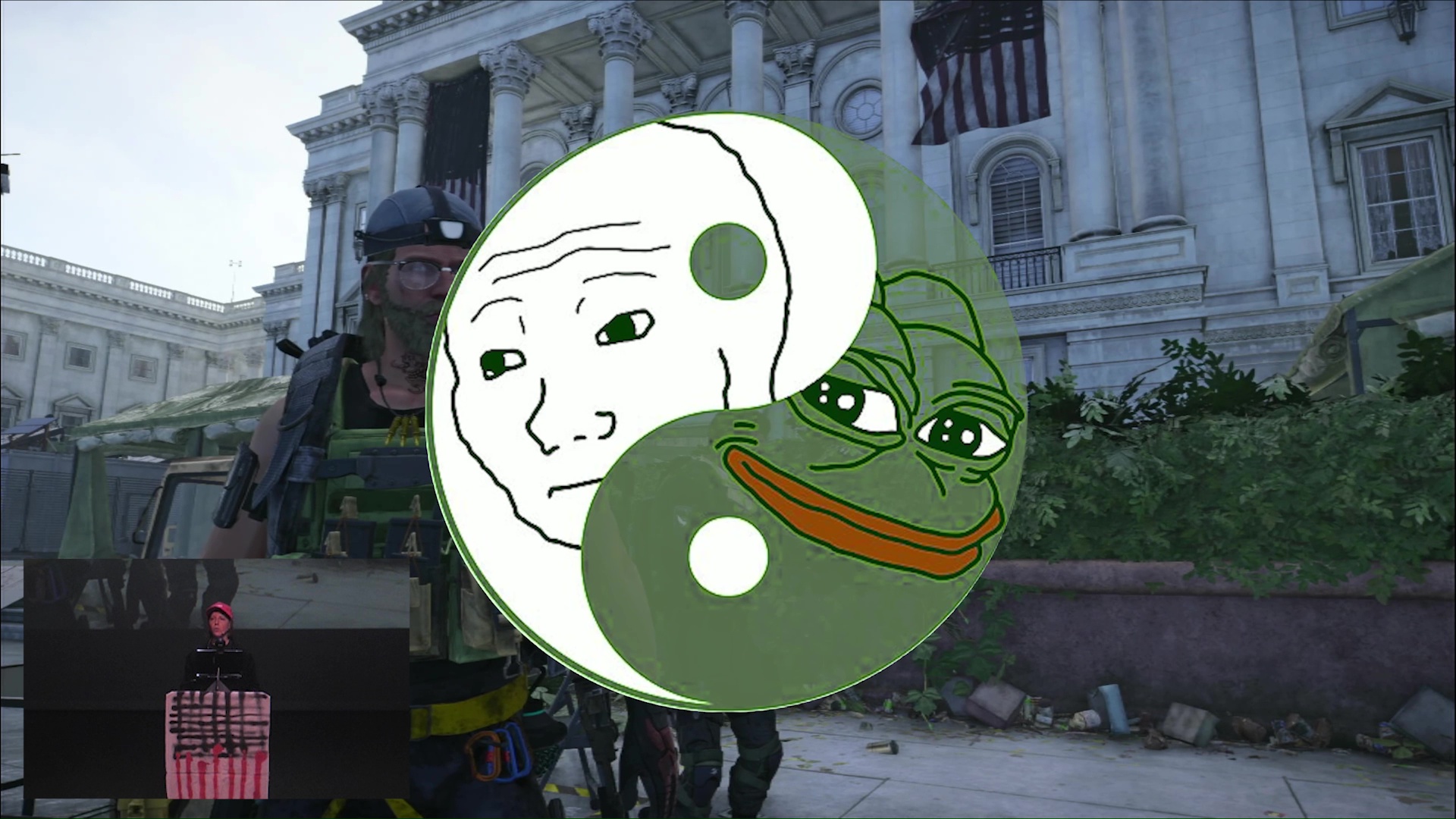
Members of the Total Refusal collective, a “pseudo-marxist media guerilla”, are not strangers to these dynamics. Their performance/lecture/let’s play Sons and the True Sons not only reflects how gaming became a key in politics but also comments on the relationship between virtual reality and the physical world. They reconstruct the Capitol attack in the online shooter The Division and emphasise not only to what degree gamer media infrastructure is interwoven with the alt right, but Sons and the True Sons also makes apparent the performativity of videogames, especially online ones, turning them into spaces for a quasi-ironic show.
Matteo Ruggiero
Technologically-enabled performativity is also a key theme of Matteo Ruggiero’s video therapy sessions w/YouTube. We watch a “live” stream by a bear called Roger who is playing some racing game in front of an internet audience. Suddenly, the YouTube platform calls him, materialised in the form of an anime character, and begins to guide him through a weird job interview. Despite the video’s humorous tone, we feel a certain uneasiness – the protagonist is obviously lonely, visibly shy (perhaps ruining his efforts to become a popular YouTuber) and anxious about his material prospects. In the end, we are not even sure if the bear is really a bear or if it’s supposed to be a virtual double of an imagined “real” person, an avatar mapped onto movements of a material body, akin to the practice of VTubing. Ruggiero erases the boundary between the physical body, the one being read by the cybernetic vision of the camera’s sensor, and the virtual, in the form of a 3D puppet animated by a software. The video itself is also hosted on an actual YouTube channel owned by Roger. It’s a hint that Ruggiero is also interested in the dynamics of livestreaming as such – in the change that human subjectivity undergoes under the gaze of an online webcam, one marked by the fact that authentic emotions appear only sporadically, like in the most vulnerable moments of Ruggiero’s video. Yet even those become a part of a parasocial relationship we form with supposedly real people on the screen…
David Blandy
David Blandy’s How to Fly conjures similarly ambiguous emotions. His video appropriates the tutorial or a vernacular how-to form, highlighting the software tools needed for creative efforts: the UI of an operating system, recording, editing and music software. Blandy reveals the ways the seemingly clear-cut video medium is, indeed, constructed – and how a game (in this case Grand Theft Auto) becomes the artistic material. In the second part of How to Fly, we watch a cormorant gliding above the beautiful videogame landscape, one we usually associate with hedonistic violence and criminal activity. The dissonance between the romanticism-infused images of virtual nature and its artificiality is distinctly poetic. At the same time, it makes us notice the way our emotions, our relationship with the world and our surroundings are remediated by gaming and other technologies. But because Blandy exemplifies a kind of contemporary geek-artist, his artwork contains instructions on how we can invoke this almost spiritual experience ourselves.
You can learn more about Blandy’s practice in an interview that I recorded with him for a podcast that accompanies this topic (see above).
Ville Kallio
I included Venmo Combat by Ville Kallio (who uses they/them pronouns) not only because of its qualities, but also due to the fact it’s a part of an aesthetic jigsaw Kallio has been creating for over 9 years. It began amidst gallery walls, but for the last few years they have been operating exclusively within the videogame scene. There, gamers who read about Kallio’s games Cruelty Squad or Psycho Patrol R in a gaming magazine get exposed to Kallio’s distinctive aesthetics. The games represent a continuation of a recognisable style and approach via different means; what is typical for both Kallio’s games and their early work is sarcastic layering of twisted motifs, lifted from the world of late capitalism. Similarly, the gig economy, warfare or precarity meet in the five-minute-long video Venmo Combat. It’s partly an interview of a platform user with a gig worker-assassin, partly a karaoke and motivational reel. A view of a real-world forest (captured by a phone, it is remediation again) is overlaid by a pop-up interface and a crosshair; 3D figures dance and connect a mundane shot with the author’s feverish worldbuilding. When, at the end, the interface vanishes, the only thing left is a text sign expanding on an azure sky. A promise of transcendence that might arrive once we close our iPhone Fold. But is mindfulness in a cybercapitalist world even possible?
Kent Sheely
While the violence in Kallio’s work is carnivalesque and excessive, Kent Sheely in dust2_dust takes what is seemingly innocent fun (the well-known online shooter Counter-Strike) and reintroduces into it our repressed relationship to real killing. He modified the game (aligning himself with a tradition of gamer modding), removing all the player characters and leaving only levitating guns. Usually, it’s terrorists and counter-terrorists who fight on a famous game map taking place in a nondescript middle-east town – in dust2_dust all is left are disembodied kalashnikovs, M4 rifles and Glock pistols. This radical alteration, alongside the artistic context and a new medium (dust2_dust is a video), brings back politics into the game that is usually considered as just entertainment or sport. In Sheely’s work, we watch the scenes from a spectator’s perspective. We think about our affective bond to the virtual battlefield set into a geopolitically fraught region. We ponder how games abstract the complex reality into simple schemas (anonymous terrorists against special ops of different nationalities) and construct this place where electronic sport imitating war never ends. Because Sheely actually modified Counter-Strike, one has to suppose the game was personally significant to him – dust2_dust shows how personal involvement can make media criticism even more pressing.
Petra Szemán
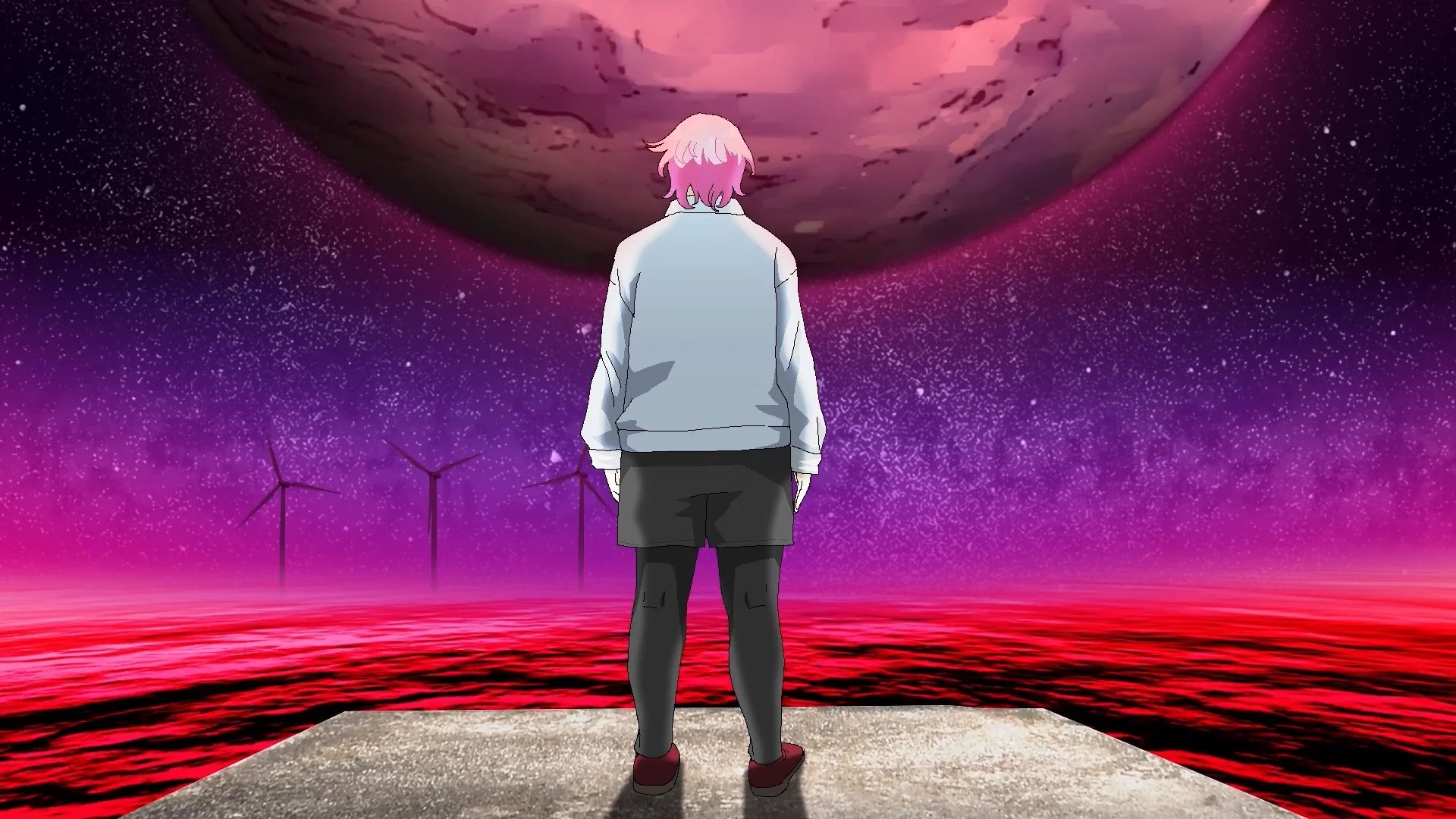
Petra Szemán (also using they/them) has been examining the boundaries between the digital and physical for a long time, using aesthetics inspired by anime to explore their own subjectivity literally wedged between worlds. In their work, photography, animation and 3D scans meet and recurrent motifs such as trains symbolise both the journey from one interface to the other and a channel that connects them. Szemán themselves act in their works, in the form of a hand-drawn figure with pixelated lines – a loop between their own self and a virtual double weaves back into itself and the distinction blurs.
For this topic, Szemán remade their video Border as Interface into an interactive form. Using Twine, a free text-game engine, they broke the video into pieces and re-shaped it, remediated it, perhaps remediating themselves at the same time. Both video and the text game oscillate between a distant spectatorship and a heartfelt, autobiographical perspective – akin to the way that the technical infrastructures we are embedded in require just as much critical reflection as emotional and affective mapping.
If you are interested in the wider context of Szemán’s noteworthy oeuvre, one that traverses borders of media and scenes, listen to the interview in the podcast accompanying this topic (see above).
LINK FOR A GAME BORDER AS INTERFACE
Lilith Zone
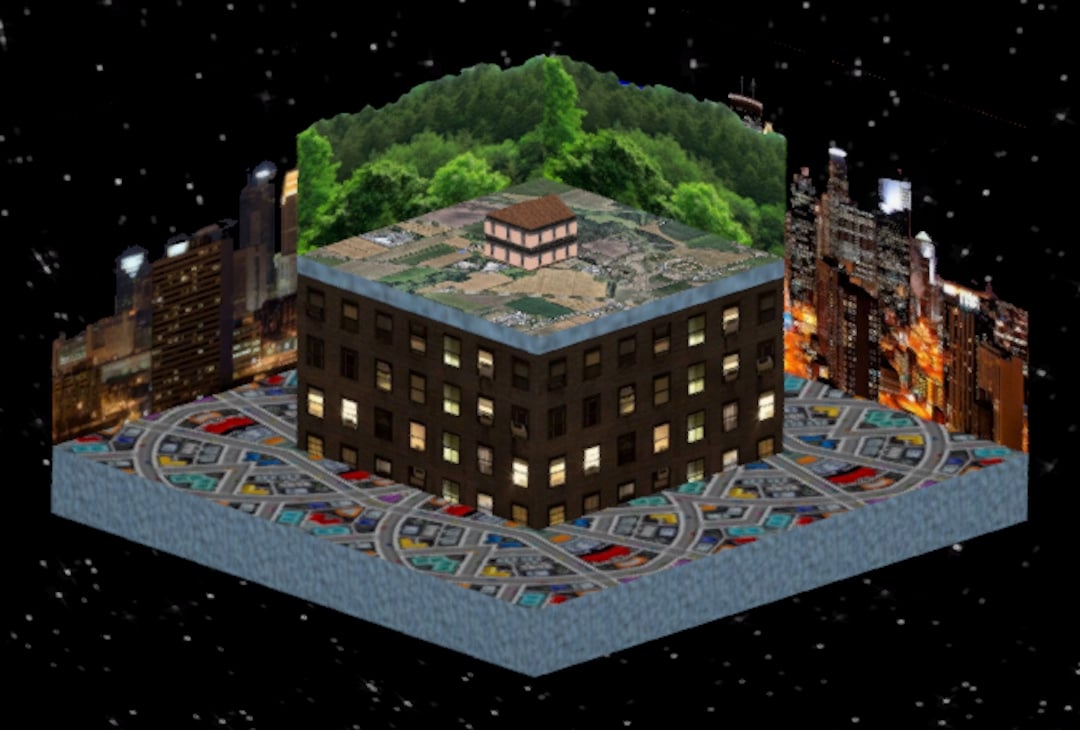
I encountered the work of Lilith Zone on Itch.io, a website dedicated to the independent videogame scene. Their work Room Map draws from a real place, a mental health center. We find ourselves in a stylised room, watching cutouts of stock-photo doctors walking down the hall through the door’s slit. On the ground between ominously dimmed beds, underneath the gaze of the TV’s greenish screen, stands a miniature apartment block. Against the conventions of the virtual worlds’ movement, we can enter it just by coming closer. The camera moves through the wall (“clips”), slows down, perspective shifts, and lets us visit the various peculiar inhabitants and their rooms. Behind windows and on the floor we see photos (or screenshots?). When we try to get nearer, another layer of the world peels back, revealing hidden objects and entire microworlds.
This map is more than (just) a territory; in games, the movement and camera’s perspective often mimic reality. Zone changes these conventions in Room Map, showing not only how to use the game engine in a novel way but also that the “default” way of orientation is not self-evident after all. Moreover, the stalactite texture on the ceiling suggests we are, in fact, in some sort of cave. McKenzie Wark borrowed the Platonic metaphor for her book Gamer Theory, and used it to talk about gamer dens. According to Wark, gamer dens function as our contemporary caves, but what they show are not false shadows but rather contours of digital capitalism in their most naked forms. Lilith Zone invites us to a cave that is (just) like this. To a space that is sometimes claustrophobic, locked in a normative institution, but nevertheless teeming with inconspicuously rich life that resists any definite interpretation.
LINK TO A GAME ROOM MAP
· · ─ · ꩜ · ─ · ·
Art criticism and curatorial texts alike often suffer from efforts to decisively explain artworks and completely describe them, expounding their meaning and sticking a clear interpretation on them. Even though I did try to offer some guidelines, all the selected artworks are more than just critically “useful.” Initially, I wrote about our journeys into the halls of mirrors, during which Szemán, Kallio, Blandy, Ruggiero, Sheely and Total Refusal can help us. But that’s only part of the picture.
No less important – and harder to describe – are emotions, that something brimming over the limits of a critical reading: laughter, melancholy, perhaps even a cautious hope or nervousness. Thanks to these affects, we can, perhaps, slightly open our hearts. And then we can let the glint emitted by these artworks and their technical interfaces enter through the crack. I leave it to you if what you see are shadows on the cave’s walls, cast by the flickering flames, or rather the rays of daylight creeping in through the cave’s mouth.
Each of these artworks shows a different way in which game-inspired art can not only reflect our reality, so intimately tied with technologies, but also how it creates situations where we can lose ourselves, all in order to return a bit different.
Ondřej Trhoň
Artist biographies
The pseudo-marxist media guerilla Total Refusal explores and practices strategies for artistic intervention in contemporary computer games. It works with tools of appropriation and rededication of game resources.Since its foundation in 2018 the collective has been awarded with more than 70 awards and has been screened at more than 130 film and video festivals.
Matteo Ruggiero examines the boundaries between human experience and systemic mechanics. He strives to understand our contemporary existence through technology, films, music, computer games, and mechanical rhythms. In his work, he often creates imaginary digital worlds or landscapes, blurring the boundaries between humans and machines-spaces where a ceaseless data feed pulses beneath the surface of the everyday and human weariness becomes automated. Ruggiero also performs and releases music under the moniker sxilence.
David Blandy, who lives & works in Brighton, is an artist examining global structures of control and networks of resistance, in areas that range from ecology, history and science to arenas of play. He makes videos, games, sound and ephemera, deconstructing forms to put them back together again. He searches for meaning in cultural life, an expanded form for auto-anthropology, sifting through multiple forms of archive, from historic texts to academic archives, archaeology and ecological theory, twitch streams and film archives.
Ville Kallio, who lives and works in Helsinki, is an interdisciplinary artist and a videogame developer. Under the name Consumer Softproducts, they have released critically-acclaimed shooters Cruelty Squad (2021) and Psycho Patrol R (2025).
Kent Sheely is an intermedia artist based in Los Angeles who takes inspiration from the aesthetics and culture of video games, examining the relationships between the real world and virtual ones as well as the influence of psychology and politics on digital spaces. This manifests in a variety of forms such as experimental screenshots, critical game modifications, short films, and interactive installations.
Petra Szemán, born in Budapest, is based between England and Japan. They’re a moving image artist working with animation and game-like landscapes. Their practice focuses on the murky borderlands along the arbitrary line separating real and fictional, and the kind of lives and experiences that are possible there. Using a virtual version of themself as a protagonist journeying through animatic realms, they explore liminal spaces and threshold situations, looking to dissect the ways our memories and selves are constructed within a landscape oversaturated with fiction (both on- and off-screen).
Lily Zone is the famous fantasy animal that everyone loves. If you were to reach into her guts, you would find the jewel called 'TRUTH'.
Authorship and co-authorship
Author: Ondřej Trhoň
Ondřej Trhoň is a cultural critic, developer, and artist. He has long been involved in the independent video game scene and is a member of the No Fun collective, which won the Jindřich Chalupecký Award for its work at the intersection of games and contemporary art. In addition to his own work, he produces an accompanying podcast for Artyčok, translates, works on the editorial board of the literary magazine Revue Prostor, and occasionally curates exhibitions.
Translation: Vít Bohdal
Publication: 10. 3. 2026