interview Veronika Švecová 11 results

Veronika Švecová

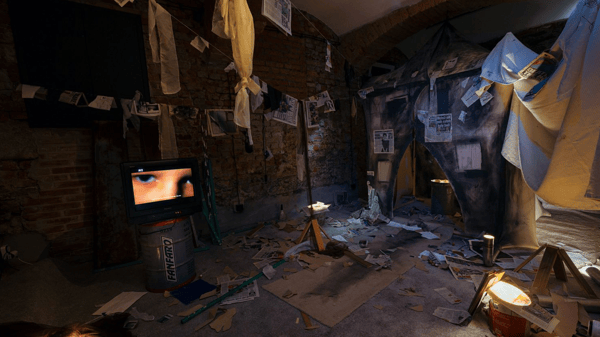
The plumbing work you did here is disastrous - not stupid, not sloppy - just absolutely disastrous.
Music [under your feet] is the first exhibition of Rolf Julius in the Czech Republic. However, his traces can be found elsewhere. The archive of Jiří Valoch contains several works that Julius dedicated to Jiří Valoch and Milan Knížák.
The environmental aspect of Hussite thinking is particularly noteworthy. Like today's generations, the Hussites lived with the prospect of dramatic changes in the world (or even its end, as it was known at the time) either approaching or already underway. As a result, their radically revolutionary agenda also carried with it a significant dimension of what today could be described by the popular term "degrowth."
The exhibition is concerned with contemplative pieces that exist in themselves as unfolding inquiries, probes that fluidly transition from the quotidian to the exceptional utilizing technical means as a virtual haptic pathway inviting us to delve deeper, to consider and reconsider.
The artistic team is meeting in the underground space to explore the psychoacoustic attributes of sound, and the physical limits and resonance properties of the human body; the use of music during rituals and religious ceremonies, and the possibility of connecting occultism, music, and sound as a means of communication, meditation and spiritual work.
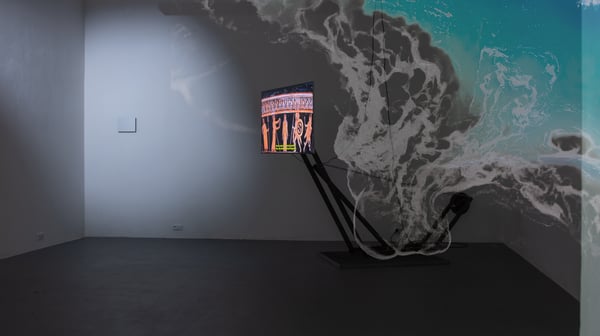
The long life of industrial products, their slow decomposition and their subsequent journey into the earth - with all this, the artist gives nature and geological time a far more optimistic perspective than we as humans can attribute to ourselves. We now know that the garbage patch in the Pacific Ocean has exceeded the size of Texas and is approaching the size of all of North America.
Conceptual artist, performer, and writer Milan Kozelka (1948‒2014) left an indelible mark on Czech art, especially in the 1980s and 1990s. He devoted himself to poetry from the 1960s onwards, and his poems are now considered part of the Czech response to American Beat literature. At the turn of the 1970s and 1980s, he turned his attention to action art.
Welcome to Oikos. Oikos is a house that breathes and hums. Branches grow through it, which, together with its inhabitants, keep the house running. Giants, bald mermaids, shape-shifters, crows with anthracite cloaks, Johan, inseparable twins, Erlenah, who locks the door with a chain, Ama, who knows all kinds of medicinal plants, Pragma, with problems well hidden under the carpet, Tarván with two fish tails, but also Diamon, a monster who takes on the form of our worst anxieties and fears. Alma, the author of this exhibition and book, also lives there.
What's behind that forest? Can you identify the trees? Shall we have our snack here? Which of the demons here is the loudest? Does Ester ever come here to sing? Is there a skinny dwarf behind the tree? Has Ester been to Japan? Is it morning or evening there? Can you smell the polypores? Who do the beetles love? Haven't we been here before? Is that moss okay? Why is no one naked there? Do you use tick repellent? Is it like the photo? Does Ester know mushrooms?