
0:33:12
It comes from both our bodies, so from galaxies countless light years away and collides us with scales that, though we interact with them on a daily basis, they are often foreign and distant. This foreign dimensionality (outside) human matter, its longevity and creativity also enters the work of Anetta Mona Chişa, who both in her own projects and in collaborative work with artist Lucie Tkáčová, often tries to cooperate and speculate with animate materials and inspire us and herself with their creativity. Also the program of the Visiting Artist's Studio at AVU, which Chişa led last year, therefore tried to lead productive dialogue with matter and to explore its different histories and futures.
With a deeper focus on materiality, its nature and reactivity, shows that matter itself is active -- just as we produce the world, it does as well and changes its character. Its extraterrestrial creativity, creating planets, cliffs or grains of dust, organizes itself at radically different times and dimensions than human ones. Materials therefore escape the possibilities of our understanding, at the same time they can say a lot about ourselves, about our relationships with others and with our surroundings. It's because matter also contains traces of human activities, it absorbs, inhales, accumulates and spreads wastes of society and turns them against the living and inanimate inhabitants of the planet. And just dust in its form captures this parallel distance and proximity to materiality, it absorbs and transmits 'our' problems and at the same time goes beyond them to go to meet other dimensions.
Philosopher Reza Negarestani writes that “every particle of dust carries a unique one view of matter, motion, collectivity, interaction, affect, differentiation, composition and infinite darkness -- a crystallized database or plot prepared [...] for being told. " These unique stories fall to Earth from space in tons, coming from our technology, animals, chimneys, trees or ourselves. Their diversity thus questions boundaries built by humans (for example, half of the dust particles just above North America come from other countries and planets), because it non-hierarchically connects fragments of almost all cosmic entities within itself, regardless of origin. It encourages us to see things, and people, together. Perceiving their different stories, but which have always been interconnected in a complex entanglement of material relations.
Even every breath connects us to others, with every touch (of dust) we simultaneously become in contact with ourselves and others. The perspective of dust -- or matter in general -- also humans are presented as part of non-human standards. Its productive and variable nature reveals that man's separation from nature is purely fictitious and teaches us to see ourselves, and our actions, in the breadth of planetary relations and their deep temporality. Artistic listening to materials leads to turning in purely human stories and can serve as endless inspirations, transcending the boundaries of understanding or imagination. It shows that as humans we are constantly 'in a relationship' with others. As Negarestani writes, "breathe, as deep as you want, the dust will never run out anyway. ”
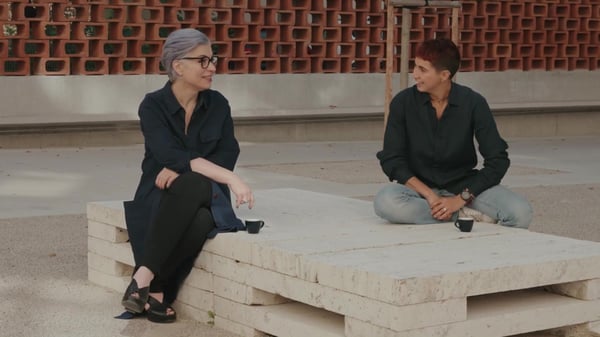
The video was created on the occasion of the pedagogical stay of Anetta Mona Chişa in the Visiting Artist Studio at the Academy of Fine Arts in the summer semester 2020/21.
| artists | Anetta Mona Chisa |
| tags | |
| directing | Štěpán Pech |
| camera | Štěpán Pech |
| sound | Štěpán Pech |
| editing | Štěpán Pech |
| translation | Deana Kolenčíková |
| category | Profiles |
| published | 2. 9. 2022 |
| duration | 0:13:21 |
| language | Česky / English |
| embed |  |


