art education 73 results

art education

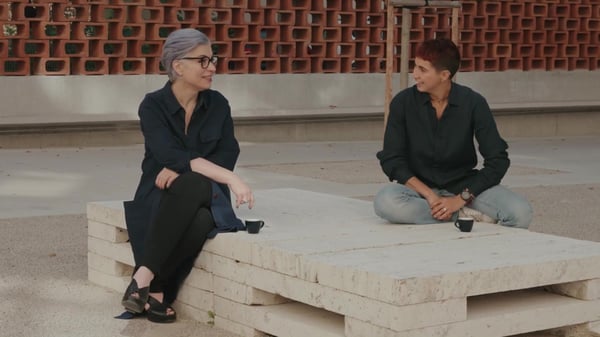
In the lecture Dubravka Sekulić focuses not only on what and why needs to change in architectural education in an effort to make a discipline more equitable, but also on how this change can happen.
School of performance is a part of an extensive project called School of avant-garde which Avdej Ter-Oganjan started in 1995 and which continued until 1998. The first group of students he worked with included students of different ages with non-artistic backgrounds and their cooperation did not last long. The second group included mostly Avdej´s son´s David´s friends who were of more or less the same age. The project was an experimental introduction of inexperienced and naïve teenagers into the world of art.
Bromová is often associated with the transformation of the perception of female identity in the art of the 1990s in Central and Eastern Europe. She is interested in women’s sexualized position in society. In her ritualized performances of recent years, on the other hand, she emphasizes the archetypal healing power of femininity, fertility, relationships, and collectivity.
Her uniqueness, not only in the art world, lies in her sincerity and sincere interest in students and art, in integrity that feels almost unwavering, although she is in the position of power, in the ability to inspire people, especially in times when they feel that any effort is vain. Not because she would try to convince people – with here innate charisma – about some dogmatic truth of her approach toward art and artistic creation, but because her view on art she believes in and fights for resonates with people.
The author considers the video as a part of the decolonisation process within the framework of the history of Czechoslovak cinema. His conceptual method of work is based on the deconstruction and re-interpretation of original scenes from Czechoslovak films, e.g. Křik (Jaromil Jireš, 1963), Jak básníci přicházejí o iluze (Dušan Klein, 1984) and Dědictví aneb Kurvahošigutntag (Věra Chytilová, 1992). All these films feature stereotyped black characters.
Anton Vidokle is the type of artist who might not seem to be a very prolific author, at least not in the classical, material sense of art production. Vidokle is interested in art as a means to learn as much as possible about the world we live in, to explore it.
Artlist:Talk enriches the possibilities of this procedural documentation and offers artists a live presentation format. The aim of Artlist:Talk - like Artlist - is to provide the interested public with an understanding of contemporary artistic approaches and expression, which in this case is complemented by the unique perspective of the artists themselves.
It's obvious that the issue of the environment and ecology in art is increasingly becoming a consciously political decision that affects what art we create, how we teach it, how we talk about it, or how we present it. Artwork is intertwined with cultural activity, which is linked to activism and vice versa. The context, material used and financial resources are increasingly accentuated.
The film shows the members of the art club of the Bedřich Václavek Community House in Třebíč with Antonín Kybal during their outdoor painting trip which took place in the countryside around Ptáčov in 1959. This club was founded in 1953 for mostly amateur painters and a number of professional painters were involved in their training and education.
Probably the only film footage from unofficial Confrontations, the exhibitions organized by students of Prague´s art academies in 1984-1987.The second exhibition of the six took place in 1984 in a house rented by a student of the Academy of Fine Arts, Petr Petr, in Krymská 21, Praha-Vršovice. The participants were students from the Academy of Fine Arts, Academy of Arts, Architecture and Design and two foreign visiting students who covered not only the walls of the house, but also space in the yard and on the porch by their artworks.
Words that become popular in the world of art often quickly fall from one side to the other. The words alone are not to blame. Some of them have an imaginative power which surpasses their real meaning. They become an incantation whose weight of imagination tilts the words over the edge of depletion. Decolonisation is one of them.
"I am the future and the past, a loophole in time and space, I am the essence of everything matter […] You can't escape me, I'm driven by forces that are here billions of times longer than you, dear” says dust in Annetta Mona Chişa's video Tell Me, Dust, about your Complicated Matter. Inanimate materials, such as dust particles, make it difficult by its very nature, to have a common understanding of the world, or even the whole universe.
The alibi of the Czechoslovaks, which historically exempted them from responsibility for the era of European colonialism, is seriously undermined if we take a closer look at some episodes of Czechoslovak history and if we revise the attitude that Czechoslovak citizens took towards colonies and their people and what orientalizing ideas they created. This attitude certainly does not apply only to non-European people and cultures, but also within Europe itself, as Vobořil demonstrates in his work.
Gideon Boie is an architect and philosopher and a founder of the BAVO collective. He lectures on the ethics and theory of architecture at the Faculty of Architecture of KU Leuven in Brussels, and his work focuses on the political dimension of art and architecture.
Born in Jakarta, Indonesia, 1984, Grace Samboh lives in between Yogyakarta and Medan, Indonesia. Due to questioning (a little bit) too many things all at once, she does curatorial work as well as research. She truly believes that every person needs at least three copies of themselves.