Noemi Purkrábková: Metabolic Modulations
The following selection intends to provide a glimpse into something that does not denote a “topic” as much as a certain “quality”. If we conceive of a topic as definable within a given cultural and social discourse, describable in language or representable with an image, what we are dealing with here is a more obscured matter, whose elusive dynamics the videos in this selection dive into. In doing so, the selections are not necessarily linked by their content, but rather by the shared impulse to give shape to the elusive visual interactions that, at a frenetic pace, weave together today's post-digital reality – a reality which problematizes the formal (temporal or spacial) distinction between the world “in front of” the image and the one “within” it.
While the following videos probe into the murky riverbed of our current audiovisual situation, it would nevertheless be a mistake to consider these only at the level of form, or with regard to the respective technological base from which they arise. We can rather think of them as of material articulations of a particular spatio-temporal transformation – one which simultaneously incorporates us. The tools of visual and audio postproduction, 3D modelling software and generative algorithms have become so integral to our daily experience of the world that we often hardly acknowledge their presence. Yet something fundamental is happening to the (technical) image, as it gradually drifts away from its representational function, ceasing to be the image of “something”, a record, or some distorted “reflection” of the reality preceding it. Instead, it produces a reality of its own which, far beyond the edge of the screen, merges as one with the very world we once hoped to fix with(in) the image.
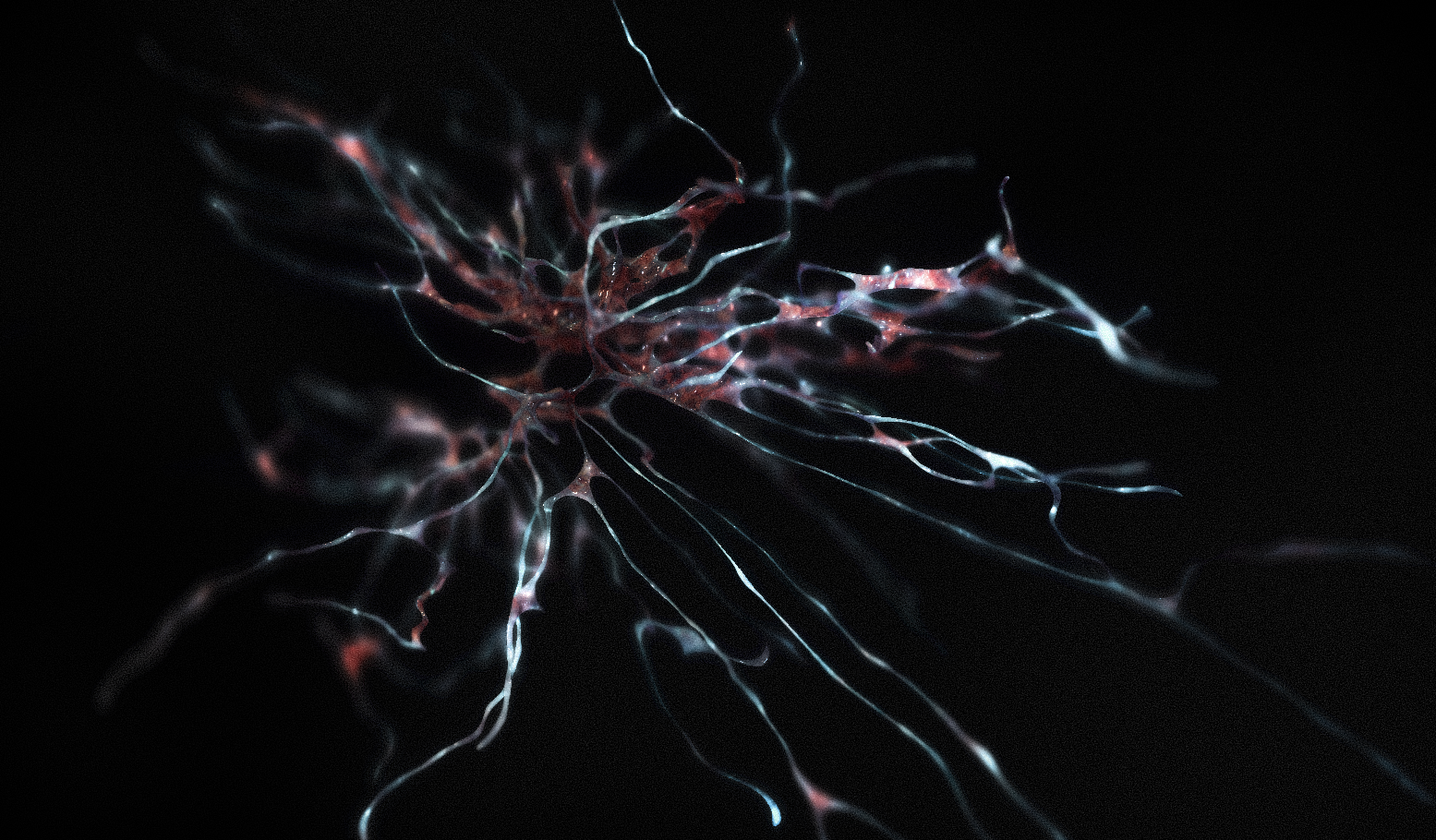
nismo: graphics based on a 3D model of rat's neuron
According to some, we can thus no longer describe the material structure of the (post-)digital landscape in terms of Cartesian space, but rather topologically: its key property lies precisely in its constant modulation, and the concurrent openness to multidirectional deformations – stretching, twisting, warping, folding, bending. Instead of a solid space divisible into discrete objects, we can thus conceive this image-matter as a sort of opaque “magmatic substrate” (Sha Xin Wei's term)[3] – a kind of malleable all-encompassing (infra)structure that is always in a process of transformation. Within it, images spill freely across screens, altering not merely their own form, but the entire milieu.
This traction of images on “reality” was observed by the artist and theorist Hito Steyerl, who notes that “it has become clear that images are not objective or subjective rendition of a preexisting condition, or merely treacherous appearances. They are rather nodes of energy and matter that migrate across different supports, shaping and affecting people, landscapes, politics, and social systems”.[4] The digital image thus must be treated as a materially productive force; it affects our bodies and our environment, as well as how we experience it. Moreover, film and media theorist Shane Denson underlines that images now largely affect us at a magnitude that exceeds not only our cognitive but often even perceptual capacities. He thus suggests to label the current media regime as “post-perceptual”, since the visual interactions within it elude not only our rapidly aging heuristic tools but rational comprehension as such.
[3] Sha Xin Wei, Poiesis and Enchantment in Topological Matter, MIT Press: Cambridge (2013), p. 263.
[4] Hito Steyerl, Too Much World: Is the Internet Dead?, E-flux Journal: The Internet Does Not Exist, Berlin: Sternberg Press (2015), p. 11.
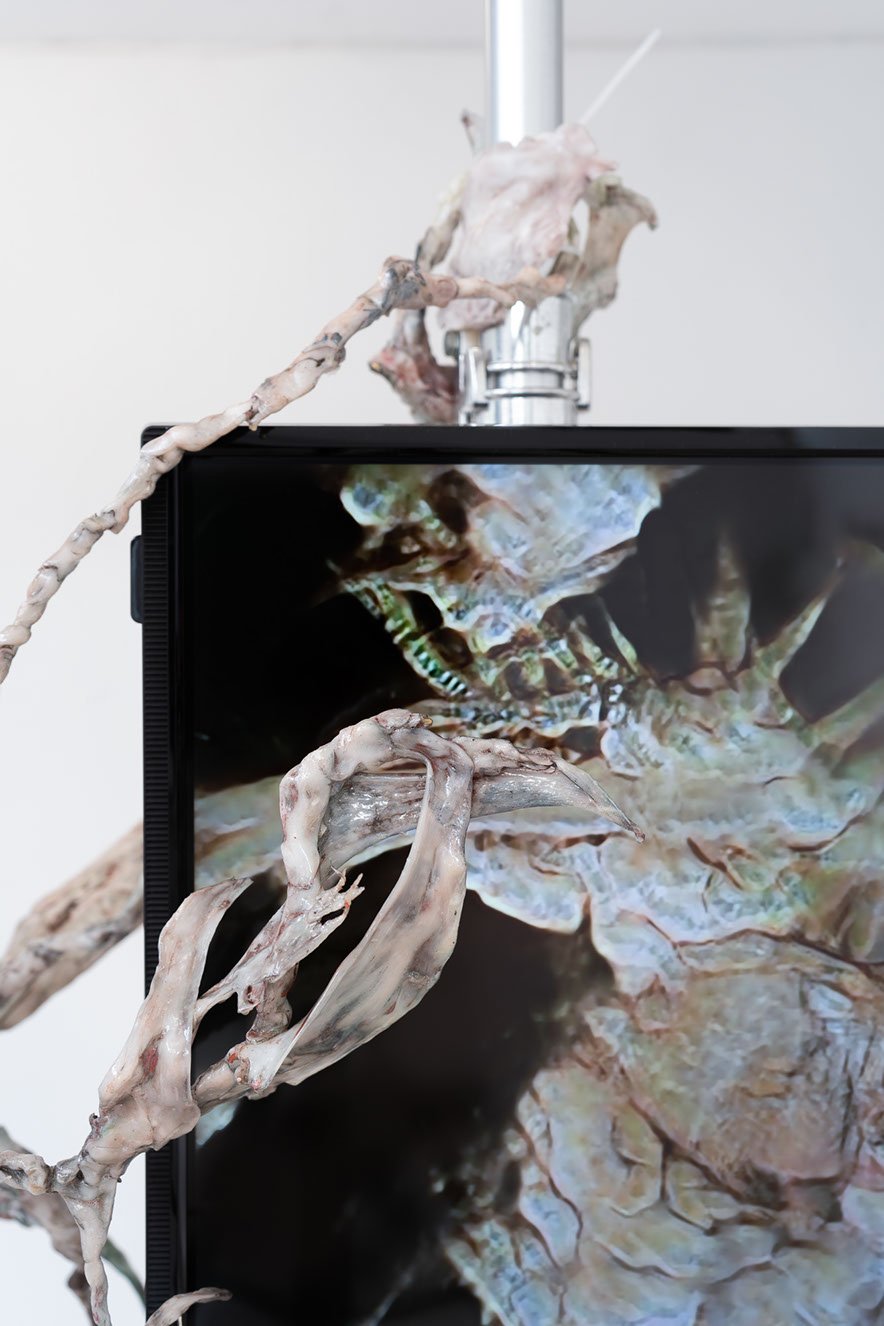
Marios Stamatis: EXOEXO (2020)
Steel, Aluminium, Plastic, Acrylic, Neural Video
- a photo from the Urban Antibodies show at Weekend.Athens -
Our relationship with digital images is nevertheless so intimate that, according to Denson, it might be considered “metabolic”, insofar as it involves changes in the “material, biological and ecological” nature of our lives.[5] This metaphor can also be imagined very literally: in a reciprocal process of ingestion, dissolution, absorption and transmutation of matter, all actors involved are irrevocably transformed. As Denson points out, the metaphor of the metabolic process makes it clear that what we deal with is a movement beyond our control that exceeds the consciousness of the subject, while it also cannot be limited to a body as an isolated object. Instead, it forces us to realise that if we want to consider this process in its complexity, we must always observe the organism (whether a body or an image) and the environment together, from a perspective that is inherently pre-individual – that is, prior to any clear-cut division of the identities of subject and object (or viewer and image).
The following works, each in its own way, explore this metabolic process. Often focusing on different particularities, there is a strong resonance among the works concerning the bidirectional digestive movements between a human author, the audience and the technical “tools” that defy the traditional, subordinate meaning of such a term. However, it is not their aim (nor the intention of this short introduction) to claim that we are faced with some purely machinic “imagination” or an autonomous “artificial intelligence”, or to fall for reductive fantasies about an interspecies, non-anthropocentric horizontality imbuing the creative processes of the (post)digital space. As the videos’ images and sounds imply, we are dealing here with something much more akin to an exploratory dive, an expedition onto a stormy sea or a voluntary sinking into the swampy depths: an immersion into a difficult-to-grasp substance that has long permeated our lives, and which, despite our best efforts, defies our attempts to elicit “meaning”.
After all, the forms and contents of the present works often roam the overgrown border between the human and the technical. In part, they convey this obscure terrain to the viewer using more conventional narrative or artistic methods, although in some cases they become infected with a highly technical vocabulary that can seem alien and impenetrable. If, however, you ever experience a sense of vertigo, confusion or lack of clarity as you watch, it's no reason to give up. If the previous lines put an emphasis on (post)digital materiality, it is because the very matter of these images – their affective force and visual intensities – affects us even if we get lost in pursuit of meaning; indeed, articulating a legible “message” was never their primary goal. In the rapid media flux of images, which often cease to be representative of anything, the affective impact provides a rare means for approaching the metabolic process we are a part of and becoming at the same time slightly more alert to its presence. In this respect, moving image art offers a productive grey zone that allows us to probe the limits and explore the tools that are now intrinsically involved in the production of “our” reality.
[5] Shane Denson, Discorrelated Images, Durham: Duke University Press, 2020, p. 41
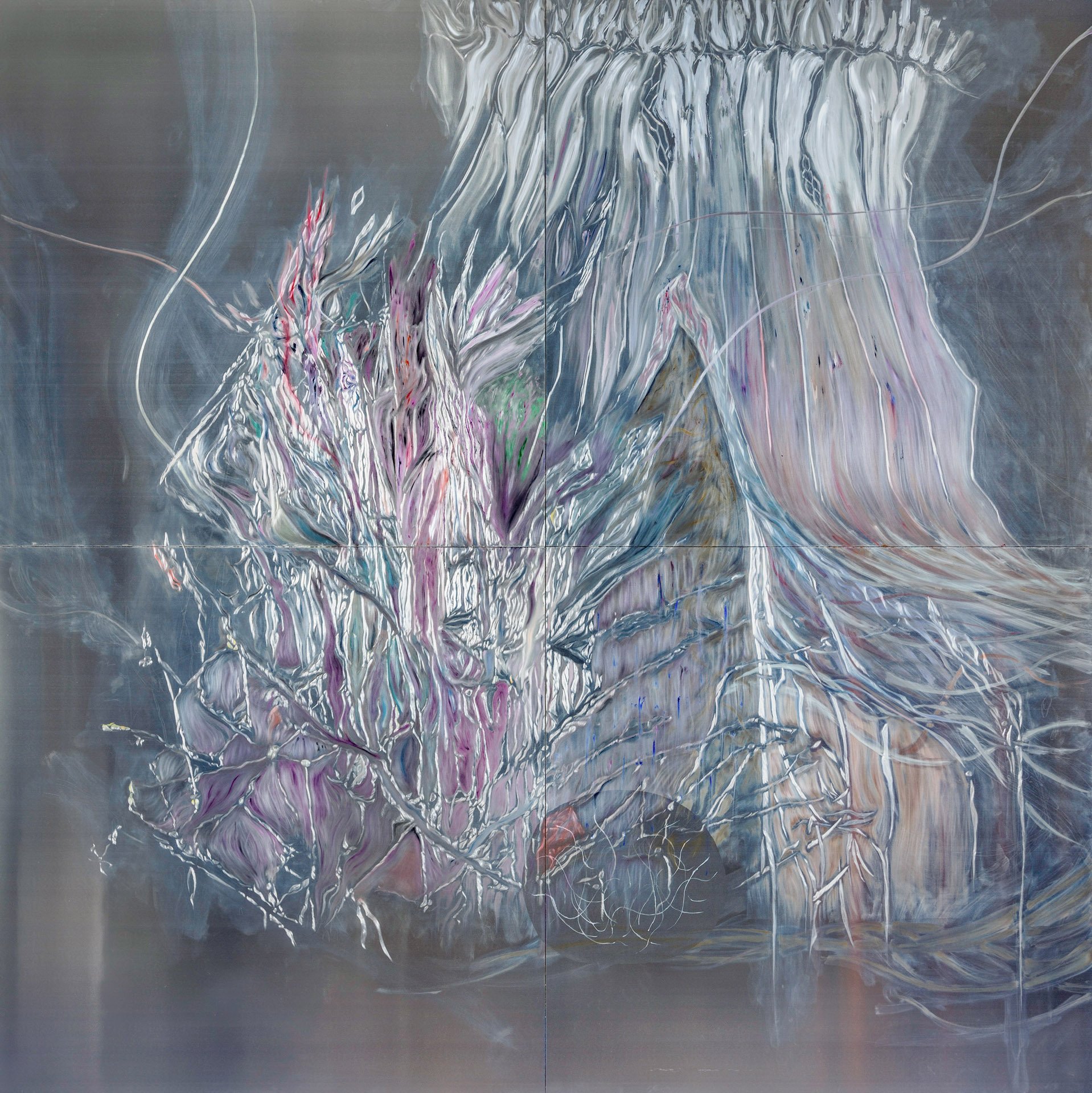
Wang Shui: Hyaline Seed (Isle of Vitreous), 2022
Oil on aluminum honeycomb in four parts, created in collaboration with generative algorithms
- exhibited at Whitney Biennale 2022 -
Lukáš Prokop: Concomitant Outgrowth Event (2023)
“I can’t shake the feeling that the whole world suddenly restructured all the scaffolding of its own reality – and apparently did so around the occluded corners of the space I inhabit,” tells us the autofictional "author" in the Concomitant Outgrowth Event project, the work with which Lukáš Prokop graduated from his MA studies at FAVU Brno. The above-quoted feeling echoes in many ways the preceding lines, and the whole piece can be considered a kind of experiment with the narrative possibilities of digital matter. Its moulding here becomes not only an artistic mean, but a narrative, even world-shaping force. From the tight entanglement of 3D modelling software, theory and science fiction, a form crystallizes before our eyes that partially relies on language (we can still hear the residue of a human voice) and modes of communication we can relate to. But it also narrativizes the processual quality of digital matter and computational operations themselves. These occur in the murky zone of computer calculations beyond the representational understanding of the image as an instrument of mediation of the world or a carrier of signification legible to us. The video itself thus becomes a testing (time-)space for the author's creative correspondence with the computer – a kneading together of post-digital matter. Here, as the artist points out, we plunge into complex “techno-biological assemblages” in which distinct geometric lines mingle with neural connections. The modelling tools of the computer thus become a kind of glue between the human and non-human, into whose obscure corners the video offers us a glimpse. However, precisely because he is aware of the limits of representation, Lukáš's work deliberately balances on its edge, integrating into the opaque operations the perspective of the “author” who sits in his room and listens to the silent hum of the rendering processor.
The collective of authors: Sands of the Microworld (2022)
The project Sands of the Microworld, which has already appeared in several exhibition versions, was created by a group of artists (Petr Jambor, Jakub Němec, Jakub Roček and Veronika Žilinská) brought together during their studies in the Drawing and Graphic Arts Studio at FAVU. The sound composition of the video was made by Tomáš Moravanský, active in the same institution. Like the sand from the video's title, which at once signifies a single grain and an entire dune, the images presented to us have a peculiar capacity to traverse across scales: in the course of the video we are taken on a flight through various layers of an apparently withering environment. Starting with a single bud, we arrive at a burning landscape, board a crashing airplane, slip into the interior of a tokamak, bounce on a stormy sea tossing a defenceless cargo ship, and wander into a windswept, post-apocalyptic construction site. Apart from the obvious ecological implications and the pervasive impression of the disintegration of our idyllic consumer-culture, the common denominator of these scenes is precisely the desire to challenge the plasticity of digital matter. We witness constant shifts between the extremities within which familiar objects and materials “unnaturally” ripple, shrink or expand in time and/or space. The audio plays a crucial role in this, often stretching the sound considerably, thus giving rise to an uncanny temporality that eludes conventional perception. This spatiotemporal malleability is best revealed to us when we slowly "fly" through a frozen second of an airplane crash, only to end up somewhere within a hovering, oily fluid.
BCAAsystem: No Blade of Grass (2021)
The video No Blade of Grass by Prague-based audiovisual collective BCAAsystem follows a group participating in a fictional LARP game, in which the members embody an act of political sabotage. To achieve their goal and break through the complex technological infrastructures of their opponent, the group needs to develop new creative practices of re-shaping and re-designing ordinary objects from their immediate surroundings. The short film counterpoising a mockumentary, a work of speculative fiction and a recorded act of performance art features local artists, who each collaborated in constructing their costumes. Without knowing in advance what tasks would be assigned, the group responded to the environments and events which thus unfold, providing the film its narrative backbone. The game takes place in a slightly extrapolated landscape, which nevertheless bears uncomfortable resemblance to the existing technological instruments of political and social repression. The tension between reality and fiction is furthermore enhanced by the open blending of documentary footage and computer-generated imagery, which sometimes proceeds in alternating sequences, while at other times, post-production interferes directly with the “real” footage. The two types of imagery merge seamlessly, as do the features of both natural and technological infrastructures: the mechanical and the biological, reality and fiction coalesce into a complex mesh that can be no longer addressed by way of simplistic binary categories. Partially inspired by the experimental practices of the Hong Kong protests, the project was first presented at the 34th Biennial of Graphic Design in Ljubljana in an immersive installation. The soundtrack features French musicians migu and Ytem.
Most Dismal Swamp: Swamp Protocol (2020)
Artists: David Atlas ⌯ Iain Ball ⌯ Lara Joy Evans ⌯ Samuel Capps ⌯ Holly Childs ⌯ Lea Collet and Marios Stamatis ⌯ Porpentine Charity Heartscape ⌯ Marija Bozinovska Jones with MBJ Wetware ⌯ Will Kendrick ⌯ Rachel McRae ⌯ Benoit Ménard⌯ Sarah Montet ⌯ Anni Nöps ⌯ Eva Papamargariti ⌯ Jakob Kudsk Steensen ⌯ Viktor Timofeev ⌯ Kyle Zeto Thorne
Swamp Protocol is the first large-scale project of its kind produced under the experimental curatorial platform and music label Most Dismal Swamp. It involved the collaboration of a total of 18 artists and, in addition to a single channel cut to be viewed here, was also presented as a site-specific installation at arebyte Gallery London. In a way, it can be viewed as a manifesto for the platform itself, which aims at “simulating and exploring a contemporary ecology that has come to be defined by the hallucinatory entanglement of multiple logics, systems, temporalities, and realities: a mixed-reality paradigm; a pervasive, horizonless swampscape”. This swampscape, where we can hardly search for an anchor point that would enable us to form a stable image of the surrounding, creeping world, is closely linked to the non-representational function of the image. If we have so far been talking about a certain “fluidity” or “malleability”, Swamp Protocol makes it clear that this is a fluid of a rather high viscosity – a mud (or a magma?) that swallows up the clear boundaries of our concepts, models and beliefs. In the video, performing bodies and generative neural network pixels devour each other within this swampy fabric, while the 3D, muscular shapes swell to the gurgling and smacking of immersive sound design, melting in the corners of both urban sites and mossy undergrowth. As seminal quantum physics populariser Carlo Rovelli put it in the title of one of his most famous books: reality is not what it seems.
Jakub Choma: Gears of Life (2020)
Performance: Jakub Choma
Cinematography: Michal Blecha
The performance was realized as part of the Jindřich Chalupecký Award 2020 exhibition produced by the Jindřich Chalupecký Society and the PLATO Ostrava City Gallery.
Jakub Choma's work has long been occupied with the permeability between the virtual and the "real", the digital and the physical. In the context of previous moving images, the Gears of Life video may appear different at first glance, as it features neither fleshy digital renderings nor computer-generated images. This is, however, precisely why it occupies a key position within this selection: it shows us that in a post-digital reality, the influence of digital media does not stop with the edge of the screen, but permeates deeply into the surrounding materials, including our own bodies. The video itself is a recording of a performance that Jakub Choma made as part of his installation for the Jindřich Chalupecký Award exhibition. The installation consisted of his signature cork objects, wooden boards, slats and plastic, from which he built a multi-layered environment resembling a kind of specialized construction site. Printed all over its surface are the fragments of his life on screen(s) and in the studio. Visitors could thus walk through an intricate labyrinth covered with podcast series titles, Facebook comments or pictures of his own body. The whole space bore traces of the artist's movements and touches, otherwise captured only on video. It is precisely the author's body here that, by being captured on video, allows us to piece together retrospectively the various fragments of the whole project; it migrates across the physical installation and into his online presence, it turns into an image and then finds its way back to the "material" reality, far from resembling the glossy phantasmagoria of virtual avatars. The experience of the digital is fully metabolized here, reaching the extreme level of physical scratches and wounds, which threaten with the possibility of bodily dysfunction. It is said that such dysfunction can manifest as an intense metallic aftertaste in the mouth, to which Choma's silvery makeup alludes.
Authors and Collaborators
Curator
Noemi Purkrábková
Editors
Tereza Špinková, Janek Rous
Translations
Vít Bohal (Concomitant Outgrowth Event)
Brian Donald Vondrak (Swamp Protocol)
Andrew Wilson (Text Proofreader)