Chooc Ly Tan: New materials in the reading of the world
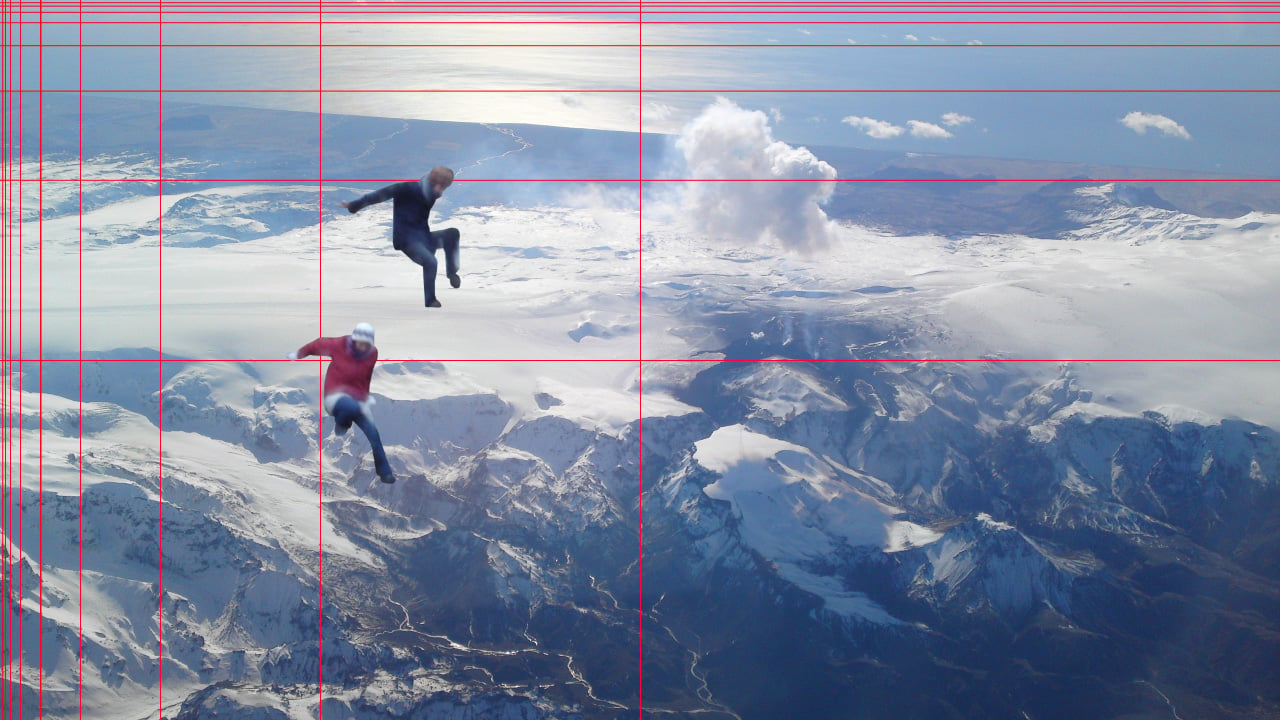
Still form video New Materials in the Reading of the World by Chooc Ly Tan
Velká Británie, 2011
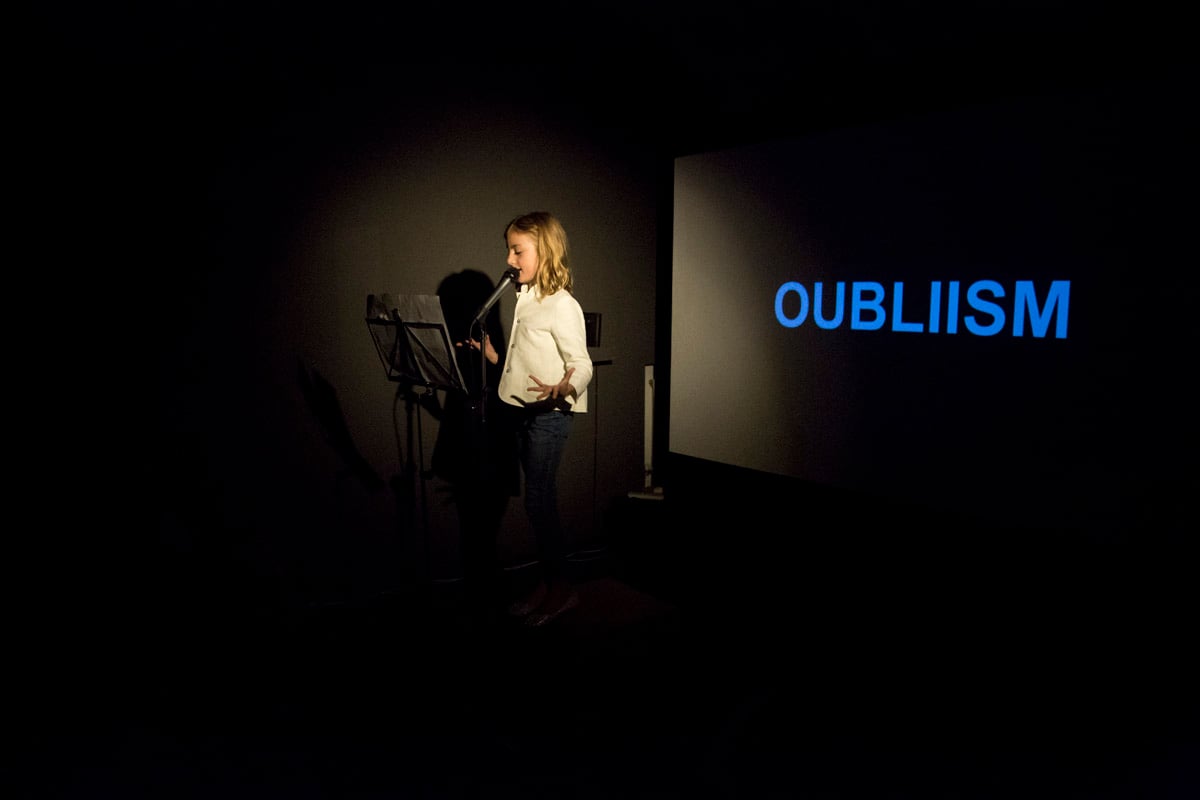
OUBLIISM
The signatories of Oubliism have, under the glare of a nuclear starburst
Committed
to Shed tears
OUBLII!
Our tidal encounters conceive new physical realities from which we will harvest fresh perspective.
OUBLIISM symbolises the most fundamental relationship with the surrounding reality; with Oubliism new worlds and systems are perpetually borne from the ashes of a withering civilisation.
we disown this life
With its simultaneous confusion
Of
Chaos noise disorder
Of
light separated in a rainbow
We are gathered here to proclaim the birth of an Oubliist physical reality where extragalactic rhythms are captured
At a star formation rate
by the sensational shouts and fever of its temerarious continuum psyche and in ALL its destructive interference within reality.
Here lies is the cross faded apogalactic line between Oubliism and all other physical realistic trends.
To herald the genesis of cosmic time, Oubliism refuses the atomist attitude towards existence. It tears to fractions
all those grand words like ethics, culture, humanism, good, evil, beginning, end,
which are only covers for
All-too-rational people
those who drown in matter-of-fact swamps
THE IQM 08279+5455 METHOD
turns words into spirited forces. The letters of the word "planet" smashed and
reshaped into globular clusters.
Oubliist inverts current norms
Invents fragile forms
Aligning itself not to the symmetry of reason but to
POSSIBILITIES that forms of expression live in all physical realities.
Modernist architecture reconfigured into dance on stage,
Botany explored for its sonic possibilities
it spreads cacophony, dissonance, atonality and indeterminacy
over all the continents
The word Oublii shows the intergalactic nature of a movement which is bound by no golden ratio, or physical laws. Oublii is the inconceivably vast expression of our cosmic time, the great rebellion of revolutionary movements, the physical realistic reflexion of all those many frictions, human struggles and clashes that surround us.
Oublii demands the use of
NEW MATERIALS IN THE READING OF THE WORLD
OUblii is an organisation which has been founded in London which you can join without turbulence. Oublii is not some pretext to bolster up the pride of
a few neo thinkers (as our enemies would have the world believe).
Oublii is a state,
you are an oubliist or your aren't. Out of Uncertainties.
To be an Oubliist means
being thrown with angular momentum by events,
being against matter that settles to the bottom of the abyss; but
it also means putting your life in a vacuum... One says yes
to an existence that seeks to grow by negation.
Down with atomist-aesthetic-ethical tendencies!
Down with failed innovations!
Down with the literary hollow-heads and their theories for improving the material universe!
by Chooc Ly Tan
Contributed to the text: Shabaka Hutchings, Peter Lewis, Dada and recent Astrophysics
Chooc Ly Tan: In space there is no up or down
Still form video In Space There Is No Up or Down by Chooc Ly Tan
United Kingdom, 2012
In Chooc Ly Tan’s video ‘In Space There Is No Up Or Down’ male voices, young scientists and presenters from television, announce scientific findings and discoveries. The female presence in the video is an interruption, questioning the ‘objective knowledge’ in the context of male dominance of science and technology. This interruption is personified by the figure of the artist, who runs across the set to wipe away mathematical equations delivered by a white male scientist on the whiteboard, her body becoming a prop against which horizontality and verticality are measured. It may be the very same female body that throughout history has been examined, represented and researched by men. The video is partly structured as an abstract manual to create and test an imaginary device which would accurately interpret natural events. Here, the male voice of a TV presenter announces the device’s possible failure under a circumstance, and the circumstance is in this case is musical and female.
Julia Tcharfas: New materials for the reading of the moon
OUBLIISM is an exclamation, a proposition, a text, and a video by artist Chooc Ly Tan, co-written with Shabaka Hutchings, Peter Lewis, Dada and Recent Astrophysics. Tan describes OUBLIISM as a manifesto in which OUBLII! is a call to ‘conceive new physical realities’, to give birth to ‘new worlds and system’. The artist creates the new declaration in hopes of generating new meaning and hence a new reality.
In order for a new reality to manifest itself, ‘to herald the genesis of cosmic time’, one must forget familiar concepts.
‘[OUBLIISM] tears to fractions all those grand words like ethics, culture, humanism, good, evil, beginning, end…’
OUBLIISM, Tan suggests, is both a word and a world. It is something one can be a part of. In fact, for her it seems to reside somewhere in London.
Perhaps in an attempt to visualize a new reality, new languages as well as new words have always been essential. Science fiction is exemplary of creating new worlds through language and changing our understanding of the world by populating it with new concepts and terms.
Recently, I have been taking part in the Future Polities reading group, organized by Living in the Future Magazine, where we have read Ursula K. Le Guin’s sci-fi novel, The Dispossessed (1974). Much like Tan’s invented manifesto, The Dispossessed uses the difficulty of language to question societal norms. It features an anarchist society on a moon (Urras) looking back at a world much like the Earth (Anarres). The two worlds orbiting in synchronicity present polar realities: one of a paradisiacal nature inhabited by a society of inequality and greed, and another of a barren silver-dust desert of few resources and humanist ideals.
The anarchic lunar society strives to achieve equality through a strict control of language. Their language, Pravic, shuns possessive pronouns, assuming by the principle of linguistic relativity that meaning can only be created once it has been expressed in words. In Pravic, words such as ‘his’, ‘hers’, ‘mine’, or ‘have’ are deemed ‘nonorganic’ and therefore are excluded from language. The inhabitants of this world would not attribute possession to things or people, referring to ‘the mother’ instead of ‘my mother’, or saying ‘the hand hurts me’ instead of ‘my hand hurts,’ and so on. As a teacher on Urras explains, “Speech is sharing — a cooperative art.”
The novel’s complex emotional landscape presents the inherent contradiction in this governance of language: on the one hand, the limited vocabulary facilitates the concept of equality, and on the other it creates a mechanism of control within the mind of the individual. The female character Takver learns to overcome the internal conflict, when she defines love and is able to explain her own concept of a relationship. This also frees the mind of the main character, Shevek.
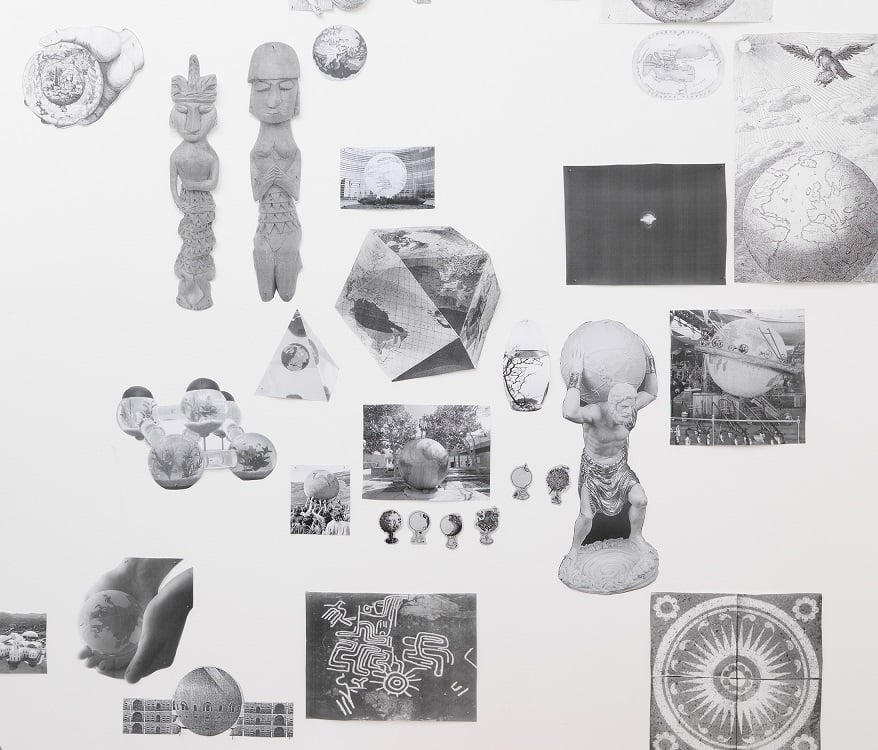
OUBLIISM’s manifesto video is punctuated with a collage of images of space and technology. In my research, I have found many parallels between the imagined worlds of science fiction and the history of exploration in our own solar system. In this sense, new realities and parallel worlds are found not only in science fiction, but in the material universe that surrounds us. In The Dispossessed, an alternate reality plays out on a moon, but our own moon is in many ways a world full of projected realities, fictions, and terminology.
In English, early attempts to name our Moon, have called her a goddess governing nature: seas, oceans, and food cycles. In return, she gave us new concepts of time, lunacy, and menstruation. It is in nomenclature that we define boundaries: spatial, temporal, social, and cultural.
Our world’s only natural satellite has had as many names as there have been cultures on the Earth. In the Algonquian Native American tradition, she has taken on 12 names at once, one for each month of the year. Now known as either the Anglo-Saxon ‘Moon’, or the Latin ‘Luna’, she has become a sphere of projections. Just like the people chained to the walls of Plato’s cave, for centuries we have observed the dark craters of the Moon, and began to allocate names to these shadows.
By observing the moon we have seen animals and faces in the shadows of its surface, and later seas and forests. We have given names to the geographical features of the landscape. The craters of the moon are populated with names of historical figures, scientists, astronomers, as well as dead astronauts and cosmonauts. Out of the thousands of named craters 20 are women of historical significance. But perhaps the biggest anomaly, are the 40 craters named with popular women’s names of differently cultures. These names don’t belong to anyone in particular. They have never had a body, historical or otherwise. The 40 women on the moon, like the moon goddess herself, are a cultural cosmic manifestation of an illusory female history on par with science fiction.
Chooc Ly Tan: Biography
Let's Make it Another Possible Now, performance, Flat Time House 2014
London-based artist Chooc Ly Tan works across moving image, installation and performance. Selected film and video-programmes include Selected 4 (2014) and Selected 1 (2011) touring at CCA, Glasgow, Whitechapel gallery and more venues across the UK; Austerity Measures touring at Cell, London, CCCB, Barcelona, Fuso International Video Art Festival, Lisbon, Waterside, Riga, BIOS, Athens, Timishort Film Festival, Romania, Milano Film Festival (2013).
Recent performances include ‘Let’s make another possible now’, Flat Time House and Gasworks (both London, 2014). Residencies include WAÏ #2, Saint-Lunaire, France (2014); Defining Pi, Wysing Art Centre, in collaboration with Cambridge Computer Lab (2013). Chooc Ly Tanhas had solo exhibitions at Carlos/Ishikawa, London and Transmission Gallery, Glasgow (both 2012).
Julia Tcharfas: Biography
The Conquest of Gravity as Such, Tim Ivison and Julia Tcharfas, Tenderpixel Gallery, Photo by OriginalandtheCopy
Julia Tcharfas (born 1982, Donetsk, Ukraine) is currently working as the assistant curator of the Cosmonauts: Birth of the Space Age exhibition at the Science Museum in London. A significant part of her work is an ongoing collaborative practice with artist and researcher, Tim Ivison.
Her recent projects include, Art/work Association, Auto Italia, The Conquest of Gravity as Such, Tenderpixel Gallery, Systems Learning from the Inside, Chisenhale Gallery, Recent Work By Artists, Auto Italia, and Render, Hilary Crisp Gallery.
New Feminism – I turn the images of my voice in my head
”New Feminism – I turn the images of my voice in my head” is a regular online presentation of work by a generation of artists responding to the on going fourth wave of feminism. Author of the project is Hana Janečková. Screenings of artists’ moving image will be accompanied by commissioned texts from curators, critics and theoreticians writing about the influence of feminism, technology and new media on contemporary culture.
What has happened recently to your body? Are you proud to be male or female? Can you be a feminist if your avatar enjoys wearing pink? Do you think gender is a capitalist concept? If so, do you think it existed in the former Eastern Block?
Exhibition credits
Author of the Project / Curator: Hana Janečková
Authors of Texts: Julia Tcharfas and Hana Janečková
Online Exhibition Concept: Hana Janečková and Lenka Střeláková
Realization: Lenka Střeláková and Janek Rous
Translated into Czech: Palo Fabuš