nature 66 results

nature

Both authors work with fictional worlds (seemingly) untouched by humans, which serve as romanticized escapes from the chaotic reality of the present. Instead of the desired contemplation, the scenes of an untouched natural world evoke an almost disturbing feeling of permanence and death.
The long life of industrial products, their slow decomposition and their subsequent journey into the earth - with all this, the artist gives nature and geological time a far more optimistic perspective than we as humans can attribute to ourselves. We now know that the garbage patch in the Pacific Ocean has exceeded the size of Texas and is approaching the size of all of North America.
What's behind that forest? Can you identify the trees? Shall we have our snack here? Which of the demons here is the loudest? Does Ester ever come here to sing? Is there a skinny dwarf behind the tree? Has Ester been to Japan? Is it morning or evening there? Can you smell the polypores? Who do the beetles love? Haven't we been here before? Is that moss okay? Why is no one naked there? Do you use tick repellent? Is it like the photo? Does Ester know mushrooms?
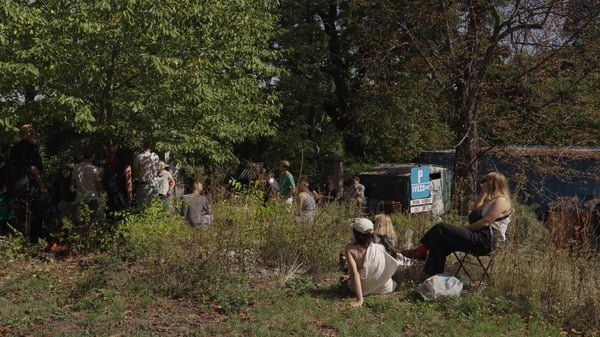
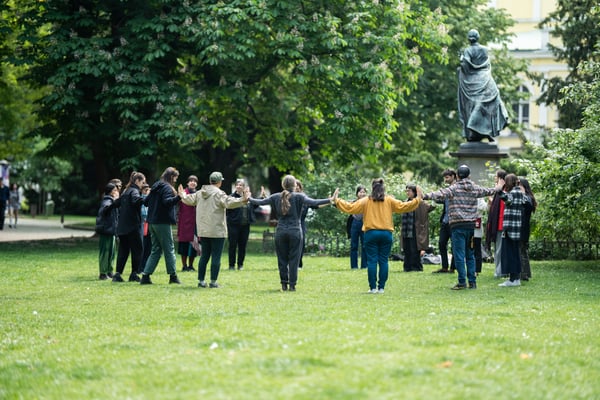
The Heron is a film about the Stromovka park, however, it is perhaps more about us, people, and the different activities we may pursue in city parks. It shows inexplicitly to what extent people are influenced by parks and parks by people. What role do parks play in our contemporary society, in our everyday lives?
The legacy of the garden.
The legacy of the Kafka studio.
The legacy of architectural statues.
The legacy of figural sculpture.
We would like to outline the conditions for a new sensibility and redefine our needs and future actions, based not only on the logic of endless production and consumption, exhausting fragile ecosystems. Last but not least, through this joint rearrangement of basic and small stones, we try to actively integrate non-growth strategies into our lives.
Randal Plunkett introduced a unique approach to wild landscape restoration called V-wilding. It combines ecological principles with vegan philosophy and offers a model for sustainable restoration of natural habitats. Dalibor Dostál focused on the return of large herbivores as a means of restoring biodiversity, which is disappearing today at an unprecedented rate.
The protagonists of Sikora’s similes are trivial animals, plants and mundane elements of material world in their simple state of being. He takes interest in marginal and repressed social phenomena and thinks about them visually.
Welcome to Oikos. Oikos is a house that breathes and hums. Branches grow through it, which, together with its inhabitants, keep the house running. Giants, bald mermaids, shape-shifters, crows with anthracite cloaks, Johan, inseparable twins, Erlenah, who locks the door with a chain, Ama, who knows all kinds of medicinal plants, Pragma, with problems well hidden under the carpet, Tarván with two fish tails, but also Diamon, a monster who takes on the form of our worst anxieties and fears. Alma, the author of this exhibition and book, also lives there.
The key significance of the accelerating development of artificial intelligence and other digital systems lies in the fact that they allow us to newly recognize the plurality of other forms of non-human intelligence that we have been “secretly” surrounded by all along. We needed to invent thinking machines to notice that everything around us is thinking.
The international exhibition Beyond the Sound presents a contemporary approach to the specific and lively artistic field of sound art. Sound is presented not as an independent aesthetic form, but as a medium used to explore and reveal phenomena that are often unrecognisable to the eye.
The tools brought about by technological progress and the network society create an alternative way of establishing communication and building new relationships of interpersonal and interspecies cooperation. However, we suggest listening to the sounds of practices associated with community: rituality, coexistence with the world of plants, animals, and fungi, dissolving the hypersensitivity of the individual "I" in favor of the collective "we," sensitivity to the stories and perspectives of plants and animals, oil, or clouds.
The exhibition is not only a departure from the established boundaries of the field, but also a demonstration of the possibilities that ceramics offer within contemporary art. The fact that it is ceramic clay, in various forms and shapes, that fills the gallery spaces is not a surprising result of a symposium focused on this material. However, ceramics is not the only means of expression that the exhibiting artists work with in their creations, which is also reflected in their latest works created during their four-week stay in Bechyně.
It's obvious that the issue of the environment and ecology in art is increasingly becoming a consciously political decision that affects what art we create, how we teach it, how we talk about it, or how we present it. Artwork is intertwined with cultural activity, which is linked to activism and vice versa. The context, material used and financial resources are increasingly accentuated.
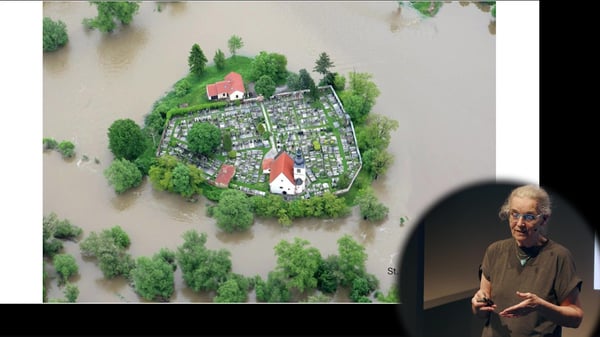
Currently, we encounter these changes and catastrophes being discussed in regional public debates by people from the scientific community, government agencies, and politics, who use the authority of expert images to describe the ongoing changes and impending catastrophes. We do not see images that deviate from the established norms of scientific representation in the public sphere, and the voices of those directly affected by these changes are heard little or not at all in public debate. However, the presence of the planet as an active force producing its own images and ways of sharing them gives power to these alternative voices, languages, and images.
Artistic practice of Jindřiška Jabůrková is interdisciplinary, includes installation, creation of objects, sometimes photography and video or performance. Her fascination is with the processes of transformation of matter, whether of human or natural origin. She is interested in the relationship between the human subject and nature, the relationship of man to the material world, sometimes deepened by the spiritual thoughts.
Markéta Adamcová's exhibition delves into the themes of mortality, generational trauma, and corporeal vulnerability. Her work highlights the importance of understanding history and family constellations as key factors in understanding our current state and behavior.
The second part in ‘New Feminism’ programme brings together moving image works by London based artist Chooc Ly Tan and an essay by the curator, artist and researcher Julia Tcharfas. It links mythical stories about gender of celestial beings to invention of new words and language through the text of science fiction writer Ursula K. Le Guin, video collage and astrophysics.
By imitating the gestures of objects and things that are already in the gallery space; by slowing down, pausing, lingering, alighting, unwinding... through these actions we can escape the entrenched trajectories we found ourselves on in the morning, rid ourselves momentarily of what we have already become, so that we can lose ourselves in thoughts of what we might be.
Diana Lelonek explores relationships between humans and other species. Her projects are critical responses to the processes of over-production, unlimited growth, and our approach to the environment.
What futures do plants make possible? From colonial extraction to regenerative practice, from taxonomy to kinship, plants have always mediated the terms of human life.