Audio-visual Art 134 results

Audio-visual Art

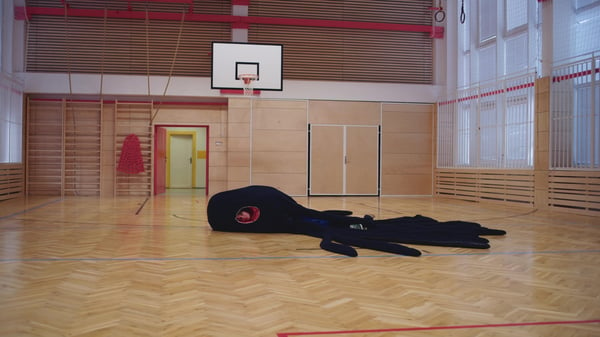
Instead of students, the building was temporarily inhabited by creatures created by the artist, and the footage is accompanied by Koťátková’s gentle, sensitive, yet critical voiceover (letter to the school). It is complemented by the echoes of children’s voices and quotes from the school rules, serving as a reminder of how strongly the elementary school environment shaped us. What memories do we carry into adulthood from the spaces of gyms, locker rooms, cafeterias, desks, and “in front of blackboards”? 
Kateryna Khramtsova filmed a short documentary about a non-binary performer and soldier entitled Qirim (2023), which has been screened at many film festivals, both here and abroad. In the accompanying essay, Kryštof Kočtář presents the film in the context of Khramtsova's artistic work.
Brood – Stranger’s Vial – Womb is a “game that has forgotten its own rules” and “a story without an ending.” Instead of a clear, linear fantasy, it offers a fantasy space that we view through several layers of material and media abstraction. It makes everyday objects and (in)human identities special. It invites us to notice the affects of humanity in the midst of the climate crisis, which can only be glimpsed through peripheral vision, somewhere at the edge of gilded metal. Just beware: The sides will be reversed.
The Heron is a film about the Stromovka park, however, it is perhaps more about us, people, and the different activities we may pursue in city parks. It shows inexplicitly to what extent people are influenced by parks and parks by people. What role do parks play in our contemporary society, in our everyday lives?
Diana Lelonek explores relationships between humans and other species. Her projects are critical responses to the processes of over-production, unlimited growth, and our approach to the environment.
The alibi of the Czechoslovaks, which historically exempted them from responsibility for the era of European colonialism, is seriously undermined if we take a closer look at some episodes of Czechoslovak history and if we revise the attitude that Czechoslovak citizens took towards colonies and their people and what orientalizing ideas they created. This attitude certainly does not apply only to non-European people and cultures, but also within Europe itself, as Vobořil demonstrates in his work.
The author considers the video as a part of the decolonisation process within the framework of the history of Czechoslovak cinema. His conceptual method of work is based on the deconstruction and re-interpretation of original scenes from Czechoslovak films, e.g. Křik (Jaromil Jireš, 1963), Jak básníci přicházejí o iluze (Dušan Klein, 1984) and Dědictví aneb Kurvahošigutntag (Věra Chytilová, 1992). All these films feature stereotyped black characters.
Alex constructs and, in turn, deconstructs a fluid identity that defines itself through ephemeral contributions, the power and anxiety inherent in the possibility of breaking down the boundaries between subject and object. Bold yet light-hearted, we trust the work unreservedly for its emotion and the vulnerability of the artist’s personal input.
We are unsure whether the words spoken are a monologue or a dialogue. And actually, it probably doesn’t matter much. Sometimes we are telling someone something and we are actually saying it more to ourselves. The other person acts as a mirror, a mere part of the process in which we reveal ourselves to ourselves in a new form. The difference between monologue and dialogue is blurred.
The section of the motorway D11, which will run across the Trutnov and Žacléř regions will add a part of the East Bohemain frontier district, a forgotten bracket between the Krkonoše National Park and the Protected Landscape Area of the Broumov region, as another bead to an illusory rosary connecting Paris with Moscow. It is no more controversial than the other eight motoways under construction in the Czech Republic. May the presented requiem for our landscape be read ad exemplum.
What is shared, what is private and what are the possibilities of self-presentation in contemporary screen based culture? Adopting conventions of a YouTube vlog, Magdalena’s teenage diary entries surface raw and seemingly unedited. Stored in a number of disused mobile phones; songs, gifs, low-fi images and movies weave into and trail off in unfinished stories, anecdotes, soundbites and faces from childhood, where experience of mental illness is quickly interrupted by pop lyrics.
heart icon 2 3 4 ...12