Qirim film
To sensitively capture moments unfolding in reality: On the art of Kateryna Khramtsova
Understanding and the experience of pain
Born in Kharkiv, Ukraine, Khramtsova has been living and working as an artist in Prague since 2019. During her studies in Kharkiv, specifically between 2017 and 2019, she was active in the experimental theater group Vakhtery, which specialized in socially oriented projects—for example, helping people affected by war. A turning point in Khramtsova’s artistic development was when she met the Ukrainian conceptual artist Antonin Romanov, who later became the non-binary artist Antonina Romanova. Khramtsova enrolled in Romanov’s master class, where she was, in her words, completely blown away by his performances. In his politically motivated action art, Romanov used his own body as a material, which he deliberately subjected to all sorts of violent and painful practices. The naked, defenseless body as the focus and target of various external encroachments was also later found at the center of a pair of performances Khramtsova realized in 2020.
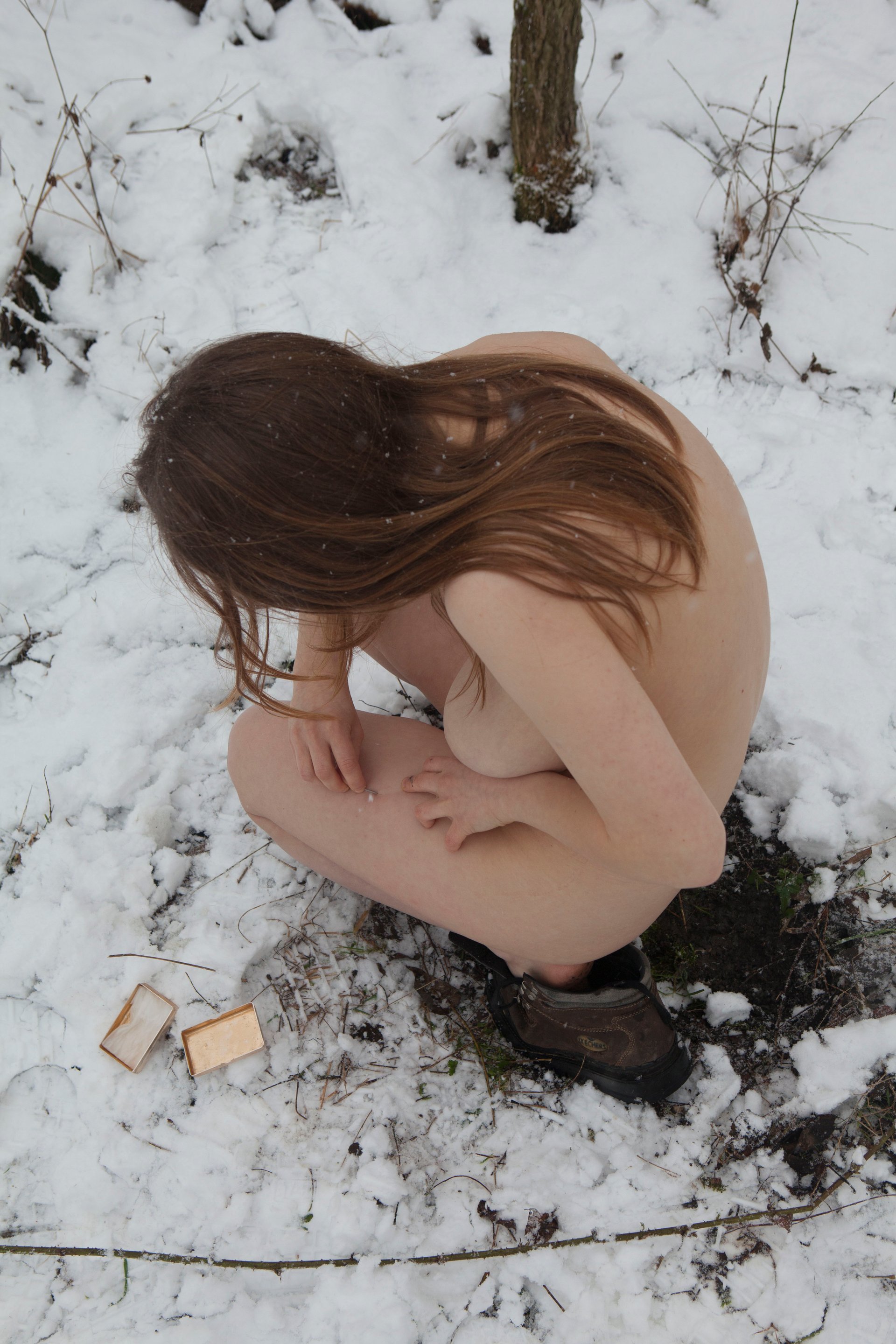
Both performances were inspired not only by Romanov’s work but also by the performances of Czech action artists Jiří Kovanda and Petr Štembera. Her open-air action ČBČ – Černá Bílá Červená (BWR – Black White Red) consisted in the creation of a trio of side-by-side colored lines. This tri-colored artistic composition was created using Khramtsova’s own body and the natural world: the thin red line resulted from the artist cutting her thigh with a razor blade, the white stripe was formed by snow, and the black one was the frozen soil that emerged after the snow cover had been removed. The act in question carried within it a certain intimacy contingent on examining one’s own body and contemplating its direct immersion in its surroundings. At the same time, it contained a somewhat drastic and masochistic framework that was meant to lead to, in the words of the artist, “the experience of pain as a tool for narrating and visualizing a concept.”
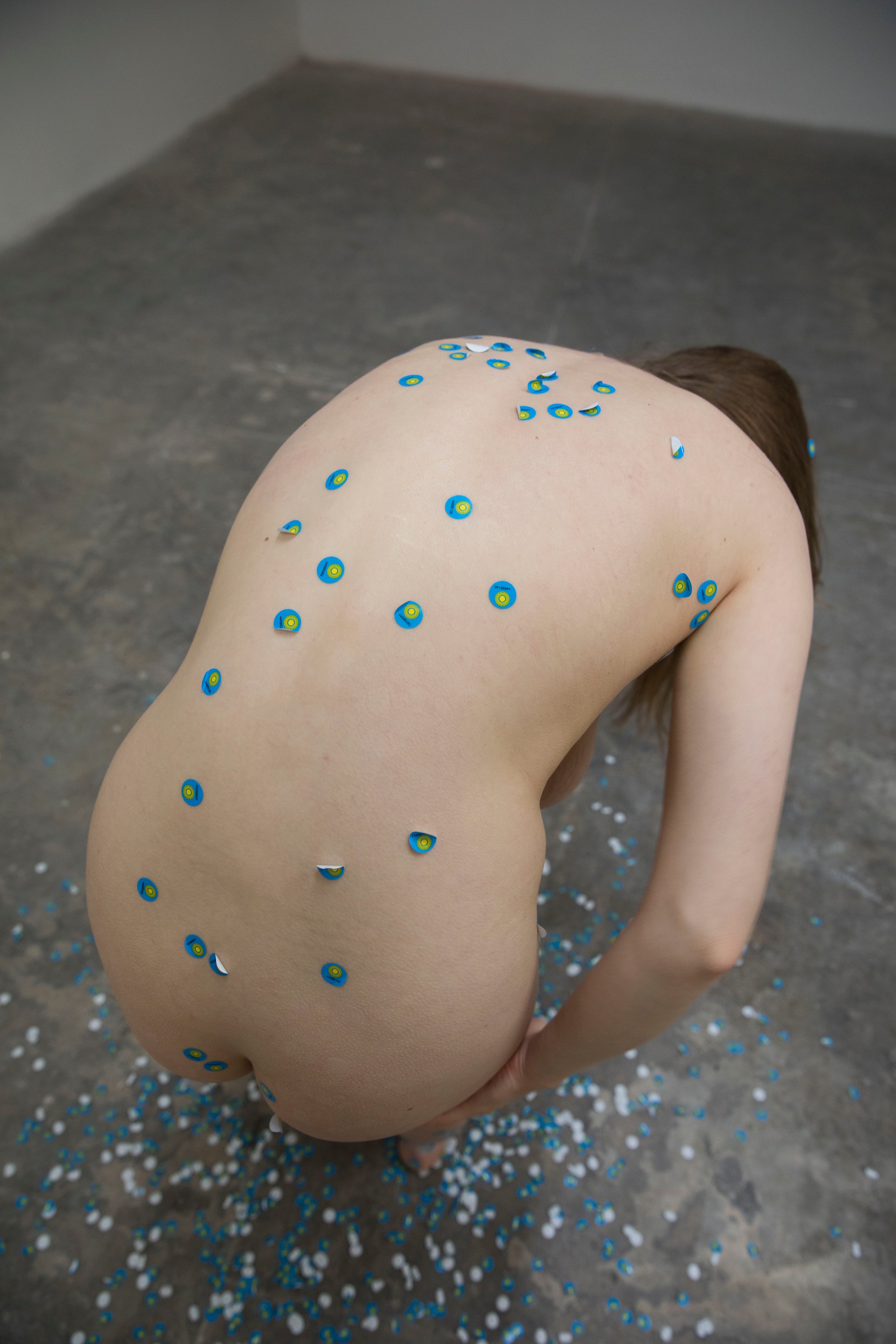
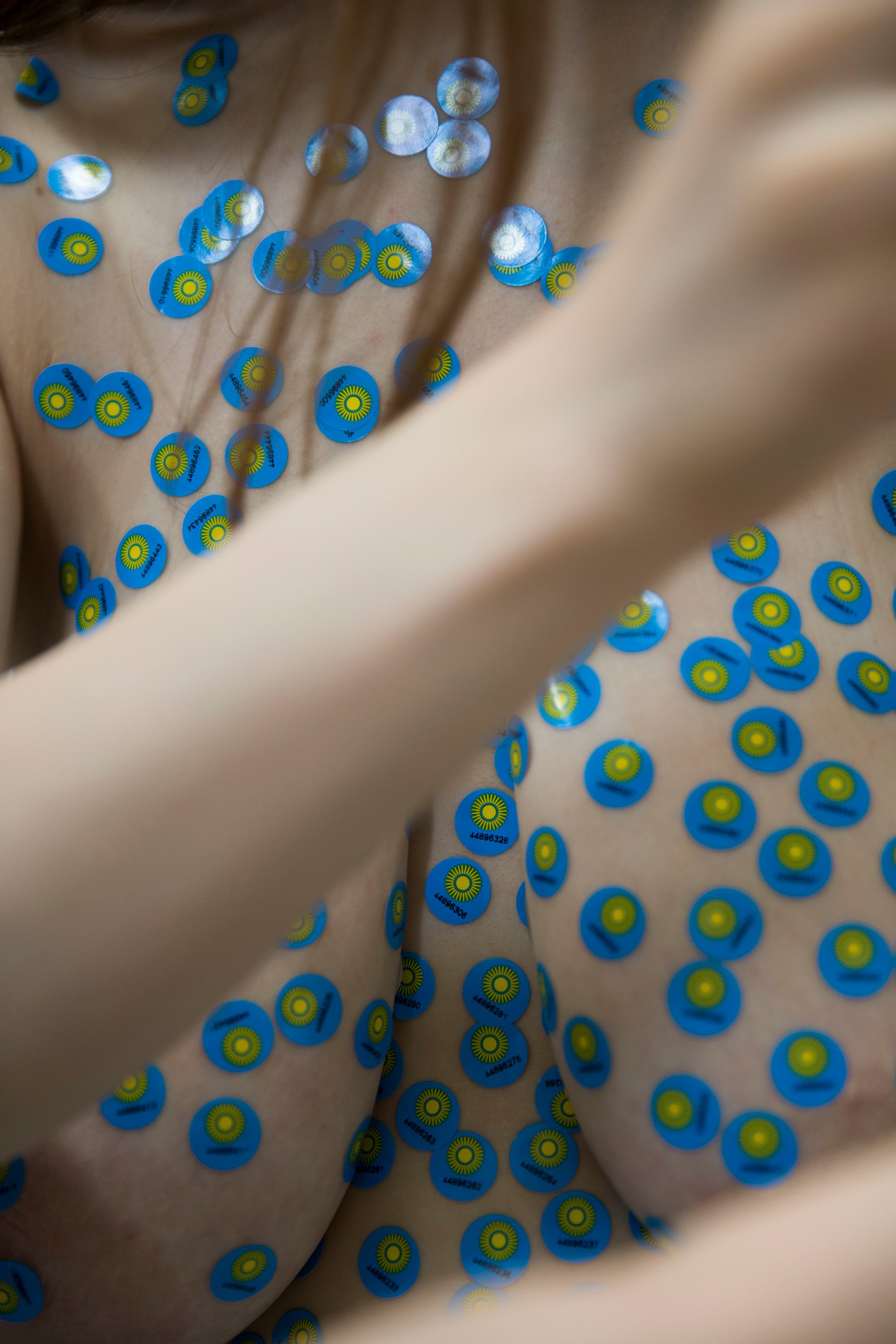
In the performance Kapitulace (Surrender), Khramtsova gradually covered her naked body with countless adhesive labels in an attempt to express her perception of how the capitalist world works. The act of manually covering her entire body with labels was a reference to the mechanical nature of work under capitalism. The performance subsequently culminated in the spontaneous stripping of all these external, foreign objects in an act of purification—a cleansing of the self. In other words, it was a metaphorical shedding of the accretions left upon us by the incessant process of objectification and commodification that we are a part of under capitalism—a reversion to an imaginary primordial starting point where the body is pure, free of all the labels and tags (literal in the performance, metaphorical in reality) with which its environment ceaselessly covers it.
Accepting and simultaneously rejecting the outside world
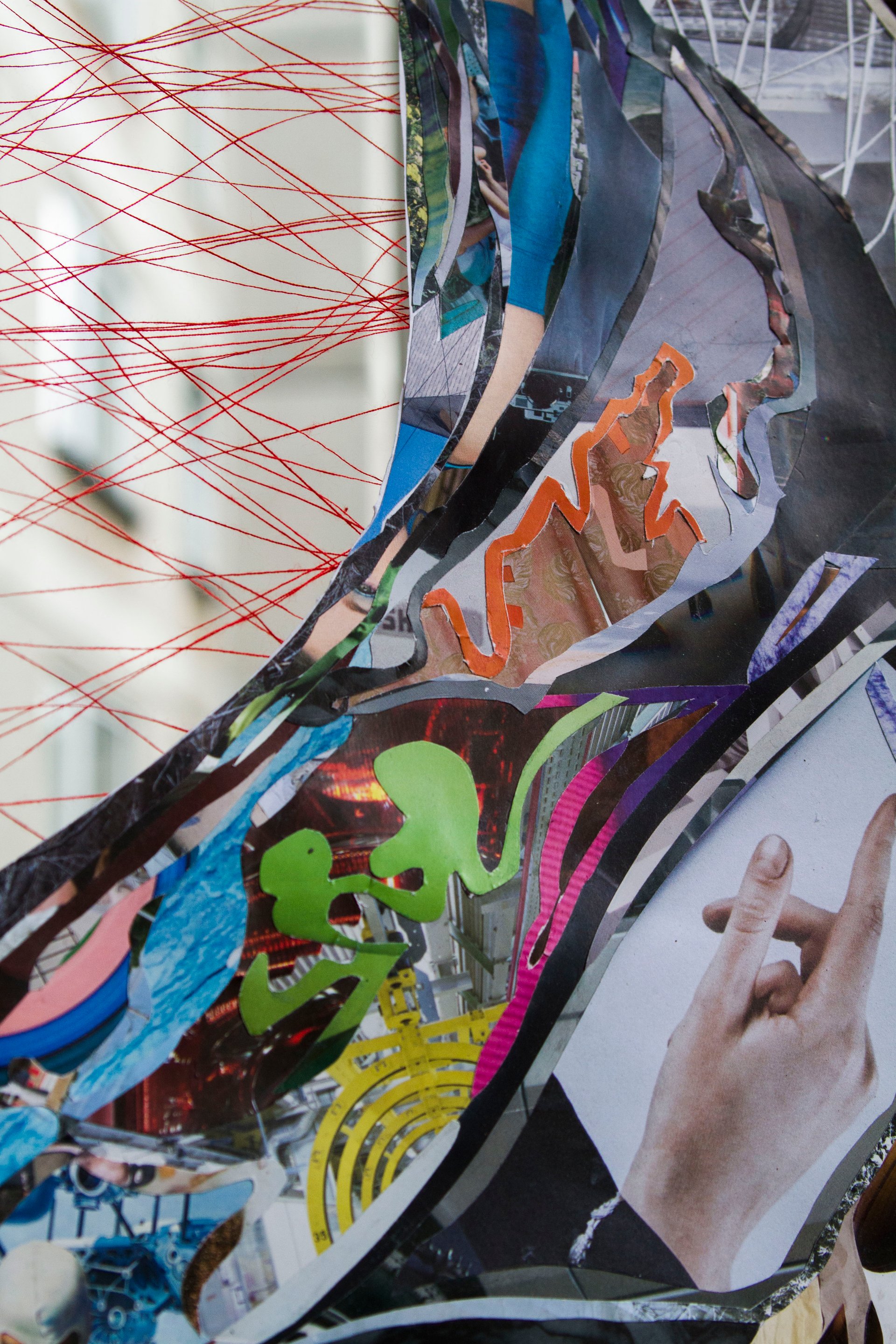
Since 2021 Khramtsova has also been creating artistic artifacts. The common denominator of her works is recycling. Her first collage-like object, titled Saggy Tobby, was created using a combination of thread and various photographs from magazines. The title refers to a fictional character—a homunculus—which the piece is meant to represent; he embodies the artist’s “repressed states” while also manifesting the array of her “emotions of accepting and simultaneously rejecting the outside world.” This ambivalence—the internally contradictory tension between acceptance and rejection—is noteworthy, not least because the object Saggy Tobby more than anything resembles a mask. According to art historian Hans Belting, a mask is itself an extremely ambivalent object since it has the ability to “make absence visible,” meaning to reinforce the absence of something through its imitation.
Another of Khramtsova’s art objects from 2021 is an untitled collage that uses copies of the magazine Fotograf as its building blocks. The artist glued and stitched together clippings from many issues of the magazine and placed the resulting multicolored strips in a network of threads stretched across a four-armed wooden frame that was installed in a park. The ecocritical work conveyed a message about the connection between the state of the earth and human activity, with the fragility of this coexistence seemingly underscored by the precariousness and frailty of the four arms of the frame, which were all tethered together and held the collages off the ground.
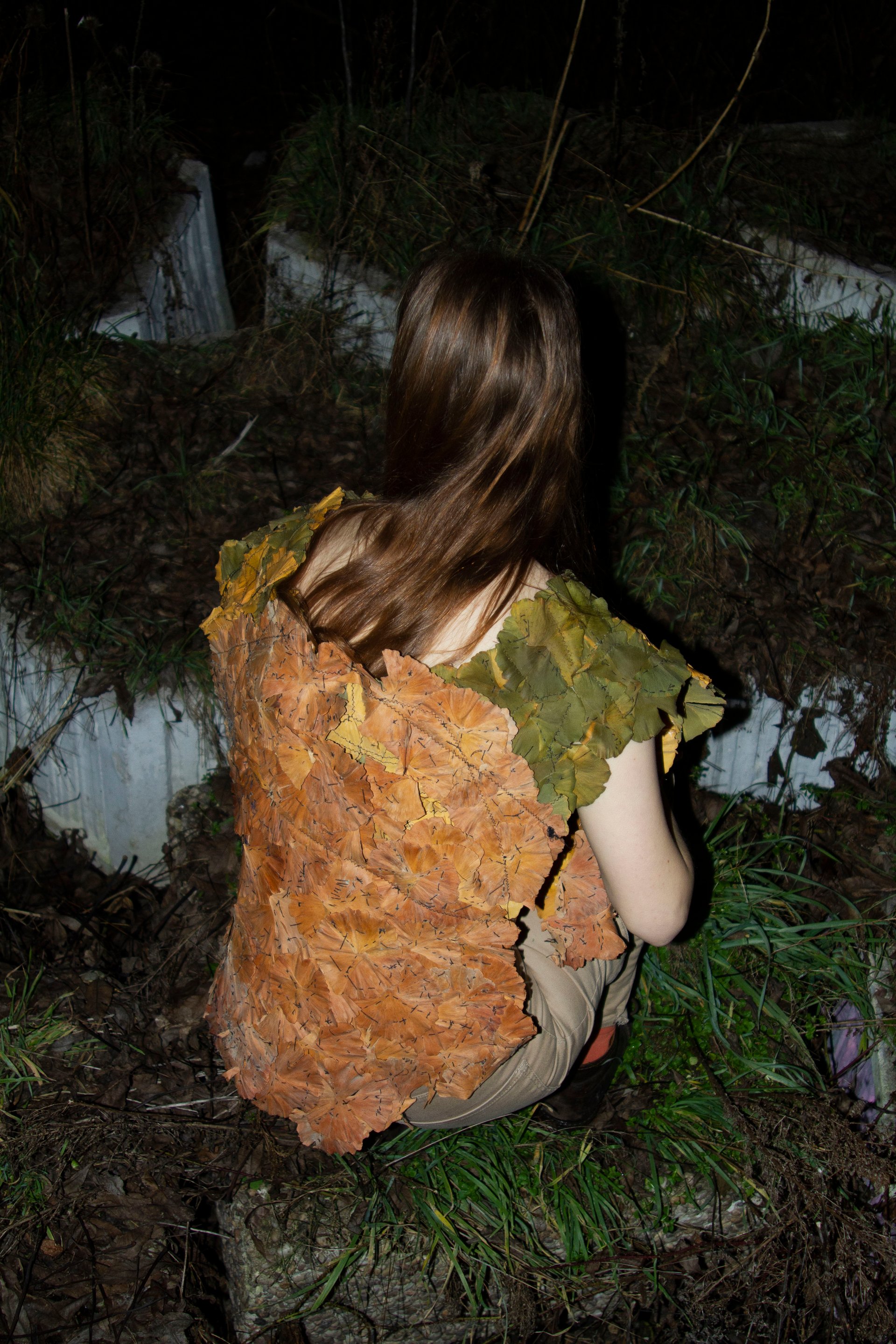
The practice of recycling materials for applied art is also evident in the artist’s aptly titled object Vesta z Ginkgo (Ginkgo vest, 2022), a garment woven from Ginkgo biloba leaves. Her inspiration was her introduction to the Berlin-based collective Kulturlabor Trial&Error, who specialize in considering alternatives to consumer culture and with whom Khramtsova’s sister had previously collaborated. The creation of this vest in soothing, almost autumnal shades of subtle yellowish brown and faded green was accompanied by a less comforting recollection. While making it, Khramtsova was thinking about when she had to “buy bulletproof vests for Ukrainian soldiers for the first time.” Another reference to the bleak situation in Ukraine can be found in the artist’s latest object, Atomový kryt (Atomic shelter, 2023). “The only thing that people in Ukraine are preparing for now is an encounter with atomic bombing,” Khramtsova says. The work, made of recycled paper, cardboard, and plaster, takes the shape of a street curb because, according to government instructions, that is what people in the city should lie down next to with their eyes tightly closed in case of a nuclear attack. The artist thus wants to draw attention to the not-so-obvious significance of this common piece of the urban landscape.
To work for a better world for animals
Beginning in 2023, Khramtsova began to focus primarily on filmmaking. She brought the character of Saggy Tobby to life through animation in the short film Saggy Tobby Movie (2023), in which she took numerous scenes of a sun-drenched spring landscape and overlaid them with a second layer of images, thus introducing a walking pair of animated figures whose peripatetic dialogue touches on themes of social inequality and environmental issues. Much more minimalist and less communicative, then, is the related pair of shorts Kéž by(ch?) tam nebyl (I wish he [or I?] weren’t there, 2023) and Lovers (2023), both of which are single-shot studies of the bodies and lives of animals.
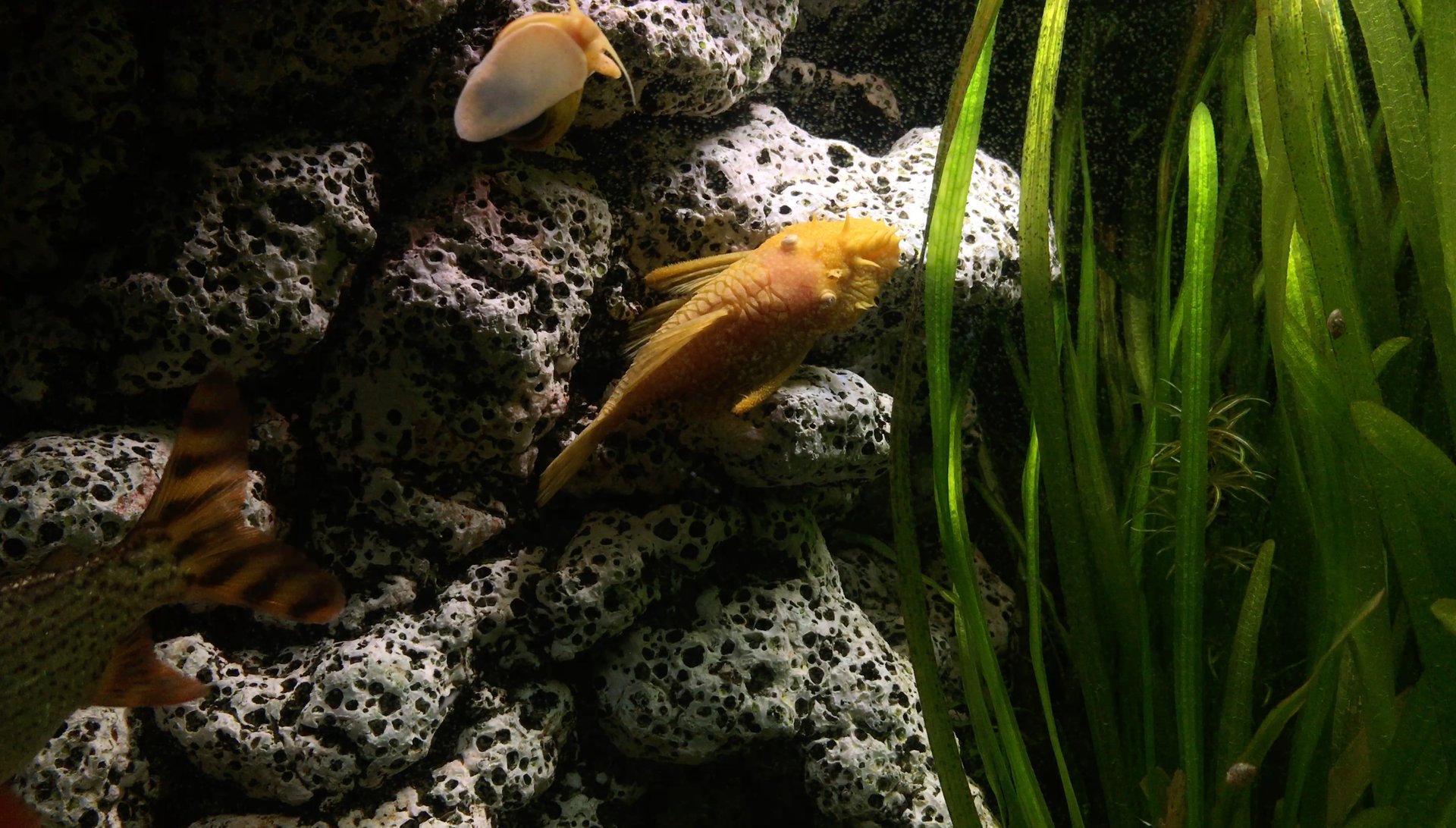
In Kéž by(ch?) tam nebyl, the camera is trained on an aquarium in a pet shop, where the imprisoned animals are completely dependent on humans for their existence. In the center of the shot we observe a motionless orange fish that seems completely apathetic and indifferent to its surroundings, which are teeming with a multitude of other animals. Even the passing water snail displays greater activity and willingness to move. But how great is the observer’s stake in this? How much can we ourselves surmise about this natural microcosm with our human vision? In any case, it’s safe to say that the artist, through this fixed, static shot with minimal postproduction, is drawing attention to the existence of countless tiny dramas which permeate the world and which are usually found outside our field of vision, beyond the human horizon. After all, Khramtsova herself has said she wants to “sensitively capture moments unfolding in reality” as well as “work for a better, freer world for animals in a time of war and climate change.”
In the film Lovers, the camera almost voyeuristically pesters and zooms in on a pair of mating Roman snails. Close-ups reveal the many protuberances covering the fabric of their slimy bodies or the texture of the eyes at the end of their antennae. In the text that accompanies the work, the artist connects this inconspicuous moment—of which in lived reality there are always countless simultaneous occurrences, the vast majority of which lack an external observer—to the idea of an all-encompassing archive of every event in the impending digital future. She sees it as a “‘social network,’ where everything that has ever been filmed on earth will be ‘viewable online.’”
I would rather discuss my art than win awards and read about reactions to my work
Out of all of the works in the artist’s filmography, the short documentary Qirim, which is the word for “Crimea” in Crimean Tatar, has undoubtedly attracted the most attention. This film, which, like Khramtsova’s art collages, consists of many different cinematic elements (including, for example, animated passages, drone shots, and archival footage), was made as part of the workshop My Street Films. It premiered at the Ji.hlava International Documentary Film Festival in 2023, where it received a special mention in the tenth edition of the My Street Films Award. Qirim was subsequently screened at a number of other festivals, both in the Czech Republic (Mladá kamera Uničov, Marienbad Film Festival, etc.) and abroad (e.g., goEast Filmfestival). It centers around Antonina Romanova (formerly Antonin Romanov—see above), a queer, non-binary Ukrainian citizen who worked as a director, performer, and actress before the war. On the 25th of February 2022, the day after the Russian invasion of Ukraine began, she and her partner joined the ranks of the Ukrainian armed forces, where she has been serving as a mortar operator until now (summer 2024). Khramtsova’s portrait of her is a kind of birefringent mirror because, according to the artist, it reflects both the personality of Romanova, whom she has known for a long time and whom she admires artistically, and the filmmaker herself, although she is hidden behind the camera.
Qirim itself begins with a dialogue between these two artists. Romanova is sitting in front of the camera wearing an army uniform embellished with a patch that reads “VEGAN.” She is in an anonymous, shabby room, and behind her we can see cracked floral wallpaper and an assault rifle leaning against the wall, while Khramtsova remains behind the camera. We should add, however, that this encounter was not a given as only a handful of journalists and documentary filmmakers get the opportunity to come into contact with active members of the military. Khramtsova had to submit many required documents and then wait two months for permission to film. During this time, there was a line of other applicants in front of her with similar intentions, most of whom were unsuccessful and had their applications rejected. The filmmaker herself says that during the whole process she primarily capitalized on her background in law and that, with all the accompanying difficulties, she found it much more challenging than, for example, the postproduction of Qirim, which took about a week to edit.
Nevertheless, when introducing herself, Romanova states that although she was born in Crimea, her entire family is from Russia, and she therefore has no Ukrainian roots. Before the war, she never believed that Russia would attack Ukraine, but she says she now understands that it has always been an enemy, which is why she is actively trying to resist. Romanova’s resistance began even before the war, through her participation in anti-Russian political demonstrations. She also let it loose in her performative work. Russian studies scholar Alena Machoninová points out that in Russia today there is practically no apolitical art—regardless of the intentions of the artist—since de facto every artistic expression is scrutinized as political. And Romanova seems to have similar thoughts about the impossibility of acting non-politically in the face of Russian aggression: “All of my performances are political, and I don’t believe in art outside politics whatsoever,” the artist says in the film. To illustrate her words, we see archival footage from one of her actions, during which she used her own blood to paint various slogans on blank sheets of paper and her own body in front of the Russian Embassy in Edinburgh. She repeated this performance in various cities around the world, whereupon the staff of the Russian embassies always tried to remove her, either by themselves or in cooperation with the police. In Edinburgh, one such man even kicked and trampled on her banners, as we see in Qirim.
Khramtsova says that she sees a certain ritual framework in the art of the aforementioned Czech performers Štembera and Kovanda. Through violent self-torture, they tried to achieve liberation from the influence of the socialist regime of the so-called normalization era, which was “imprinted on their bodies.” This—like Romanova’s performance—evokes for me the thinking of the art theorist Josef Vojvodík: “If it is possible to understand violence as a specific form of collective ‘contagion,’ as a—under certain circumstances very virulent—form of ‘contagious’ violence that engulfs entire social groups, it is equally possible to understand the affective-emotional reaction to this violence as a contagion, the decision to opt for it, even with an awareness of its consequences. It is a correlative relationship between infection and victim, violence and suffering, between (the ambivalence of) the sacred and the profane.” The self-harm and pain inflicted on Romanova’s own body appear exactly “adequate” or proportional—in short, an aggressive and drastic reaction to the equally aggressive and drastic violence perpetrated by Russia. That is, not as a passive acceptance of pain, but as an active infliction of pain on oneself for the purpose of resistance and purification. However, we also see Romanova performing naked in forest meadows in the Ukrainian wilderness, meaning in the same setting where, in addition to her intimate and artistic activity, we also see soldiers firing mortars, presented through a split-screen image. In connection with this imaginary juxtaposition—the comparison of art and war—the filmmaker told me that Romanova understands that art loses against war, for she has never experienced anything stronger than war in her life. Although in some of her earlier performances she, for example, cut her tongue, the pain caused by this was insignificant in relation to the pain caused by war. Romanova is therefore considering becoming a critic or curator after the fighting ends, but she does not plan to return to making art.
Another important aspect of the film Qirim is Romanova’s unconcealed sexual orientation. In this context, perhaps somewhat surprisingly, I will mention Gilles Deleuze and Félix Guattari, who write about so-called “minority literature,” which emerges and functions within a majority language and in which, according to the authors, everything becomes politicized and takes on a collective meaning. In the words of Deleuze and Guattari: “How many people today live in a language that is not their own? Or no longer, or not yet, even know their own and know poorly the major language that they are forced to serve?” Although Qirim doesn’t even remotely relate to literature or language, the same internal mechanism described by Deleuze and Guattari can be observed in Romanova’s actions. As a member of the LGBTQ+ minority, she enters the majority structure of the Ukrainian army, and since she makes no secret of her queer orientation and openly refers to herself with feminine grammar, all her actions become somehow politicized and take on a collective meaning. After all, according to the filmmaker, Romanova has already found herself in the spotlight of Russian propaganda on a number of occasions, when she was pointed out as an example of a queer person in the Ukrainian army in an attempt to to disparage and ridicule the organization.
However, it is precisely a certain inclusivity of the (Ukrainian) army that Khramtsova also reflects on in her film. Although this environment is usually perceived as a predominantly masculine one, there are now over fifty thousand women in the Ukrainian army, for according to the filmmaker, Ukrainians realize that if the army remains an all-male (and heterosexual) force, it has no chance of winning the war. That’s why it also needs queer people like Romanova, who undoubtedly disrupts the idea of what a “standard” soldier should look like. I should add that the philosopher Bernhard Waldenfels writes about the difference between productive and unproductive action, where the former finds itself trapped within a certain order and the rules set by it, while the latter transcends the order and thus directly reshapes its structure. On the basis of this classification, we can say that Romanova acts productively—she has no intention of disguising and hiding her identity for the sake of existing conventions; on the contrary, she is completely open about it and directly raises the issue of the inclusivity of the army in front of others (and the audience of the film), which the process helps set in motion. And although, as Khramtsova points out, some of Romanova’s fellow soldiers refuse to address her using feminine grammatical forms, others fully respect her wishes and do so.
In an interview for My Street Films, Khramtsova had this to say about Ukrainian society’s attitude toward LGBTQ+ people: “Ukrainians, like Poles, are conservative in many ways, which is connected to religion. At the same time, there are many young people in Ukraine who want to change society. Ukraine is slowly moving toward inclusion. […] Nowadays, the LGBTQ+ community is getting more attention. There used to be a lot of negative comments, but now it has shifted to a neutral or even positive acceptance. I’m happy about that. Those who used to speak out strongly against the community are currently fighting, and they have no time for criticism. We’ll see how it plays out. But love will prevail.” And she says she has had feedback from Ukrainians that some old-timers have rethought their opinion of LGBTQ+ people after seeing Qirim and that they were not so much convinced by the film itself but rather by Romanova speaking through it. And provoking discussion and highlighting and debating various issues is precisely what Khramtsova’s artwork aspires to do. Let us conclude, then, by mentioning this thought of hers: “I would rather discuss my art than win awards and read about reactions to my work.”
Collaborators
Author of the text: Kryštof Kočtář
Translation of the text: Brian D. Vondrak
Translation of the video: Zuzana Halamíčková
Published on November 13th 2024