We are an editorial collective shaped by the artistic environment. Our focus is on contemporary art in the context of current social issues, along with an exploration of its critical potential.
We are looking for stories and practices breaking the paralysis, exacerbated by the growing environmental problems and (not only) the energy crisis —
—--- and that is why we share several contributions from the field of art and activism.
Although they deal with different repertoires of tools and strategies, they have a common motivation: they are based on the questioning and criticism of the current economical system and speculatively model other, more or less utopian realities.
The work thus creates a space for listening to invisible and less dominant voices,
they are looking for slowness and a deeper experience,
heal the landscape, themselves and others,
they expand beyond the boundaries of their own bodies and individualism in favor of a climate- and socially just future.
We would like to outline the conditions for a new sensibility and redefine our needs and future actions, based not only on the logic of endless production and consumption, exhausting fragile ecosystems. Last but not least, through this joint rearrangement of basic and small stones, we try to actively integrate non-growth strategies into our lives.
Nikola Brabcová and David Přílučík
Diana Lelonek: Compost
Diana Lelonek graduated from the department of Photography in the Faculty of Multimedia Communication at the University of Art in Poznan (PL). Phd at Interdisciplinary PhD Studies, University of Art in Poznań. Currently she works at the Academy of Fine Art in Warsaw. Diana Lelonek explores relationships between humans and other species. Her projects are critical responses to the processes of over-production, unlimited growth, and our approach to the environment. She uses photography, living matter, and found objects, creating work that is interdisciplinary and often appears at the interface of art and science.
Jan Škrob
weather
only seldom is there
space in which the weather
opens up i’ve no idea if it’s
morning or evening
you say watching
the forest you say it’s
drawing near the creaking
of the sparse planks the knife
i wipe the cherry juice into
the ladder behind the shallow
window just imagine
the weather like
something tangible
only seldom is there
weather in which the forest
returns in the finger-
tips we feel its deep pulse
march
the billionaires have left for underground
shelters we’re dealing with another heatwave
the war slipping through our fingers
it’s good for such things
the fly amarita you say it’s the new
moon tables and armchairs in the reeds statues
with heads knocked-off i’m interested
in situations of return destabilisation
face coverings
a landscape spread-out
in the shape of wings
shards a former motorway
a man with a lute on his back taking a burning
book in his hand we’ve got no
plan we never were after one i brushed against
a billboard pillar with my shoulder and
i feel somewhere behind me dawn rising
i cannot tell time from space
planes of drawing paper around
the fireplace stand four horses the situation
of return sliced
bergamot we could no longer
separate ourselves from life
we’ve got plan we never were after one
you sit at a table
reorganising the cinders it’s the new moon
there are things inside us
there’s no way of breaking into
we hold the terrain of the situation of return
the inside and the outside
bark
in a bottle with a cut-off
neck willow bark
is macerating all the stones
are in their places
In my hand I’m holding a stick with a fox
skull enveloped in leaves
and I’m walking against the direction of the spiral
it is important to know how to create
a situation in which you know what you are doing
I am always accompanied by fox
eyes painted on willows
spectrum
the pattern in the space gets animated
through walking i remembered
mushrooms dripping with translucent milk
eaten because of the slightly oppressive
feel in the mouth i’m trying to move
here so i don’t disturb
anything the soft drumbeats
keep things on one plane i’m trying
to measure time in new units
subvert its structure somewhere
i heard about it already i feel as if
i were on an island again
the wind plays on the glockenspiels i remembered
unfamiliar banknotes and
coins arranged in front of the statuette
of the satyr i’m trying to keep as
broad a field of vision as possible but something
always escapes me which is a necessary component
of the method the pattern cannot be
impermeable the inner spectrum vanishes
in the exterior i lean along the branches
dry spell
it’s hard for me
to not let this war
define me protected by
salt willow bark murals
on walls in abandoned
office
complexes a textual interface i’m standing
here and
i can’t otherwise
it doesn’t take much
and you’ll start a career you’ll know
exactly what you have to say how
to move
i still held
some kind of chaos
inside of me i go back
to the platform with a smart
watch
i open the entrance
to the back wing
a guitar case
leaning against the heater
means i’m waiting on the roof
a window forced open means a return
dark lipstick
another dry spell
is on the way
i still held some kind of chaos
inside of me
i crawl along scorched
ledges i have
everything beneath me a corridor
of light a woman whom
i’ve seen somewhere
before stops
to tighten the buckle
of a light sandal
Jan Škrob published the poetry books Under the pavement (EMAN, 2016), Real (Malvern, 2018) and Země slunce (Viriditas, 2021). In 2015 and 2019, he was included in the Best Czech Poems yearbook. For his debut, he was nominated for the DILIA Litera award for discovery of the year in 2017, and in 2018, together with Bastian Schneider, he became the holder of the Dresden Poetry Prize. In 2019, he was nominated for the Jiří Orten Award for his second book. His poems have been translated into English, French, German, Polish, Dutch, Lithuanian, Greek and Slovenian. A selection of translated texts from the Real collection was published in 2020 by the German publishing house hochroth Leipzig under the title off topic. He earns a living as a translator and is a member of the Association of Writers.
Re-set
Barbora Bakošová works in the RESET organization (platform for social and ecological transformation) on the subject of solidarity economies. In the past, she worked in the organization NESEHNUTÍ, where she dealt with urban planning and civic participation. She also worked as a journalist covering environmental issues. She is a member of the Tři Ocásci cooperative in Brno.
Tereza Silon is an interdisciplinary artist, performer, text weaver, embodied researcher, studying and practicing bodywor. She is interested in different linneages of herbalism(s), in the vivacious, the erotic, the brithing and dying and all in between and beyond. They are studying life, the sensual, the ecological and queer/ing (in multiplicity/ies). Individual and collective ´health´is for them closely related to autonomy, (inter)relationality and access. She is exploring various possibilities of intimacy in the current extractive system(s).
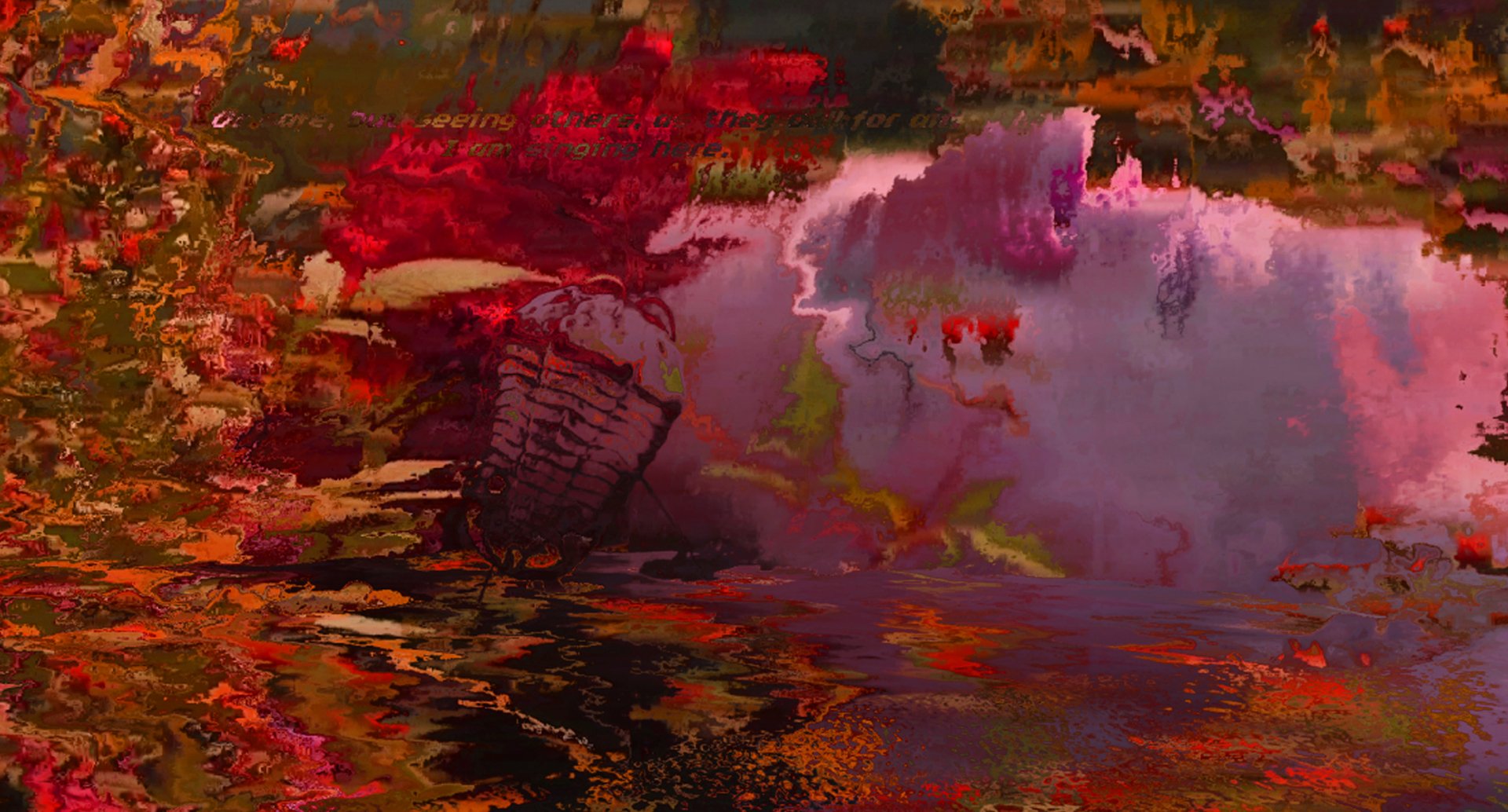
András Cséfalvay: Trilobites - The Valley of Death
Memento mortis convallis - poetic walking simulator. Human intervention and extraction resulted in the uncovering of trilobite fossils near Prokopské údolí, southwest from Prague. Besides the construction material and a few research results from the fossils, ghosts awake from their long sleep pressed between Devonian layers. The ghosts of trilobites speak to the visitor. Tell a warning tale about extinction, that is brought about not maleficent greed, but simply effectivity. Art piece for interactive game environment.
Martin Čech: The Suit I Wear to the Office Might as Well Be an Apron
Tracts of ploughed black earth lie exposed all the way to the horizon. Here and there, a small copse or a few bushes pass by. And every five minutes, an affected voice announces the name of another identical village. Nothing but a couple hundred houses and a church looming over the square. Every time I go home by train, I think about how different the story of my life would be if I had been born in one of these villages. I suspect it would be the same, just in a different setting. I’ve made this trip so many times that going through another turning point in my life here seems mundane.
Holiday excursions to the city with family to go shopping or to the cinema. The first trip to secondary school, at a far-too-early hour of morning. The first time getting drunk at a club with girlfriends I’ll have for forever, or at least for today. The first time going on a date and the first time coming home from one. Excited after the first kiss and heartbroken after the last. And today it’s a visit to the family after dropping out of university. The contrast is soothing. Finally, after a long time, I’m happy. I should have done it last semester. Or at least before finals. I don’t care what my mom is going to say. She’ll complain again about how she pointlessly poured money into me for nothing and how I’m ungrateful. I would tell her to keep her money, which isn’t even enough for rent, but I don’t want to pick up any more night shifts. It’s easier to let myself be humiliated for one afternoon than for dozens of evenings. Except that it’s that one afternoon that awaits me now.
We pass another field, beyond which rises the last church on my journey. We have a small strip of trees outside of the village. Not a forest, yet not just a few solitary trees either. Whenever I used to go into town with my family, I always wondered why the trees were growing there. I still don’t understand it today. But while as a kid I wondered why they didn’t cut them down and sow a larger area with grain instead, today I don’t understand why they don’t extend them up to the first houses as a windbreak. The final stiff announcement. Please exit the train.
*
: Hi, Katka! Where are you? I’m waiting on tenterhooks here.
: I told you, I won’t get there till this afternoon.
: Dad got in an accident.
: What? What happened? Is he alright?
: He says he’s fine. I guess he didn’t brake when two cars in front of him crashed. One person died, can you imagine. Dad says he doesn’t have a scratch on him. The car’s totaled, of course, so he won’t be coming today. He’ll leave it for next weekend.
: You really know how to put it dramatically. You know how much you scared me? So, Dad really isn’t coming? After all, he could take the train like me.
: Oh, come on. You’ll just have to come back next weekend. Is it his fault you only show your face around here once in a blue moon? The last time you visited was Christmas.
I really can’t have a dialogue with my mom. But today she managed to turn something against me in record time. I haven’t even shut the front door. I’m taking off my shoes and coat. On the shoe rack, I find a neatly prepared pair of house slippers—quality orthopedic footwear from the pharmacy, not worn-out slippers from the free shop, like I have at my place. When I put them on, I have to admit that my mom is right. I’m sure she wishes she could set them out for me every weekend. She hasn’t really had anyone to invite over since my sister moved in with Lars. And now Dad is only coming home on weekends again. It’s just her and the cat.
I take a seat on the new, black, leather couch. The living room has been repainted in a different color again, and the furniture has all been rearranged. I admire the attention paid to the smallest details in the room. It’s tidy but not sterile. There’s a colorful unlit candle on the table with matches lying next to it. Around it sit symmetrically arranged bowls of fruit, nuts, and candy. And cheese—no doubt just to tempt me, so go on, take one, it’s fine, I can almost hear her say. The soothing ticking of the second hand fills the room. Mici pads silently across the bureau, carefully avoiding a burnt incense stick. Time stands still, and I’m beginning to calm down.
: Who did you chat with on the train?
: I don’t know anyone here anymore, Mom. I did see Michal on the train, but I only know him well enough to say hi.
: I saw his uncle’s obituary at the town hall not long ago. Did you know him? Kind of tall, lived right below the hill. I went to kindergarten with him. But that’ll be me any day now too.
I should probably look sad or comfort my mom right now. But whenever she tells me about people I don’t know and lists what happened to them and all their mutual relations, I know she’s just being herself. And that she enjoys it. So, I listen to her. I have no idea who she’s talking about, but I know it makes her happy, and I can feel at home and safe. Still, I’m filled with anxiety. I’ll have to confess as soon as possible.
: But I could go on. What about you? All done with your exams?
: Yep.
: You see, I never doubted you’d manage. Now just your bachelor’s thesis and then on to your master’s?
: Mom, I dropped out of school yesterday.
: Are you joking?
: That school is terrible. I don’t enjoy it at all. That’s what I’ve been saying the whole time. They’re teaching us things that I don’t believe, and I doubt the teachers believe it either. I don’t want…
: Kateřina, tell me you’re joking!
: I want to do something I enjoy. And economics really isn’t it. We’re always calculating something, like we’re trying to prove to ourselves that we’re right and that what we’re doing is a science. But instead, we’re just defending inequality and oppression. We justify the destruction of the environment and call it progress. And I’m supposed to sit there and listen to this so that I can get a degree and then spread this destruction even further? I don’t believe that crap, and I don’t want to listen to it.
: What do you mean you don’t believe them? They’re university professors, and you’re telling me you don’t believe them. Why shouldn’t you believe them, Katka? What makes you think you’re smarter than your teachers?
I get it. It sounds naïve and silly. And I don’t think I’m smarter—not smarter than my otherwise great intro to law professor or that hot macroeconomics lecturer. I just don’t believe that selfishness and competitiveness should be the defining values of our behavior. I don’t believe that ignorance of the destruction of the environment is actually progress which will ultimately save it. And the worst thing is how people my age accept this doctrine. Whereas during the first year everyone shared test questions, now after five semesters no one even bothers to share class notes. Suddenly everyone has to go it alone. Freedom and individualism. More like selfishness and thoughtlessness. If it weren’t for Lenka, I wouldn’t even know that the neoclassical economic theory we’re being indoctrinated with is just one of many. Thanks to her I discovered feminist and ecological economics, which much more accurately describe what I see around me. Thanks to her I discovered degrowth and finally found hope that we can live in a more just world surrounded by living nature. We need a different world. I’ve read everything about it, and I can’t go back.
: I don’t think I’m smarter.
: So, why don’t you finish your degree? You’re so close!
: Can’t you see why not? Can’t you see all the things that are wrong? You complained to me last summer about how you weren’t allowed to fill the pool and how terrible it was that grandma and grandpa’s well went dry and a water tanker had to be brought to the village. And if our house was a couple of villages over, it would have been leveled by a tornado. It barely snowed once this year, and yet you bought me cross-country skis for Christmas… I’m sorry, but I have other things to worry about. After my internship—where I toil away for free—I have to work nights to cover food and rent, which they just raised again despite never fixing the drafty windows. And then I go to school in the morning where I learn that it’s my own fault for demanding a roof to live under. Should I choose to be homeless?
: Katka, if you need more money, just say so. But we can’t pay for everything. You just need to get used to it. No student has it easy—it was the same for us. I had to hustle too.
It would be useless to point out that my mom got this house from her parents and that my dad inherited the apartment that he still uses when he stays in Prague during the week. Or to refute the mantra about how I’m supposed to have it tough, when in fact it’s normal for students in Germany or Denmark to receive financial aid, whereas here they accuse me of leeching off the state for daring to go to university. Meanwhile, Mom starts agitatedly spritzing the overwatered houseplants, providing me with an opening to munch on a piece of cheese. I cave and take a piece.
: It’s okay, I’ll manage. But I don’t want to be a part of it anymore. I’m never going back to that company where I have my internship. Where I work all day to maintain the system that makes it so I can’t afford rent—but the important thing is that the real estate market can grow. At my expense. Anyway, I’m just a servant to them. They don’t let me do any real work. I just handle the pointless websites and plaster them with ads. The suit I wear to the office might as well be an apron. While you had to make Dad’s breakfast and get his suits cleaned, I have to tend to people making twenty times my salary so that they can keep their salaries and so that I can put on my résumé that I pranced around for them. The only difference is that these guys don’t bring their paycheck home to me.
: Katka, you really could refrain from making these kinds of comments. At least your dad and I have a normal relationship. You always want to make up your own way of doing things. First you tell us you’re a vegan and refuse to eat with us. Then you come home with two of your friends and tell us you’re in a three-way relationship. I don’t understand how you can be happy like that. It can’t work that way, you understand? And what do you want now?
Last year my mom was prying as to why I hadn’t brought Tomáš home with me for a long time. By that time, I’d already been with Lenka for several months. I didn’t know how to tell her. She should be able to understand my fear of getting tied to one person, seeing as my dad has been cheating on her all her life. She turns a blind eye or says they’re just minor failings. Minor failings that cause marriages to fall apart, that lead to families being abandoned, and that, coincidentally, happen to the majority of people. I’d really like to avoid that. Especially if you just admit that humans aren’t monogamous. Trying to live up to that fairy-tale idea just destroys relationships. But I’m not about to bring that up again today.
: What do I want? I want the world to be fair. All of us could have our basic needs met. But instead, we tell ourselves how normal it is that some people earn more in a month than others do in a year. Forget in a month—in a day! We act like the whole world will collapse without profit, when really it’s profit that has us all by the throat. Do you think it’s okay that Patrik will be paying off a debt to some giant company for years just because he lost some online bets…
: Patrik’s stupid.
: So what! Now his life is ruined just for the sake of some corporate shareholders, and he let his mom lose her house. Just because of profit. We don’t need this at all. Companies could easily operate as non-profits, putting everything they earn into improving their services or other good causes. As it is, Patrik is paying for some rich people’s vacations in the Canaries with his almost minimum-wage salary. I refuse to be a part of this system, you get it?
: And you’re gonna change it somehow?
: I want to at least hope that it doesn’t have to be this way—that we don’t need to keep acquiring more and more and working more and more. I want to have enough, and that’s all! This is just like with Tomáš—I’ve been through this a million times with him. He’s always reading sci-fi and can’t wait till we settle on Mars, while we can’t even manage to maintain life here. We’re devastating a huge landscape and mining tons and tons of materials… If we at least… We let others do the mining for us in countries where we’re stealing their wealth, and we call it the free market. All for some kind of idol of economic growth!
: Katka. That’s enough.
It isn’t enough. I’d like to tell my mom that it really isn’t enough. But I already have tears in my eyes, and I feel like someone has me by the throat. Why do I always have to be in opposition like this? Am I actually mistaken and it’s me who’s wrong? When I read about this, I always feel like everything fits together, but then I’m the only one saying these crazy things, and I feel like an idiot. I shop at thrift stores or get clothes from the free shop, and then at home my mom always forces me to take kilos of clothes that she’s only worn a couple times. I try to avoid having any unnecessary appliances at home, and then my mom goes and forces her old plate warmer on me.
: So, we’ve been pouring money into you for three years, all for nothing? That’s pretty ungrateful of you.
It’s done. I think we’re done.
*
I leave feeling devastated, like I’m the worst daughter in the world. I’d like to be normal. I wish I could just make my mom happy, not get into endless discussions with anyone, and simply be satisfied with everything the way it is. I can’t do it. As soon as I walk out the door, dozens of cars block my path, while others speed down the street making it so I can hardly cross to the other side. Everyone has to go somewhere. We’re in the middle of fields, in a place where the shop shut down years ago and the post office last year. They weren’t bringing in enough. So now everyone drives twenty minutes to the nearest supermarket or half an hour into town to work. To keep the wheels of the economy turning.
I feel like an outcast on this island, where every last one of them would stone me for my heretical views. For not wanting to fall further down this spiral of growth. For saying we should only produce what we need and not more. I saw enough at my class reunion. No one wants to give up the dream that one day they’ll be rich—they’d rather go into debt from a failed start-up. Yet the exact opposite would suffice. Being a millionaire just isn’t moral when there are people dying homeless on the streets. Or is it? And we can’t all be millionaires. Then who would deliver food to our doors by bike in the rain? I’m a complete idiot for even bringing something like this up to my mom. I always try to inspire her with the things I’m currently living, but then I just come off like an idiot.
: Katka, mom called, dont quit school. Call you tonight
I’m glad my dad couldn’t come after all. I would have just let myself be even more humiliated and would have barely tried to defend myself. I wonder if he’ll call tonight. He never calls. Curt text messages are his maximum—luckily for me. Besides, I want to fill out my application for the ecological economics program in Vienna today. I’m completely immersing myself in pathos. Better than wanting to kill myself. Lol.
–
The author is an environmentalist who works for the Brno-based organization NaZemi, where she focuses on the political-economic-social theory of degrowth. Degrowth, which Kateřina mentions in the text, is both a critique of the current economic system and a proposal for a transformation to a more socially and environmentally just society.
Economic growth is incompatible with economic sustainability; it cannot ensure that climatic catastrophe is averted, nor can it solve the issue of poverty and reduce inequality, even though the current mainstream assumption—which is refuted by data—is that that these promises are the main reason behind green growth. Therefore, since the 1970s, degrowth academia has been formulating a critique of the current global economic system while working on a model of society that does not rest on the condition of endless and exponential economic growth. Degrowth is then the democratic downscaling and stabilizing of production and consumption in order to reduce environmental impacts and increase social justice and quality of life.
The degrowth discourse consists primarily of academic articles in professional journals. Published books that present degrowth in an accessible and comprehensive manner include In Defense of Degrowth and the first original Czech degrowth publication Čas : dorůst, which was published last year by the Czech degrowth collective as a free download. The Future is Degrowth provides a good overview in English, and for French, see Ralentir ou périr.
Natália Trejbalová: About Mirages and Stolen Stones
Natália Trejbalová lives and works in Milan. In her latest films, through the speculative creation of sci-fi environments and worlds, she explores individual perceptions of transformations on a global scale, possible future interspecies relations and changes in the planetary environment.