ecology 62 výsledků

ecology

Randal Plunkett introduced a unique approach to wild landscape restoration called V-wilding. It combines ecological principles with vegan philosophy and offers a model for sustainable restoration of natural habitats. Dalibor Dostál focused on the return of large herbivores as a means of restoring biodiversity, which is disappearing today at an unprecedented rate.
The relationship of man towards land has always been a significant mover of the organization of social, cultural and spiritual life. Land is inseparably linked with our basic needs, it is the source of our nourishment, offers us a safe home and a space for the merger with the cycle of nature. Despite all this we have managed to bring this relationship to the verge of a crisis full of misunderstandings, visible in all spheres of our coexistence.
We hope that by combining a number of various artworks and projects, hints of possibility will begin to emerge, from which a way out of today’s situation, that is oppressive on many levels, can slowly be carved. When it seems there is nowhere to run, we can try running into the future – and from there, start to reshape the present.
Bromová is often associated with the transformation of the perception of female identity in the art of the 1990s in Central and Eastern Europe. She is interested in women’s sexualized position in society. In her ritualized performances of recent years, on the other hand, she emphasizes the archetypal healing power of femininity, fertility, relationships, and collectivity.
The lecture will guide you through a heterogeneous series of projects that are developed by associative thinking. Historical precedents mix up with everyday references, generating designs that aspire a densely layered and surprising character.
It's obvious that the issue of the environment and ecology in art is increasingly becoming a consciously political decision that affects what art we create, how we teach it, how we talk about it, or how we present it. Artwork is intertwined with cultural activity, which is linked to activism and vice versa. The context, material used and financial resources are increasingly accentuated.
A more-than-oceanic perspective is a speculation on perception, emotion, intelligence, and agency. It brings with it a tidal wave of decolonial thought, posthumanism and material feminisms, queer ecologies, media theory, and spirituality, refracting it through interdisciplinary aesthetics and environmental justice.
The section of the motorway D11, which will run across the Trutnov and Žacléř regions will add a part of the East Bohemain frontier district, a forgotten bracket between the Krkonoše National Park and the Protected Landscape Area of the Broumov region, as another bead to an illusory rosary connecting Paris with Moscow. It is no more controversial than the other eight motoways under construction in the Czech Republic. May the presented requiem for our landscape be read ad exemplum.
Artist Sissel Mutale Bergh describes her latest film, Elmie (2023) – a Southern Sámi word meaning sky, air and storm – as a documentary poem and a lamentation on air, breath, birds, mountains and wind power. For several years, Bergh has followed the construction of – and opposition to – industrial windfarms at Fovsen/Fosen in the southern district of reindeer herding at ÅerjelFovsen Njaarke Sijte.
The May lecture from the Land/Scape series featured New York landscape architect Michelle Delk from Snøhetta and Swiss landscape architect Thomas Kissling from VOGT Landscape Architects. The topics were inspirational places for contemporary life, the connections between people and their surroundings, and water in the landscape.
Diana Lelonek explores relationships between humans and other species. Her projects are critical responses to the processes of over-production, unlimited growth, and our approach to the environment.
What futures do plants make possible? From colonial extraction to regenerative practice, from taxonomy to kinship, plants have always mediated the terms of human life.
Brood – Stranger’s Vial – Womb is a “game that has forgotten its own rules” and “a story without an ending.” Instead of a clear, linear fantasy, it offers a fantasy space that we view through several layers of material and media abstraction. It makes everyday objects and (in)human identities special. It invites us to notice the affects of humanity in the midst of the climate crisis, which can only be glimpsed through peripheral vision, somewhere at the edge of gilded metal. Just beware: The sides will be reversed.
Jussi Parikka is a writer, a media theorist and Professor in Technological Culture and Aesthetics at Winchester Art School (University of Southampton). He is concerned mainly with contemporary culture theory, philosophy, contemporary art, cyber-culture and digital culture. He has contributed significantly to the field of materiality of media, which he analyzes from the viewpoint of philosophy of new materialism. He deals with the relationship between nature and technologies using the term medianatures, which is a clear reference to naturecultures of Donna Haraway.
The aim of RurArtMap is to strengthen the cultural awareness of the countryside and create a space for cultural presentations, a platform for cooperation and activity planning which would make the art and cultural activities in rural environment more accessible.
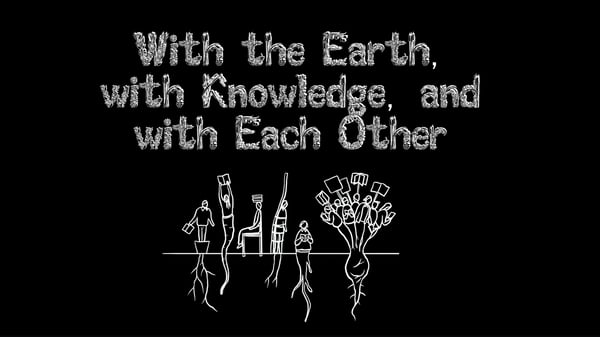
Life on Earth has gone through some four billion years of evolution and has always already been together, intertwined with a network of intimate relationships. We all share a common ancestor, we all need the same compounds to live, and our structure is made with the same building blocks, we all share common understanding of “substance semiotics”.
In the heart of Madrid a ravaged forest lays calm in the aftermath of the storm. Shepherds, sheep and dogs roam among the branches of uprooted trees. Above them, the city resounds with birdsong and underneath we hear the murmurs of the herd. Old walls, new barriers enclose this territory. At night its borders dissolve on the hilltop. Under a black sky the contours of its inhabitants emerge. The land rings out and the city glimmers. 
How and to what extent can we understand the land, and what do we all know and not know about it? To whom does it belong, and how do we change it, for better or worse? How can we express and capture in human, rather than statistical, terms, both the visible and invisible transformations that the land undergoes, both locally and globally, with regard to the entire biosphere and climate?
We would like to outline the conditions for a new sensibility and redefine our needs and future actions, based not only on the logic of endless production and consumption, exhausting fragile ecosystems. Last but not least, through this joint rearrangement of basic and small stones, we try to actively integrate non-growth strategies into our lives.