0:04:52
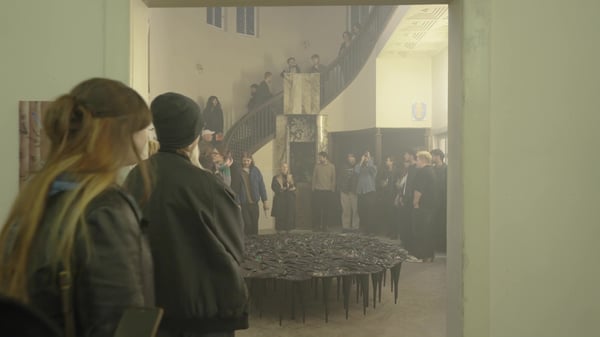
The Master Jam exhibition presents the Masters students of the Finnish Academy of Fine Arts who started their studies last autumn. Having taken their BA degree somewhere else, they now study at the Academy to further their knowledge and skills in the field of art, but these ìoutsidersî also bring in new blood and even a new blood group.
The exhibition underlines an era where different techniques have been mixed up. When the medium is not used in a familiar way, an enchanting state of confusion is created.
Painting as a medium is tested from one end to the other, from a mass to minimal imperceptibility. I am delighted to notice that the influence of a separate paper room in the Printmaking Study Programme. Something as marginal as a doll art has found its way to the Academy. Half of the artists in the show have used camera at some point in the creation of the works in the show. Some use it as a tool only, others document; some comment a painting; others come near the realm of film.
In a group show, everybody represents their own uniqueness with the works. However, what they have in common is that they master the medium used.
| artists | Haidi Motola, Paula Ollikainen, Juan Kasari, Pia Mannikko, Anastasia Lobkovski, Arttu Merimaa, Markus Lampinen, Mari Hallapuro, Laura Vainikka, Mari Metsamaki, Elina Vainio, Aino-Marjatta Maki, Heini Matveinen, Anne Tamminen, Jouko Korkeasaari, Jani Rattya, Heli Kurunsaari, Sari Palosaari, Kimmo Kanerva |
| curators | Hannele Kumpulainen |
| place | Finland |
| tags | |
| cast | Haidi Motola |
| camera | Hába |
| sound | Hába |
| editing | Hába |
| interview | Hába |
| published | 19. 9. 2011 |
| language | Česky / English |
| embed |  |