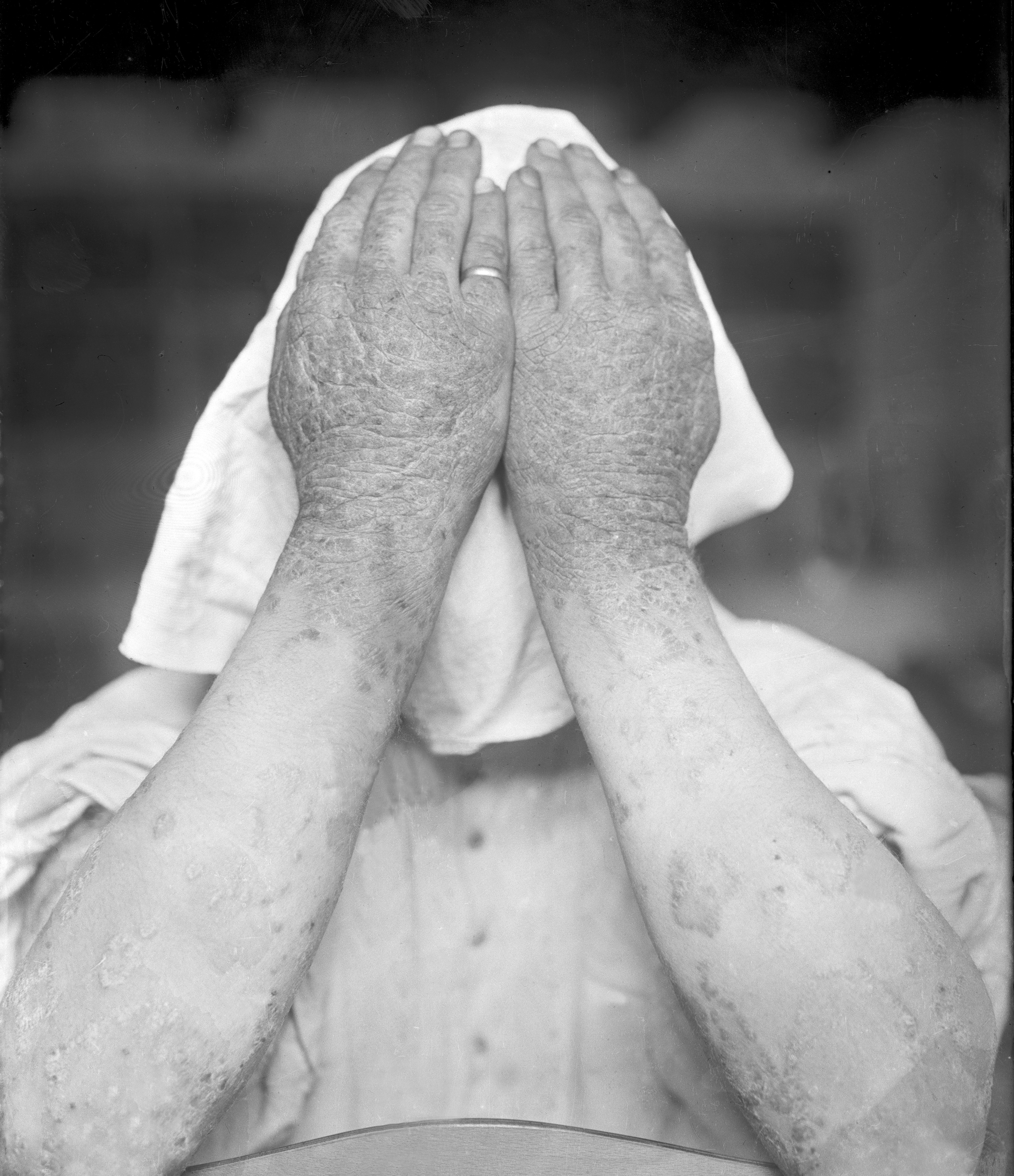
Woman with psoriasis, Subcarpathian Ruthenia, Koločava, 1930
author of the photography: Vojtěch Suk
published with the permission of the Archive of the Institute of Anthropology
(Faculty of Science of the Masaryk University in Brno)
Jiří Žák - Incantation called decolonisation
Let us start with one possible way: „Perhaps we can take the word – colonisation – unpack it and see what it really means...“ said Gabi Ngcobo, curator of the 10th Berlin Biennale, in an interview for Artyčok TV in 2018. According to the historian Alexander Kiossev real colonisation has several recurring characteristics despite the difference and variability of various examples. We may mention for example military occupations, the settlement of conquerors, establishing control over local people, administrative control of the population based on ethnic or cultural differences between the ruling and the ruled or the establishment of cultural hegemony. There are undoubtedly more forms of colonisation, for instance external, internal or settler colonialism. However, at present colonisation often looks different compared to the period from the 16th century up to the mid-20th century, which is the era of modern colonialism, which caused the rise of the European dominance in the world. The extent of this dominance is shown by the fact that only five countries in the world escaped being colonised by Europe during that historical period.
Nowadays, in the postcolonial period, the former colonial powers often exert political and economic power rather than military power, although we are currently witnessing the tragic war in Ukraine led by Russian imperialism. A similar example is the recent war waged by the US in the Middle East under the banner of fighting terrorism. Other powerful players, whether they are states or multinational corporations, prefer to use the power of big capital in today's type of colonization process. This process is known also under the term of neocolonialism. The term was coined in 1965 by the Ghanaian politician Kwame Nkrumah in his book Neo-Colonialism: The Last Stage of Imperialism.
In this sense we are all – figurativelly but also practically – being colonised by a great capital regardless of our nationality, ethnicity or class affiliation. Both economic and historical colonisation, which influenced the present order of the world, are actually physically manifested in our lived reality. In this sense, then, the decolonisation process, which can reverse the consequences of colonisation oppression of marginalised population, has a similarly tangible meaning. It is an emancipatory effort, which has the potential to change people´s lives for the better (sometimes on the material level - for instance European museums returning stolen artifacts back to the African continent, other times on a symbolic level).
The intensity with which art institutions engage in issues of decolonisation and global inequalities is growing continuously. This is happening regardless of how hard different crises are knocking on the doors of western companies, e.g. political, economical or refugee crisis, or the worst one – the climate crisis. The concurrence of crises makes us think about the current setting of human societies across the planet, which also entails questions about the form, functioning and history of the post-colonial world. No wonder discussions related to these issues have recently culminated also on the institutional level (both artistic and academic) and a great number of artists feel the need to deal with them.
Different approaches were also visible in curators´ conceptions of significant world exhibitions of contemporary art and this year (2022) many of them dealt with different issues of colonisation. Starting with documenta 15 in Kassel (whose reverberations will still resonate), over to the less (but also) discussed 12th Berlin Biennale or Manifesto 14 in Pristina in Kosovo, and finally, the second Biennale Matter of Art in Prague.
We regard the interest of artists across Europe in decolonisation topics as positive and we can only hope that this interest will somehow reach further beyond the walls of galleries and draw the attention of the general public who does not seem to be really concerned with those issues. But the art scene alone is often, despite its declared activities dealing with decolonisation, a merely passive recipient satisfied with cosmetic gestures. This is reflected in the above-mentioned interview on Artyčok.TV with the curator Gabi Ngcobo in 2018 who responded with a certain amount of frustration to the more or less verbalised request of the privileged white western art community to tell them what is “the correct way”, since she is of South African origin. In other words how to curate significant art shows beyond the principles of Eurocentrism and anti-racially: “As Toni Morrison said, colonisation also has to do with repression and racism. We keep explaining, which delays us, because all the time we have to be in this postion where we have to explain to other people who have the privilege of not having to know and so the 10th Berlin Biennale is not going to be this platform of explaining again and again, because for hundreds of years people have been writing books and trying to explain the colonial conditions and the post-colonial conditions, and many subjectivities that have been formed by these historical conditions. [… ] I´m tired of sitting in symposiums feeling like there is a kind of déja-vu always because all the time you end up explaining why we feel the way we feel. And I think everybody must go there and do the work that needs to be done. I´m not hired to do this work here.”
Man with pathology, Subcarpathian Ruthenia, undated
author of the photography: Vojtěch Suk
published with the permission of the Archives of the Institute of Anthropology
(Faculty of Science of the Masaryk University in Brno)
Modes of Decolonisation
Decolonisation as an emancipatory process has its practical impact in politics. Beyond the context connected with colonialism what we mean by decolonisation is the process of emancipation and negation of all types of oppression, for example racism, nationalism, sexism, homophoby or transphoby and others. The figurative meaning of decolonisation, its metaphorical reading, which on a symbolic level negates oppression, is the most common key through which art relates to a multitude of topics. Naturally, art is not the only field where we can come across the metaphor of decolonisation. It has found its place also in struggles for social justice of all kinds. However, this depends once again on the country and context. In former European colonial states with an ethnically diverse population this will be, of course, more apparent than in countries like the Czech republic.
We can decolonise history, mind, language, human relationships, sexuality, gender, public institutions or science. We speak about decolonising the production of knowledge, decolonisation of attention, sleep, communication or access to information. As we can see, thinking through the decolonisation discourse brings a significant imaginative charge that helps to reveal or talk about different types of oppression. The question is whether decolonisation metaphors have weakened or strengthened its political charge. Whether decolonisation as a metaphor broadens our social imagination, which may also manifest itself on a practical political level or whether its spreading outside the original contexts does not lead to depletion and trivialisation. Whether it does not get beyond the above-mentioned edge where it becomes a buzzword, an incantation lacking former contexts. For example academicians K. Wayne Yang and Eve Tuck claim that decolonisation is not a metaphor and that the term cannot be used for other processes through which we wish to do something to improve our society in the field of social justice. They are particularly critical of the appeal of decolonisation in education, where decolonisation serves as an umbrella that covers the fights against all kinds of oppression (e.g. racism, sexism, heteronormativity, ableism, but also performance oriented capitalism etc.) They believe it is difficult to merge those fields and claim this would lead to the loss of opportunities to engage in these issues meaningfully.
Decolonisation has no synonym, say Yang and Tuck, therefore it cannot be replaced by other processes. Their text is anchored in the materiality of what colonisation means practically. According to them metaphorical reading of decolonisation, the so-called colonial equivocation or ambiguity (colonial equivocation). This criticism is undoubtedly legitimate, above all in places where indigenous peoples are still fighting to claim land that was stolen from them (USA, Canada, Scandinavia, countries in Latin America). However, despite the emphasis on the materiality of decolonisation, Yang and Tuck, slightly paradoxically hyper-focus on language. I believe that the situation is even more unclear in the field of art, where imaginative and metaphorical thinking are typical. I tend to believe that the decolonisation discourse (including metaphorical reading) is enriching and we may find art institutions which contribute to its development through undoubtedly good practice which is anchored to a certain extent in the materiality of decolonisation and avoids boundlessness, e.g. Gallery SAVVY Contemporary in Berlin.
However, it is important to realise that the political impact of art has its limits. A general vice of the art world is that it somewhat overestimates its own influence. In other words, to decolonise art does not necessarily mean to change but rather to show. Works of art can thus help us to understand or simply, but all the more importantly, emotionally connect to problems in our history and also our present. That in itself is quite enough. There is another reason why we need such artworks in our lives. There exists another aspect of the extension of the original meaning of decolonisation beyond the field of art that requires our caution. In recent years, we have been able to see how conservative politicians make use of intellectual instruments of the decolonisation discourse and the so-called identity politics in a regressive manner, with emphasis on ethnocentrical nationalism against the liberal ethos of Western democracies.
Let´s forget now the problematic nature of this type of liberalism, which Western states use in the often used term „liberal democracy“. As Achille Mbembe said, the history of modern democracies is the history of two faces, two bodies and called them solar body and nocturnal body. The solar body is presented as a peaceloving and non-violent one, supervised by the police, while the nocturnal body is inextricably linked with the colonial, imperial and slavery legacies of Western democracies the same as with the control, regulation and repression of certain groups of their own population. Thus, liberalism proclaimed by the West, could historically originate due to the long-term accumulation of colonial wealth and was established during a short period of development of the welfare state in the 1950s and 60s after World War II.
The reason why I am writing about this in a text accompanying art videos is that I feel it necessary not to see decolonisation as a mere cultural topic, but a living political process which has its progressive as well as regressive orientation. The culturalization of politics is one of the consequences of culture wars, which are skillfully used by right-wing and ultra-right-wing forces in Europe. Gáspár Miklós Tamás, a Hungarian marxist philosopher, politician and publicist, came with the term post-fascism in relation to the advent of conservative authoritarian politics in Europe. He also claims that European liberal (center-right and center-left) politics, which lays emphasis (or rather laid emphasis, because after the so-called refugee crisis there came a general shift to the right) on the so-called multiculturalism cannot adequately stand up to the post-fascist forces due to the focus on those topics. This situation is described from a different point of view also by the Polish sociologist and theoretician Jan Sowa, who, within the framework of the international research project called Perverse Decolonization, focused on criticism of the post-colonial theory and above all on identity politics. Identity politics that originally represented an emancipatory project were taken over by new types of nationalisms and conservative-minded elites e.g. in Poland or Hungary. Jan Sowa says: “…the logic of Polish rightists is that they deny women and gays their rights claiming that those rights are not a part of “our cultural traditions” and therefore all efforts to introduce them in Poland are a part of the process of colonising Polish culture by the European Union, which is considered by Polish rightists as a colonial project.”
We can ask, somewhat provocatively, together with supporters of Orbán in Hungary or the Law and Justice party in Poland whether we are really being colonized by the Western theoretical discourse (they would probably speak about values). This is perhaps an absurd statement, but it is good to take it seriously in order to better understand the current conservative and authoritarian tendencies in Europe. The term self-colonization might also be stimulating. Alexander Kiossev uses the term when speaking about hegemony without domination, which is the result of the influence of European colonial centers on their peripheries and semi-peripheries, e.g. Eastern part of Europe. Art may help us place decolonisation thoughts into the space we live in, so that we do not become mere passive recipients of theories which are anchored in a different political context.
Methods of Decolonisation
Works of art might play a positive role in finding and exploring decolonisation topics in Czech, Slovak and Eastern European history in general, in galeries as well as outside. That is why educational and didactic work with decolonisation in our country and situating decolonisation in local conditions is so important. This may show us its own validity in relation to our past and present. In order to be able to sweep around of our own front door as well as in our whole house, we must make use of all available tools. We must learn to use them and understand where they are useful. As we shall see in works by different artists, decolonisation is exactly one of those tools. But cleaning our house and getting rid of layers of dust that covered historical memory and traumas is not our final goal. Our goal is to change ourselves.
Jan Rousek - Empty Locations / And what about you, Mireček?
The video Empty Locations / And what about you, Mireček? by the filmmaker Jan Rousek, which was created with the support of Artyčok.TV, is based on his doctoral thesis at FAMU entitled Czechoslovak Colonial Film. It is based on the assumption that colonialism also applies to countries that did not explicitly participate in colonialism, but historically benefited from it. When speaking about the theme of his thesis Jan Rousek said: “Czechoslovak film adopted from the West the colonial stereotype of the black man with a limited range of roles – a black man in Western films was seen for a long period of time in particular as a slave, criminal, native primitive, entertainer or erotomaniac. This stereotype was supported by the character of the cinema industry since blacks did not get many opportunities to form a discourse of themselves. Czechoslovak cinematography adopted this model and films from the period of the first republic show blacks, for example, as servants or barbarians, or in roles emphasising their bodies, e.g. the role of a boxer in the film „Pudr a benzín“ starring Voskovec and Werich, 1931. Socialist cinema later brought a certain ambivalence to the history of depicting the black man – blacks begin to appear in feature films in more dignified roles of students, workers or not too specified characters. The colonial mindset ceases to be explicit, it becomes the clearest and is often connected with the context of the political and commercial interests of the Eastern Bloc (e.g. the film Křik (Scream) by Jaromil Jireš or the poet series by Dušan Klein).
The title of Jan Rousek´s work refers to the text by the theoretician Homi K. Bhabha entitled The Location of Culture. He interprets the location of culture „... as a space where the coloniser and the colonized meet on an abstract and practical level. These are, for example, racial stereotypes that appear in culture and art, but also in interpersonal communication or power structures”.
The author considers the video Empty Locations / And what about you, Mireček? as a part of the decolonisation process within the framework of the history of Czechoslovak cinema. His conceptual method of work is based on the deconstruction and re-interpretation of original scenes from Czechoslovak films, e.g. Křik (directed by Jaromil Jireš, 1963), Jak básníci přicházejí o iluze (directed by Dušan Klein, 1984) and Dědictví aneb Kurvahošigutntag (directed by Věra Chytilová, 1992). All these films feature stereotyped black characters. Jan Rousek says that „... the selected films represent to a great degree the approach of Czechoslovak cinematography towards unfamiliar characters, in this case towards a black who always appears only in a supporting role and is often ridiculed because of being different, because of the different colour of his skin. The character of a black man usually serves as a kind of mirror reflecting the main character who is always played by a white.“
In practice, Rousek re-filmed the given scenes shot by shot in the original locations. But in his film those locations are empty, without actors and in an unclear space-time. We can hear the original soundtrack of the film but the moments when characters of black descent speak, their lines are cut out and replaced with subtitles. The absence of problem moments serves to emphasize the colonial relationships in the story in each film. The absurdity and essentialist bias of the dialogues is made visible thanks to the disruption of the original film experience. Classical films, which are repeated ad infinitum on TV, are already part of the collective cultural memory. They are imprinted in this memory naturally with all the problem places and tropes. It makes sense to become aware of the tropes and look at them from a new, critical angle, because it increases our receptivity and sensitivity which are a necessary prerequisite for changing our behavior outside the fictional space of the film, within our everyday life.
Tomáš Vobořil - Reverse Ethnography of Carpathian Ruthenia
The artist Tomáš Vobořil deals with colonial aspects of the civilizing mission that the Czechoslovak state carried out in Transcarpathia between 1919-1938. The Czechoslovak state was also represented by anthropologists and ethnographers, who could fulfil themselves professionally thanks to the newly acquired territories in the east. The artist lays much greater emphasis on the affective aspect of art. Originally this work was an audio-visual installation accompanied by photographs from the archive of the anthropologist Vojtěch Suk.
Suk´s archive was used by Vobořil to tell the story of Czechoslovak activities in Subcarpathian Ruthenia in a new way. The alibi of the Czechoslovaks, which historically exempted them from responsibility for the era of European colonialism, is seriously undermined if we take a closer look at some episodes of Czechoslovak history and if we revise the attitude that Czechoslovak citizens took towards colonies and their people and what orientalizing ideas they created. This attitude certainly does not apply only to non-European people and cultures, but also within Europe itself, as Vobořil demonstrates in his work.
Vobořil also suggests that in the process of creating orientalizing ideas art may be complicit in the rationalizing views of a white scientist. This motif is personalised in the character of the writer Ivan Olbracht, who is mentioned in the video and who despite his leftism is indirectly complicit in creating a fantasmatic romantic version of Subcarpathian Ruthenia. This romantic approach can never show the real life of people living in this region because in fact it denies them inner complexity and demeans them to the positions of pure and simple souls living in a more primitive (and therefore more authentic) way. Finally, they seem to be here so that the civilized Czechoslovak realizes his own superiority and he is touched by their simplicity, which reminds him of where he came from.
What I find important in Vobořil´s work is the fact that he deals with how we make up our Others. Nobody is interested in the testimony of the Ruthenians themselves. As the author says in the narrator's voice: you hear my voice, but not my words. From the viewpoint of contemporary context we may say, with a bit of exaggeration, that if the Czechoslovaks did not have their Ruthenians, their own Others, they would have to invent them. However, stereotypisation and essencialisation are even today common starting points in the interaction with minorities. This is also why we need works like Reverse Ethnography of Subcarpatian Ruthenia.
Ondřej Doskočil - Uprooted Black Metal as a form of Language
In the introductory part of this text I mentioned the return of artifacts stolen by European countries to their original homes, which is an example of decolonisation with a symbolic but also material meaning. The history and origin of art works exhibited in European museums is a topic which comes to our minds when we looking at the work of the artist Ondřej Doskočil. Apart from post-colonial issues, the specific context of the black metal subculture, with which the author has personal experience, is also important for this work. It is represented here by means of a specific voiceover typical of the metal subgenre and is also related to it through the texts embedded into the image. In the video, which was made with the support of Artyčok, we find ourselves in a London museum full of sculptures and artifacts from all over the world.
The exhibits are imprisoned in glass cages or attached to walls and categorized according to age and geographical origin. We are looking at them through the lens of a mobile phone held by a young man with a veiled face. The most important is the narrator and the sound of his voice; the guttural expression known to all black metal fans becomes an independent entity in the darkened and silent museum. The video may be interpreted in different ways. Is it the voice of a man talking with his head bowed to ancient statues resembling mythological monsters and gods? Or on the contrary, is it the voice of these artifacts, ancient beings forcibly displaced from their homes?
The metal growl and scream alienates us from otherwise familiar views of non-European works of art. It revives and conveys their trauma to us, even though we do not understand their language. In fact, it helps us realize that we have never really understood those cultures despite having imperial museums full of artifacts and that their cataloging within the museum infrastructure is rather an example of Eurocentric arrogance. Through untranslatable speech, Doskočil's work also subversively thematizes the use (and overuse) of the voiceover medium in contemporary art. And what he is telling us might be that we don't have the right or the capacity to understand everything.
Finally, I would like to quote the curator Gabi Ngcobo once more:
“…it is similar to the term decolonisation, which every other person, institution and text are writing about. And for me what becomes disturbing really is the idea that decolonisation is something that you go to do at work. It´s not like something that starts with the Self , you know, but it´s like a nine-to-five kind of operation, and that´s why we are not going to win because decolonisation is such a messy process, and we must start with the Self and how we describe things.“
Authors and Collaborators
Curator: Jiří Žák (*1989, Zlín) is an artist and a member of the editorial board of Artyčok.tv. He graduated from the Academy of Fine Arts in Prague. He mainly works with moving image and video installations, in which the research component is usually combined with a poetic line and form of narration. He is interested in the identity of post-communist countries and its deconstruction through non-Western perspectives. Žák presented his work in a number of independent galleries and institutions in the Czech Republic and abroad, for example at the Warsaw Biennial (2018), the Matter of Art Biennial in Prague (2020) or the Kyiv Biennial (2021). In 2015, he became a laureate of the EXIT award and in 2020 co-holder of the Jindřich Chalupecký Award.
Translation of the text: Zuzana Rousová
Editors: Tereza Špinková, Janek Rous