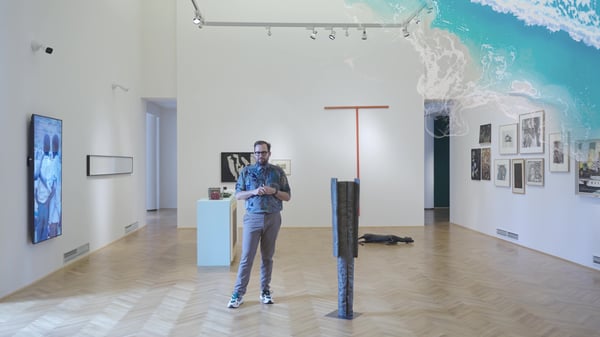
*Jennifer in Paradise is the name of the first picture ever to be photoshopped. Taken by John Knoll, co-creator – along with his brother Thomas – of the now ubiquitous software, it depicts his girlfriend at Bora Bora, Tahiti. The image was digitalized by Kodak in 1987 and supplied as demonstration of the program’s abilities with its early versions. Though initially widespread, it has since become harder to track down. Constant Dullaart’s work can be considered as an early example of archeology of the internet however tightly connected with anthropological approach.
Meanwhile John Knoll’s meme image was created on a promise of the utopian paradise of freedom of self determination, Constant’s Dullaart Jennifer becomes a meme again, but this time as a story of the nostalgia of that paradise lost. What constitutes this nostalgia is precisely the naiveté of the former Knoll’s attempt, the not-knowing that what we associate with expression of freedom is only means of oppression. The foolish freedom of the 1990s embedded in cigarettes, consumerism, combustion engines and images.
Jennifer in Paradise embodies not only the belief of image manipulation as an extension of human creativity and consequently freedom of expression, having as its roots so significantly the special movie effects industry. As its subject it also goes together with the best intentions of selling your own wife’s naked body as an advertisement for your designed product. Isn’t that almost the truest confession for commodity, the almost literally sexual connection between private life and business?
As Jennifer Knoll herself says: ”The beauty of the internet is that people can take things, and do what they want with them, to project what they want or feel.”
Hadn’t the early internet boom started at the very core with the same belief as neoliberalism – with the idea that the freedom of self determination will lead society towards overall happiness?
And what happens to it? Now we have the very tool of surveillance and proactive consumerism. Now we all know it is bad, some still have hopes, but almost no one knows what to do with it. The paradise is not anymore the freedom but oblivion. Like all those people cutting the boredom and exhaustion of their disappearing middle class lives with short travels to the Tahiti-like worlds of their tiny screens. “Prepare to cobble together a financial living doing a mishmash of random semi-skilled things: massaging, lawn-mowing, and babysitting (…) And here’s the clincher: The only thing that is going to make any of this tolerable is that you have uninterrupted high-quality access to smoking hot Wi-Fi.” (Douglas Coupland – BOHEMIA = UTOPIA)
That’s why look backwards with emotions, to that era when we at least didn’t know how exploited, oppressed and monitored we are, and we got well paid for it. Now we know and we cannot even enjoy it anymore. Just as Constant Dullaart wrote in his letter to Jennifer Knoll: “Sometimes, when I am anxious about the future of our surveilled, computer-mediated world, when I worry about cultural imperialism and the politics behind software design, I imagine myself traveling back in time. Just like the Terminator, to that important moment in technological world history, there on the beach in Bora Bora. And just sit there with you, watching the tide roll away.”
Michal Novotný