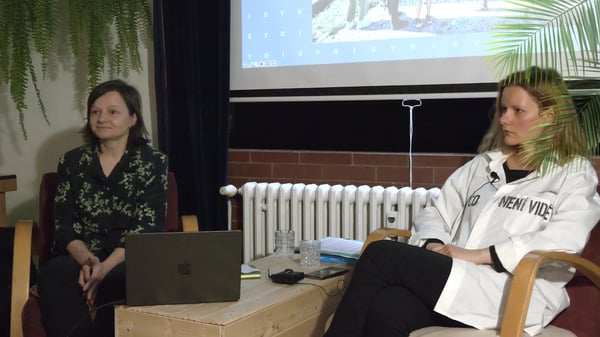
Ladislava Gažiová is a painter, curator and activist from Slovakia and has been living in Prague for some years. She studied painting at the Academy of Fine Arts under the guidance of Vladimír Skrepl and later at the Academy of Arts, Architecture and Design in Prague in the Studio of Jiří David. In 2008, after graduating from UMPRUM, she also won the Critics' Prize for Young Painting.
Her early work is characterized by the inspiration of graffiti, using of stencils and sprays, and work with social topics. In recent years, however, Gažiová has been focusing on curatorial work, in which social themes, particularly the topic of the Roma minority, are at the heart of her work.
In 2016, together with Ondřej Chrobák, she prepared an exhibition called Džas Bare Dromeha (“We Go a Long Way”) in the Prague gallery Nevan Contempo. Using both artistic and documentary pieces from the archives of the Brno Museum of Roma Culture, the curators made an exhibition reminiscent of classical national museums. The result was a chronological exhibition of Romani art – or, more precisely, the art created by the Roma – which broke common art history categorizing of art made by the Roma into the Art Brut category. A year later Gažiová, in cooperation with tranzit.cz, organized a discussion called Romafuturismo. In their contributions, the invited guests answered the question of whether the Roma could be inspired by the afrofuturistic cultural movement and arrive at emancipation through culture and art.
The exhibition concept of Drás Bare Dromeha was elaborated by Gažiová to a larger scale, and in 2017 it was presented in the Moravian Gallery. The Universe is Black, O kosmos hino kalo exhibition once again used the archives of the Museum of Roma Culture, but it was largely made up of contemporary art made during the Art Symposium of Roma artists from Central and Eastern Europe, also organized by Gažiová. The very name of the exhibition referred to an afrofuturistic hope in the space diaspora, and the idea of the Romafuturismo was a focal point for both the project’s author, and the artists participating in the symposium.
The last major project of Ladislava Gažiová is the Romafuturismo Library, which was opened in 2018 in Prague's Transit. It gathers literary works of European Roma, but also art pieces discussing oppression and discrimination against other groups. The following year, the library moved to the housing estate Chánov in Most, and was renamed Josef Serinek's Library for greater accessibility.
However, the Romafuturismo library continues to serve as a platform for a cultural program involving the Roma ethnicity.
Natálie Drtinová