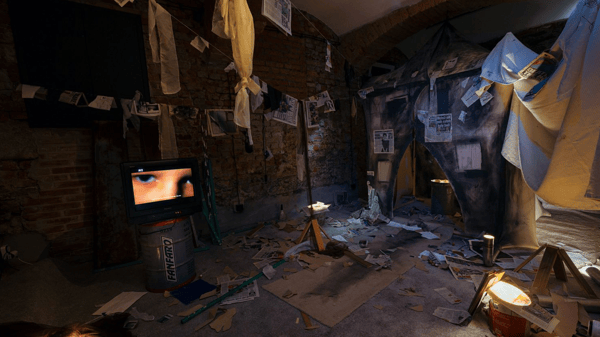
BEHIND THE SPINES OF BOOKS I'VE NEVER READ

The exhibition presents the students of The School of Painting 2, at the Academy of Fine Arts, led by Vladimir Skrepl and Jiří Kovanda. Installations, videos, paintings, and texts created specifically for the space of the Hvezda folly, without necessarily representing the typical position in the work of their authors. 


artistsDavid Landa, Štěpánka Sigmundová, Jan Brož, Josefína Nesvadbová, Petra Haplová, Adéla Součková, Ondřej Petrlík, Kateřina Zochová, Pavel Sterec, Robert Pawliczek, Marek Číhal, Matyáš Chochola, Nikola Brabcová, Viktorie Valocká, Tereza Greschnerová, Lucia Sceranková, Tomáš Kofroň, Hana Garová, Vladimír Houdek, Jana Vojnárová, Barbora Kleinhamplová, Juliana Höschlová
curatorsLenka Vítková
placeLetohrádek Hvězda
tags
castLenka Vítková
cameraJan Vidlička
soundJan Vidlička
editingJan Vidlička
interviewJan Vidlička
translationEva Maršíková
published27. 7. 2011
languageEnglish / Česky
embedlink icon
arrow down
related
BEHIND THE SPINES OF BOOKS I'VE NEVER READ
By imitating the gestures of objects and things that are already in the gallery space; by slowing down, pausing, lingering, alighting, unwinding... through these actions we can escape the entrenched trajectories we found ourselves on in the morning, rid ourselves momentarily of what we have already become, so that we can lose ourselves in thoughts of what we might be.
The concept of the exhibition is based on the ideological convergence of the work of Catherine Radosa and Jaroslav Varga, which consists in revealing the physical and symbolic traces of the past. Both artists examine these relics of bygone times and eras from the perspective of collective memory and the mechanisms of its storage. A vacant lot is an empty space, a gap left by a past situation that can be filled again. The installation Colonne / Révolution captures the constant cycle of the monument in a triple projection. The period of the revolutionary Paris Commune is still a problematic period in France, similar to the period of socialism in our country: it has been and continues to be reinterpreted, tabooed, or marginalized.