installation 357 výsledků

installation

"The installation of the exhibitions will be entrusted to the artists. I see it as a second choice besides the fact that artists teach. "
In the course of the 1990s Jiří Příhoda experimented with video-projections and became known as the first artist on the Czech art scene expressing himself through sculptural-architectural transformations of exhibition spaces.
We hope that by combining a number of various artworks and projects, hints of possibility will begin to emerge, from which a way out of today’s situation, that is oppressive on many levels, can slowly be carved. When it seems there is nowhere to run, we can try running into the future – and from there, start to reshape the present.
In her work, Cornaro uses found objects imbued with symbolic potential or emotional value, which she presents in different types of display and media to reveal the subtle shifts of meaning provoked by processes of reproduction and translation.
Borrowed from domestic, decorative or functional contexts, these artefacts are often linked to Western culture as a means of power, their combination and arrangement in the artist’s work invites spectators to question the relationships between systems of representation and our understanding of the world.
At present Jan Boháč is a doctoral student in the studio of sculpture led by Edith Jeřábková and Dominik Lang at the Academy of Arts, Architecture and Design in Prague. His work deals with topics related to communication, speach, messages and possibilities of understanding,which have been present in his work for a long time and are closely related to his job of an emergency call handler.
The artistic team is meeting in the underground space to explore the psychoacoustic attributes of sound, and the physical limits and resonance properties of the human body; the use of music during rituals and religious ceremonies, and the possibility of connecting occultism, music, and sound as a means of communication, meditation and spiritual work.
Artistic practice of Jindřiška Jabůrková is interdisciplinary, includes installation, creation of objects, sometimes photography and video or performance. Her fascination is with the processes of transformation of matter, whether of human or natural origin. She is interested in the relationship between the human subject and nature, the relationship of man to the material world, sometimes deepened by the spiritual thoughts.
The 35m2 gallery presents two monumental works, two different environments. Both spaces are based on the same material context, the same material language. Yet each of these realizations appeals to different senses using different techniques and materials. These new spatial configurations, structures, and installations, which shape our spatial orientation and navigation through space, primarily appeal to our basic senses, our sensory memory, and our individual/private memory.
"Slibuji" is an art project conceived by Sráč Sam. The exhibition is organized by the tranzit.cz initiative in collaboration with the SVĚTOVA 1 gallery. The installation of pillows, concrete blocks, and plates with texts presents art as a story that focuses on ordinary things and everyday relationships.
By dissolving boundaries, cultural constructs, nationalities, taxonomies, and skin, we transform old paradigms of human/non-human, toxicity/purity, and living/dead into permanent cooperation with the foreign. After all, all boundaries are only transitional spaces where matter morphs and theorizes a new existence.
The plumbing work you did here is disastrous - not stupid, not sloppy - just absolutely disastrous.
The lecture by the internationally known Ukrainian artist Nikita Kadan at the Academy of Fine Arts was introduced and accompanied by a debate with the Russianist and semiotician Tomáš Glanc. Kadan lives and works in Kiev. He works with various media, including installation, sculpture, painting and collage.
The exhibition becomes an environment of matter itself, not only of space, but also of individual objects that we glimpse as they rest. Both authors complement each other perfectly in their work. Neither is dominant, neither is lost. Interest arises in ordinary, insignificant things that are materially interconnected. The material is important here. It forms the main essence of the entire content of the exhibition.
In our jargon, the somatic exhibition was called svät. Svät took place at the turning point of time and space, embedded in and at the same time separated from the world ruled by time, space, meaning, and significance. Entering the exhibition was a ritualized transition between the world and the svät, between two different dimensions of the same reality. Pilgrims were torn from their everyday lives and thrown into a sacred space-time, where their derailed minds were exposed to events that were unheard of outside.
Seventy eight artists were introduced by a reproduction of their work and a short text. This team aimed at confronting the artists and creating a parallel to work of artists who could exhibit their work officially. However, there were different limiting factors.
In their introductory text Jana and Jiří Ševčík wrote: “There was a collapse of alternatives, a loss of interest and only a marginal position remained. Seen from inside, the problem East-West still exists. For the West eastern art is interesting only if it is compatible production or produce of victims.
In her exhibition designs she lays emphasis on simplicity, moderation and compactness. They do not hesitate to include also striking or unsettling elements. However, according to them it is essential that the design of the exhibition does not overpower or overshadow the exhibits but it must become their partner. They also believe that the installation may contribute to the interpretation of the displayed art works. It is equally important for them that the exhibition design is created in a mutual dialogue between all the people involved.
The film shows the house of Čestmír Suška and Naďa Rawová, where one of the first unofficial symposiums took place in July 1980 and which was soon followed by others (Netvořice 81, Mutějovice 83 and others). This led to a series of Confrontations (1984–1987) – exhibitions of the youngest generation of artists.
As we find ourselves in times that have extensive socio-political implications, the exhibition thematizes the insecurity, the suspicion and post-factuality gradually digging into our lives more and more. The many ambivalent mechanisms trough which we cope with this uncertainty and multiplicity of artistic processes (either politically-critical, or completely non-factual and sensual, scientific or even speculative) of the abandonment of what is considered “real” or “rational” take their forms in the interconnected realms of the technological, the natural, the mystical, the symbolical.
Dominik Lang has been involved in exhibition design for a long time. However, unlike other artists, his approach differs in the degree to which he emphasizes the creative aspects of the profession. The result often oscillates between exhibition design and autonomous installation while he himself admits that he deliberately violates this boundary. For this reason, he prefers the term "author of the exhibition's artistic design" or "author of the spatial design".
In July 1981, when Sozanský created his first work in Most, Jiří Putta came to take photographs at the place and the Film and TV School graduate Michal Baumbruck together with the cameraman František Brabec recorded on film there. The resulting film depicts not only the sculptures but also performances with actors which Sozanský staged for the film purposes. The film was called Evacuation and it was shown just few times during the 1980s at meetings of the artist's friends.
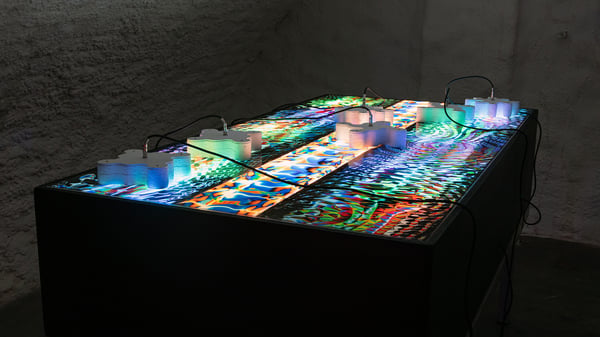
The international exhibition Beyond the Sound presents a contemporary approach to the specific and lively artistic field of sound art. Sound is presented not as an independent aesthetic form, but as a medium used to explore and reveal phenomena that are often unrecognisable to the eye.
The tools brought about by technological progress and the network society create an alternative way of establishing communication and building new relationships of interpersonal and interspecies cooperation. However, we suggest listening to the sounds of practices associated with community: rituality, coexistence with the world of plants, animals, and fungi, dissolving the hypersensitivity of the individual "I" in favor of the collective "we," sensitivity to the stories and perspectives of plants and animals, oil, or clouds.
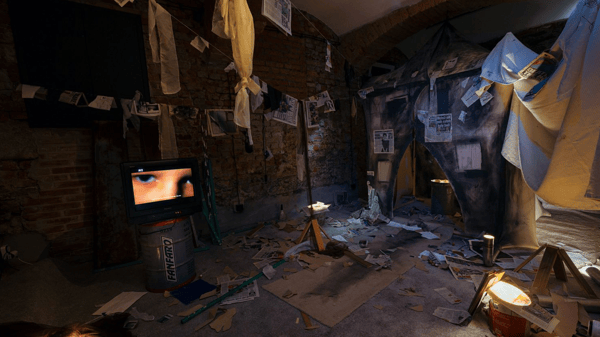
In her project DELTA Plan, Daniela Ponomarevová constructs and subsequently deconstructs a post-apocalyptic story responding to the current state of civilization. At the heart of this dystopian narrative is the presumed demise of Earth, which has become nothing more than a testing ground, a temporary refuge for humanity, which is inevitably awaiting destruction by a giant asteroid. The author opens up this fictional future scenario through a series of objects installed in the immersive environment of a supposed laboratory and a text-and-image document.
Throughout his life, Chalupecký promoted and defended new artistic trends and was interested in general questions of art, especially the meaning of art in modern society. He was a defender of art in connection with life. In today's terms, we could perhaps use the term activist or engaged art. He did not believe in the purely aesthetic function of art and culture in general.
The Grey Brick 34/1993 exhibition, included works by 34 artists born between 1941 and 1964 chosen by the jury whose members were Jana Geržová, Mahulena Nešlehová and Petr Nedoma. This successful summer exhibition took place in the gallery U Bílého jednorožce (At the White Unicorn) in the square in Klatovy and also in the Chateau Klenová and its park.
The objects are metal structures of various shapes woven with yarn, which the artists hand-dyed using different types of tea. They use weaving or scrubbing techniques, which, incidentally, most of us know primarily as half-forgotten craft practices. Their focus corresponds to the increased interest of contemporary artists in materials and technologies such as textiles, ceramics, and glass, which have long been neglected. Julia and Barbora, however, approach textiles without any obvious retro nostalgia, which could be tempting.
Music [under your feet] is the first exhibition of Rolf Julius in the Czech Republic. However, his traces can be found elsewhere. The archive of Jiří Valoch contains several works that Julius dedicated to Jiří Valoch and Milan Knížák.
Welcome to Oikos. Oikos is a house that breathes and hums. Branches grow through it, which, together with its inhabitants, keep the house running. Giants, bald mermaids, shape-shifters, crows with anthracite cloaks, Johan, inseparable twins, Erlenah, who locks the door with a chain, Ama, who knows all kinds of medicinal plants, Pragma, with problems well hidden under the carpet, Tarván with two fish tails, but also Diamon, a monster who takes on the form of our worst anxieties and fears. Alma, the author of this exhibition and book, also lives there.
Why did Jarmila B. disappear? And why should we be interested in it? Jarmila B. was a ceramist, who did not leave any interesting art work behind, only many rather messed up projects and involuntary, unexceptional compromises. What really matters is what she did not create – her radical visions, which are captured in her diaries (and which bear a striking resemblance to projects of some radical conceptual artists and performances of contemporary artists). In a way she was ahead of her time.
The choir of voices that is at times consonant and at times dissonant seeks know-how for undermining the bold narratives that revolve around heroic, autonomous figures who exert extraordinary power to overcome obstacles. Where does the saying about the events which make us stronger unless they kill us come from, and what is the actual meaning of the word “stronger” anyway?