object 256 results

object

The exhibition is not a historical cross-section of Ester Krumbachová's work (although it does reflect it), but rather an extensive network of original material, numerous texts, images, and artifacts that Krumbachová dealt with and surrounded herself with throughout her life. It primarily presents Ester Krumbachová's archive/estate in thematically interconnected blocks, revealing her thinking about costume design, particularly the role of detail and the use of color, the interconnection of meaning, artistic form, and the overall atmosphere of a film, her work with text that copies spoken language and folk storytelling rather than high literary style, her relationship to magic, realism, subjectivity, male and female polarity, and the hierarchy of species and social and professional positions.
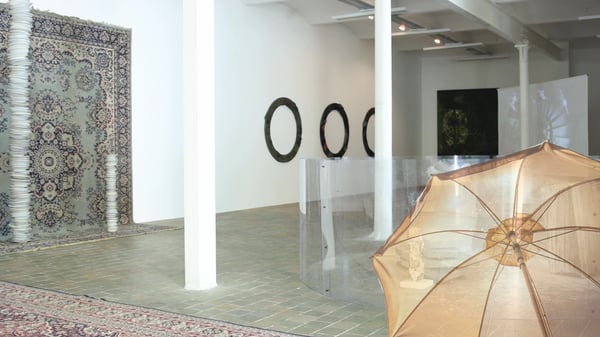
In her work, Cornaro uses found objects imbued with symbolic potential or emotional value, which she presents in different types of display and media to reveal the subtle shifts of meaning provoked by processes of reproduction and translation.
Borrowed from domestic, decorative or functional contexts, these artefacts are often linked to Western culture as a means of power, their combination and arrangement in the artist’s work invites spectators to question the relationships between systems of representation and our understanding of the world.
The environmental aspect of Hussite thinking is particularly noteworthy. Like today's generations, the Hussites lived with the prospect of dramatic changes in the world (or even its end, as it was known at the time) either approaching or already underway. As a result, their radically revolutionary agenda also carried with it a significant dimension of what today could be described by the popular term "degrowth."
In today's social climate, the line between folk horror and urban myths is as thin and winding as the old streets of Prague. In our most recent historical memory, we have seen them re-enchanted by the decline in tourism and repopulated by lonely figures of stray night walkers and people excluded from society. The age-old idea of art as a mirror that allows us to see lived reality from a new perspective comes to mind, or perhaps a distorted glass surface can deform shapes and create illusions.
The concept of the exhibition stems from a dialogue between historical works presented in 1993 by a group of emerging artists from Ústí nad Labem at two editions of the exhibition NARUŠENÁ ROVNOVÁHA (DISTURBED BALANCE) at the Municipal House in Prague and the Emil Filla Gallery in Ústí nad Labem, and completely new projects by younger artists born in the 1980s, who had the opportunity to experience the atmosphere of Ústí nad Labem, especially during their university studies, and this experience led them to develop their authentic creative attitudes.
The artistic team is meeting in the underground space to explore the psychoacoustic attributes of sound, and the physical limits and resonance properties of the human body; the use of music during rituals and religious ceremonies, and the possibility of connecting occultism, music, and sound as a means of communication, meditation and spiritual work.
The output of that research varies from works in the public space and architectural structures to sculptures and smaller work. Within this undefined area, the duo developed a practice that thematizes the friction between function (architecture) and autonomy (image) in an increasingly emphatic manner, and is centered around the central question: at what point does the daily experience of space turn into an aesthetic one?
Artistic practice of Jindřiška Jabůrková is interdisciplinary, includes installation, creation of objects, sometimes photography and video or performance. Her fascination is with the processes of transformation of matter, whether of human or natural origin. She is interested in the relationship between the human subject and nature, the relationship of man to the material world, sometimes deepened by the spiritual thoughts.
The plumbing work you did here is disastrous - not stupid, not sloppy - just absolutely disastrous.
The exhibition becomes an environment of matter itself, not only of space, but also of individual objects that we glimpse as they rest. Both authors complement each other perfectly in their work. Neither is dominant, neither is lost. Interest arises in ordinary, insignificant things that are materially interconnected. The material is important here. It forms the main essence of the entire content of the exhibition.
In our jargon, the somatic exhibition was called svät. Svät took place at the turning point of time and space, embedded in and at the same time separated from the world ruled by time, space, meaning, and significance. Entering the exhibition was a ritualized transition between the world and the svät, between two different dimensions of the same reality. Pilgrims were torn from their everyday lives and thrown into a sacred space-time, where their derailed minds were exposed to events that were unheard of outside.
For over a century, the factory in Střekov has influenced the structure of the city and the quality of life of its inhabitants. During the period of industrial development, Johann Schicht and his descendants built civic amenities in the city – a health center, spas, nurseries, a library, and residential buildings for their workers. After the company was nationalized, production continued and continued to employ a large number of newly settled residents. The national company Setuza also brought its employees together and enabled them to participate in "extracurricular activities," primarily in events organized by the Revolutionary Trade Union Movement, which included the organization of International Women's Day celebrations, St. Nicholas Day gifts, and children's camps.
Rather than an exhibition, it is an authorial environment – architecture within architecture. The vision for this solution is based on the motif of an island, a changing landscape, lithospheric plates, and the story of the mill complex itself. The basic conceptual framework creates space for collective and individual multi-genre artistic and curatorial work.
The exhibition focuses on the theme of the passage of time during crises such as war or climate change. The sharp time of political and economic development runs concurrently with the seasonal time of human waiting for the (un)imaginable end of conflicts.
An international jury has selected five visual artists under the age of 35 for the 32nd annual Jindřich Chalupecký Award 2021. They are Robert Gabris, Jakub Jansa, Valentýna Janů, Anna Ročňová, and the artistic non-collective björnsonova. The five artists decided to continue the development initiated by last year's artists and not to compete for the title of laureate, which was thus awarded to all of them.
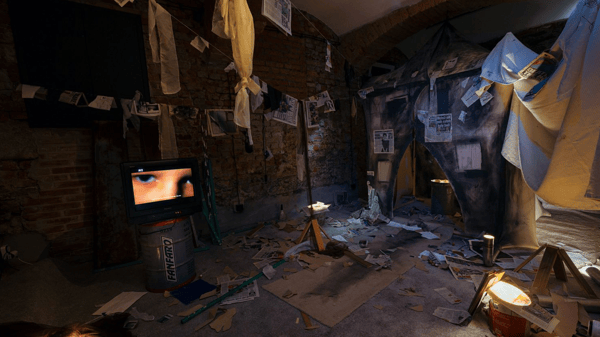
In her project DELTA Plan, Daniela Ponomarevová constructs and subsequently deconstructs a post-apocalyptic story responding to the current state of civilization. At the heart of this dystopian narrative is the presumed demise of Earth, which has become nothing more than a testing ground, a temporary refuge for humanity, which is inevitably awaiting destruction by a giant asteroid. The author opens up this fictional future scenario through a series of objects installed in the immersive environment of a supposed laboratory and a text-and-image document.
These two exhibitions share a certain local specificity. The Screenopolis exhibition attempts to reflect certain local themes through contemporary art, while Marian Palla's exhibition presents a locally based artist and his work. At the same time, there is a certain connection between the authors of these two exhibitions in that both subscribe to conceptual thinking.
How exactly does the selection and evaluation of artists take place in the context of art awards and, where applicable, evaluation and recognition at art colleges, exhibitions, and other projects? How relevant or "objective" is this selection and evaluation? These are long-discussed questions that have been raised even more intensely in recent years, when the climate surrounding traditional models of awarding art prizes has been changing dynamically in Czechia and abroad, and questions of the forms and ethics of cooperation, care, support, sustainability, etc. are being discussed more and more frequently.
Once upon a time, in an exhausted era in which nothing could apparently happen. Every exhibition is a small battle in the heat of the culture war. Individual skirmishes both consolidate and undermine constellations of opinions. Their rhythm and harmony is the heartbeat of a warring community. The culture war is both portend and sublimation. It is easy to escape its roar.
Throughout his life, Chalupecký promoted and defended new artistic trends and was interested in general questions of art, especially the meaning of art in modern society. He was a defender of art in connection with life. In today's terms, we could perhaps use the term activist or engaged art. He did not believe in the purely aesthetic function of art and culture in general.
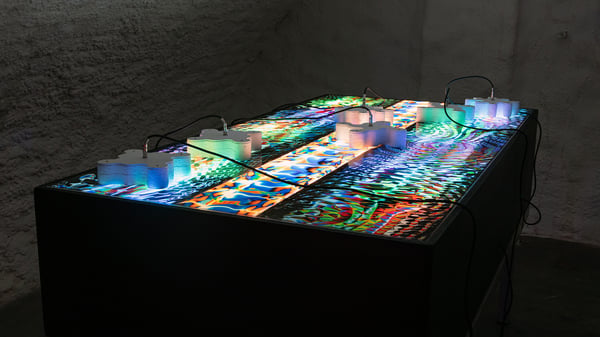
The objects are metal structures of various shapes woven with yarn, which the artists hand-dyed using different types of tea. They use weaving or scrubbing techniques, which, incidentally, most of us know primarily as half-forgotten craft practices. Their focus corresponds to the increased interest of contemporary artists in materials and technologies such as textiles, ceramics, and glass, which have long been neglected. Julia and Barbora, however, approach textiles without any obvious retro nostalgia, which could be tempting.
Four words to start with. A tongue twister or a modest incantation? The first episode of the fifth curatorial cycle at Galerie Kurzor as a space for three artists to meet. Count to five, open and close your palm. What have we understood, what has escaped us? One thing is certain. We are not ourselves.
When we deal with the legacy of mythology, we are primarily interested in what that "legacy" is. Are they themes? Specific characters? Certain models? Ideals? Through its narratives, mythology presents us not only with a multitude of archetypes and stereotypes, but also with many ideals and moral and emotional models that have been accepted to a certain extent as canons, dogmas, and model cases over the centuries. Carl Gustav Jung already noticed this in his interpretation in the field of analytical psychology (archetypes).
It is only through understanding and strengthening of our interconnections and relationships with our environment that we can bring about any societal change that will ultimately result in an improvement of the affective micro-politics. The personal is political.
By imitating the gestures of objects and things that are already in the gallery space; by slowing down, pausing, lingering, alighting, unwinding... through these actions we can escape the entrenched trajectories we found ourselves on in the morning, rid ourselves momentarily of what we have already become, so that we can lose ourselves in thoughts of what we might be.
The concept of the exhibition is based on the ideological convergence of the work of Catherine Radosa and Jaroslav Varga, which consists in revealing the physical and symbolic traces of the past. Both artists examine these relics of bygone times and eras from the perspective of collective memory and the mechanisms of its storage. A vacant lot is an empty space, a gap left by a past situation that can be filled again. The installation Colonne / Révolution captures the constant cycle of the monument in a triple projection. The period of the revolutionary Paris Commune is still a problematic period in France, similar to the period of socialism in our country: it has been and continues to be reinterpreted, tabooed, or marginalized.
The long life of industrial products, their slow decomposition and their subsequent journey into the earth - with all this, the artist gives nature and geological time a far more optimistic perspective than we as humans can attribute to ourselves. We now know that the garbage patch in the Pacific Ocean has exceeded the size of Texas and is approaching the size of all of North America.