textile 28 results

textile

It is only through understanding and strengthening of our interconnections and relationships with our environment that we can bring about any societal change that will ultimately result in an improvement of the affective micro-politics. The personal is political.
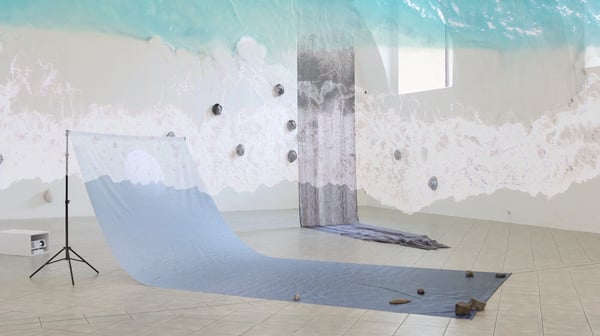
By imitating the gestures of objects and things that are already in the gallery space; by slowing down, pausing, lingering, alighting, unwinding... through these actions we can escape the entrenched trajectories we found ourselves on in the morning, rid ourselves momentarily of what we have already become, so that we can lose ourselves in thoughts of what we might be.
The environmental aspect of Hussite thinking is particularly noteworthy. Like today's generations, the Hussites lived with the prospect of dramatic changes in the world (or even its end, as it was known at the time) either approaching or already underway. As a result, their radically revolutionary agenda also carried with it a significant dimension of what today could be described by the popular term "degrowth."
Burning hair might not be available on the scale of instant scents yet. They bring critical unease into the reading of Lenka’s and Tania’s environment. Just as the camera work in a strangely voyeuristic video in which the loudest emotion besides breaking into the private zone is hopelessness. The authors gave up direct control over the camera shots and gave it to a vacuum cleaner that moves through the space on its own and cleans up.
The objects are metal structures of various shapes woven with yarn, which the artists hand-dyed using different types of tea. They use weaving or scrubbing techniques, which, incidentally, most of us know primarily as half-forgotten craft practices. Their focus corresponds to the increased interest of contemporary artists in materials and technologies such as textiles, ceramics, and glass, which have long been neglected. Julia and Barbora, however, approach textiles without any obvious retro nostalgia, which could be tempting.