SNEAKING DEMOLITION AND DOUBTFUL CASH FLOW
First let us have a closer look at the project of the private gallery Kunsthalle Praha, which is being built on the premises of the former Zenger transformer station at Klárov. „Kunsthalle Praha’s mission is to contribute to a deeper understanding of Czech and international art of the 20th and 21st centuries and to communicate this with a dynamic, contemporary programme to the general public,“ is said on the website of the future Kunsthalle. At the end of last year excavators started digging into the listed building of special architectural interest, built in the 1930s by architect Kvasnička. However, most of the structure was pulled down. This insensitive „sneaking demolition“ of a valuable building has provoked criticism from historians and architects. The project by the studio Schindler Seko shows clearly that the interior has been demolished and only the perimeter walls have remained. The building will be raised and the terrace will disappear. According to Anna Kusáková from the Club for Old Prague not much will remain of this valuable, listed building and the reconstruction aims at making the maximum use of a lucrative lot in the city center. Therefore it is difficult to believe that the Kunsthalle wants to contribute to the understanding of modern art when it is being built on the ruins of a significant piece of architecture. „Every reconstructed or newly built building in the city centre naturally provokes both enthusiastic expectations and criticism followed by discussions,“ said Petr Pudil to Artyčok in connection with the major interference into the building. He also said that the technical state of the inner structure and its chemical contamination did not allow them to transform the space into a museum. According to Pudil the facade of the Kunsthalle will be preserved and a number of important technical features will be returned. We should also pay attention to the strange history of the joint stock company Property Klárov which has owned the building since 2007 under the name of Marvikven. The company was founded by Braxton Invest, which according to Transparency International figures in the case Panama Papers and is connected with the Czech branch of the law firm Mossack Fonseca. Braxton Invest was one of the two main firms which were meant to conceal transfers of money in major cases of corruption and tax evasion. In 2008 architect Martin Rajniš joined the firm Marvikven and it was him who later on prepared the project to turn the former Zenger transformer station into a hotel. At that time the firm had at its disposal only two million crowns, which came from the firm Braxton Invest, and it operated at a loss. In 2011 in the firm´s accountancy there appeared more than 58 million crowns in the form of a short-term loan, however, the firm continued to be in the red. In the auditor´s report from the following year it was clear that the company was founded in order to own and run the building at Klárov. The company borrowed 28 million crowns from soulmates and another 40 million from the Ukrainian bank Privat. This bank served for at least ten years, until it was privatized in 2016, to launder massive amounts of money and to conceal frauds. Ninety-five per cent of corporate loans from banks were granted to bank owners or their partners, which reminds us of the cases of tunnelling of Czech firms, such as MUS. The original owners offered the building of Zenger transformer station to the Academy of Art, Architecture and Design in Prague since the school was looking for a suitable building to expand its activities. The school management turned down the offer at that time because the ill-famed Prague enterpreneur Roman Janoušek was said to figure in the company Marvikven. The plan of architect Rajniš (or Roman Janoušek) to build a hotel at Klárov with rather dubious sources of money or to sell the building to the Academy of Arts, Architecture and Design, apparently went wrong. The firm Marvikven changed its name and at present is known as Property Klárov and its statutory director Michal Drmola is in charge of real estate projects in the company BPD which we shall introduce soon. The firm borrowed over 75 million crowns from The Pudil Family Foundation that took over control of the firm and began building the exhibition space. However, according to the auditor´s report the company Property Klárov ended up in the red again, so despite the change of owners the company was recently in danger of insolvency.
FROM A COAL MINE STRAIGHT TO A GALLERY
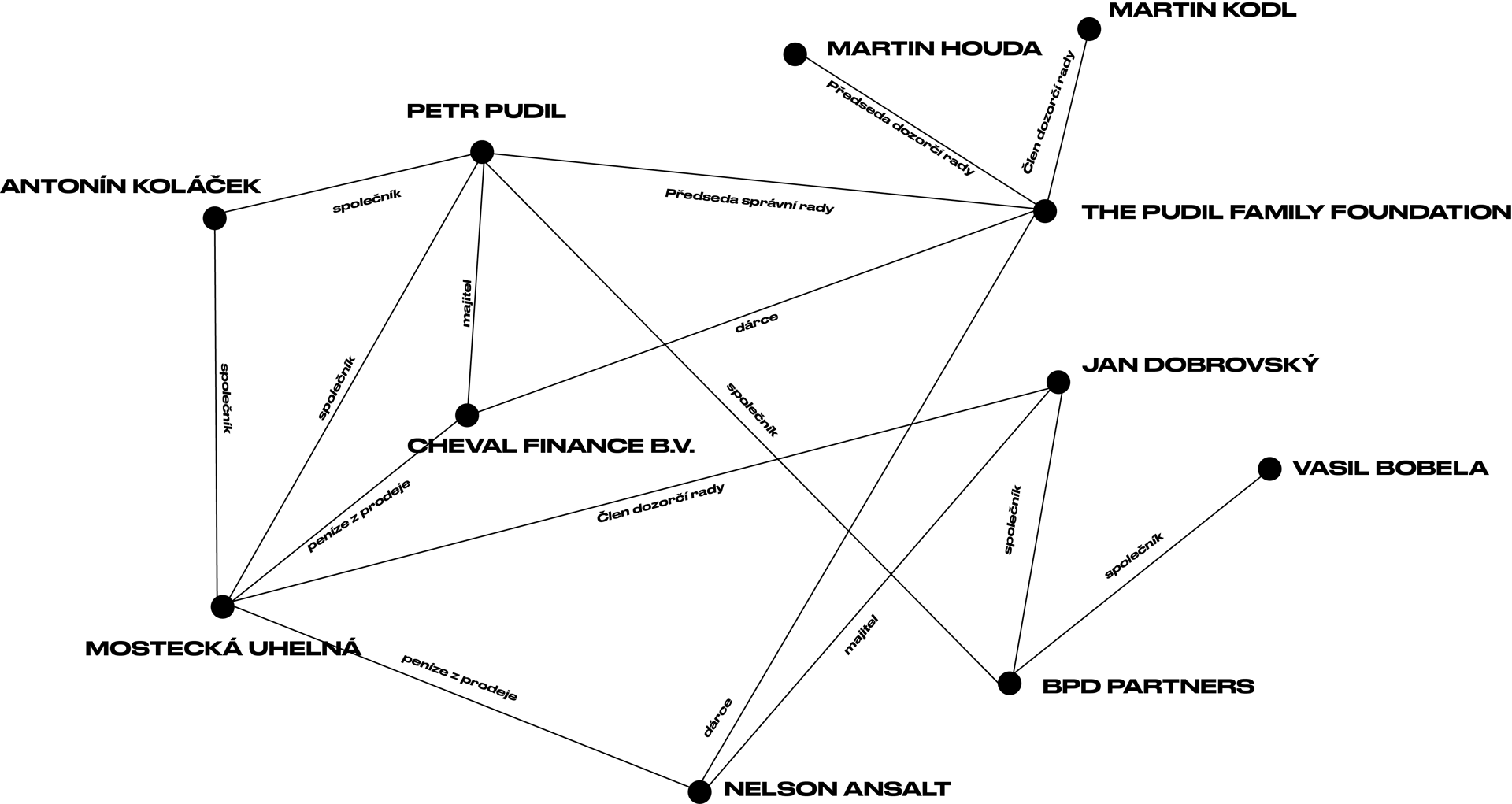
Mr and Mrs Pudil set up their foundation in May 2014 and a year later they donated their collection of 104 paintings, drawings and prints to the foundation. According to Martin Kodl, an expert on art, who appraised the art works, the gift was worth more than 238 million crowns. Besides other artists the collection includes works by Max Ernst, Toyen, Josef Čapek or Emil Filla. During the same year the founders of The Pudil Family Foundation chose the well-known gallerist, art collector and author of the evaluation report Martin Kodl to become a member of the supervisory board. Radek Pokorný was chosen as another member of the board of directors and is in charge of developer projects of the investment trust BPD Partners owned by Petr Pudil together with Vasil Bobela and Jan Dobrovský. It was Pudil and Bobela who became the winners of the wild privatization of the coal mining company Mostecká uhelná (MUS), which became one of the most complicated cases of tunnelling during the economic transformation. In a nutshell, we may say that the group of managers led by Antonio (originally Antonín) Koláček managed to take advantage of the vacuum and chaos during the economic transformation and buy shares in the firm for the money of the state company Mostecká uhelná and take over control. The state lost about 3,3 billion crowns due to this disadvantageous transaction. They managed to steal one of the two largest coal mining companies for money that was taken from the company itself through „shell companies“ abroad. According to the Swiss Court they were found guilty of fraud, money laundering and the breach of duties related to the management of assets and Koláček, the head of the whole group, was sentenced to 52 months in prison. The businessman was supposed to begin serving his sentence in Switzerland in October 2018, but the date was postponed to May 2019. However, he did not turn up and asked for postponement again. Today he says that if the court does not comply with his request, he will not go to jail. He claims that the Swiss court did not interrogate all the witnesses and did not take the Czech context into account and that he wants the Municipal Court in Prague to take over his case. We met Antonio Koláček in his office in Týnská Street. He told us how he learnt „to feel the flow of energy in a company“ in the early 1990s when he began working in Komerční banka. In May 1995 he became a member of the board of directors of Mostecká uhelná where Komerční banka had its shares at that time. In 1996 he became a member of the management and met Vasil Bobela. Immediately afterwards he invited Petr Pudil to join MUS because he said he admired his creativity and wanted him to take care of the new communication strategy of the company. According to Koláček he was also in charge of the communication with the media and towns and villages in the Most region, and finally also with the ČEZ company. Petr Pudil´s job was to present coal as a raw material indispensable for the future of the state power engineering índustry and he was expected to guarantee the growth of profit shares in MUS. Koláček mentioned that Petr Pudil had brought the arms dealer Pavel Musela to the company MUS who introduced for example the Minister of Finance Ivo Svoboda or the ex-Prime Minister Stanislav Gross to the management. Musela is said to have been giving bribes to politicians of the Social-Democratic Party under the leadership of Miloš Zeman. In 2008 Musela „fell down“ from a tree stand under strange circumstances and lost his memory. Later, his brother Karel Musela shot dead two business partners whom he suspected of organizing an attempt to murder his sibling. „I knew Pavel Musela, I usually met him only at social events. I do not remember him cooperating with MUS or with its subsidiary companies neither during the time when it was controlled by Appian Group nor later on“, said Petr Pudil to Artyčok. After 2000 Petr Pudil and others from MUS began cooperating also with Jan Dobrovský who was supposed to lobby in favour of Koláček and others for the privatization of North Bohemian Coal Mines. In 2004 Koláček, Měkota, Pudil and Bobela took out a loan of 6 billion crowns from the ČSOB bank to purchase shares in MUS. It was the lobbyist Jan Dobrovský who helped them to get the loan in the ČSOB bank since he knew well the bank´s director Pavel Kavánek. For this money Koláček and Měkota purchased 40% of shares in the company and Pudil with Bobela 10% of shares. They did not own the company directly, but through the so-called „antshalts“, special forms of legal entities registered in Lichtenstein. In 2007 they sold 49% of shares of the Mostecká uhelná company to Pavek Tykač for 10 billion crowns, sharing the profit proportionally. When, in 2007, the Swiss police began to be interested in Mostecká uhelná company, Petr Pudil and Vasil Bobela asked Koláček and Měkota to transfer the shares of the company under their management for a deposit of two billion crowns. This was the way they allegedly wanted to avoid criminal prosecutions to further reduce the value of the company, which they were planning to sell as soon as possible and divide the profit among themselves and pay off Antonio Koláček and Luboš Měkota. In 2009 Koláček went to China to meditate and as he said Pudil and Bobela took advantage of this situation and transfered all the shares of Mostecká uhelná company to the newly established anstalts in Lichtenstein without any contractual arrangements for the prosecuted joint-owners. In 2010 Pavel Tykač paid them 10 billion crowns for the remaining 51% of the former Mostecká uhelná company, at that time known already under its new name Czech Coal. According to Koláček, Pudil with Bobela gained 9 billion crowns to the detriment of the now deceased Luboš Měkota, so that is why they filed a complaint against their former business partners. The police decided to terminate the proceedings for lack of evidence. On the other hand, Petr Pudil filed a complaint against Antonio Koláček and his partners and up until the present has been claiming damage of 6 billion crowns. The money gained from the sale of the company Czech Coal (formerly Mostecká uhelná) in the Lichtenstein anstalts forms the basis of the assets of the investment trust BPD partners, whose name is made up of the first letters of the surnames of Bobela, Pudil and Dobrovský. Money from the same source flows to the family foundation of Mr and Mrs Pudil. „We have never been owners or beneficiaries of the Appian Group who owned MUS at the turn of the millenium and from whom we bought MUS. We have never been accused or convicted of anything in connection with our activities in MUS or Czech Coal,“ claims Petr Pudil in his statement on the website of his foundation. „Those are true sentences but slightly constricted. Petr Pudil with Vasil Bobela took part in the restructuring of the company and knew what was going on there. They were never accused of anything and it is really strange that their money is clean while our money is dirty,“ said Antonio Koláček in his comment on Petr Pudil´s statement. „Me and Luboš Měkota were beneficiaries of Appian for a certain period of time, but this makes no difference in the fact that they (Pudil and Bobela, author´s note) made an effort to finally become the owners. They came up with different ideas and organized the sale of the remaining shares in 1999. They were a part of a group organizing the transformation of MUS, Provided we deceived the Czech government, then they were active participants in that fraud,“ said the convicted businessman. Petr Pudil refuses to have taken part in criminal activities related to Antonio Koláček and claims that his former partners mislead him and that he knew nothing about the tunnelling through Appian Group.
EVERYBODY WILL PAY FOR THE KUNSTHALLE
„We sold Czech Coal because we did not want to continue doing business that was in conflict with the environmental policy of Europe,“ says Petr Pudil in his statement. According to him our environment was the main reason for his billion-worth transaction but in reality the main reason was the profit. Pudil´s and Bobela´s exceptional business skills and deftness as well as their very good connections with politicians also became apparent in 2007 when they founded the company REN POWER and began with massive investments in solar energy. It should be mentioned that in the same year Petr Pudil became the president of the European Association of Coal Industry Euracoal, which is the most important lobbyist organization representing the interests of European coal mining companies. „Together with the European Commission we must mainly enable access to local supplies of coal“, said Pudil at that time when commenting on his activities in Eurocoal. What he had on mind mainly was the breaking of local limits of coal mining in Northern Bohemia, which lowered the potential profits of his company Mostecká uhelná and up until today impedes to demolish Horní Jiřetín or Černice. Simultaneously, Pudil became the chief European spokesman defending the interests of the dirtiest coal mining business, but at the same time he began to invest significantly with his colleagues into renewable sources of energy. As far as investments into solar energy are concerned, this period was regarded as almost miraculous and promised exceptional profits. In 2005 the government led by Jiří Paroubek adopted a law on promoting production of energy from renewable sources, which guaranteed a very generous purchase price fixed for 20 years. At the last minute, Iva Šedivá, the Member of Parliament for the Czech Social Democratic Party, managed to put through an amendment, according to which the Energy Regulatory Office (ERÚ) could lower the purchase price of energy at the most by five percent annually. In 2008 cheap Chinese photovoltaic cells appeared on the market, which lowered substantially the costs of solar energy production. Due to ineffective laws the state could not respond to the development of the market by lowering purchase prices and therefore the solar energy business turned into a gold mine for investors who had expected a similar development. The purchase price jumped from six crowns to thirteen, which surprised everyone except for those who had already built their power plants. Among them were Vasil Bobela and Petr Pudil, who used the money of all energy purchasers to augment the money taken from the company Mostecká uhelná (Czech Coal). The amendment of the MP Iva Šedivá and the intentional or non-intentional incompetence of other politicians cost us hundreds of billions, which we pay into the pockets of a small group of well-informed entrepreneurs in good contact with politicians. Another reason why we pay a high price is the fact that renewable energy has a bad reputation because people naturally connect it with price increases and the wealth of the immoral elite. It is important to realize that these two businessmen own all solar and wind-powered plants not only in our country but also abroad through the mother company REN Power Investment B.V., which is registered in the Netherlands, which is the main European tax haven. The porfolio of the company BPD includes besides others also the Lučební závody Draslovka in Kolín, which produces the infamous Cyclon B, which is sold today under the name Uragan D. If Petr Pudil speaks grandly today about social responsibility, so taxes are the most democratic and fair way how he can repay at least a fraction of what he obtained or gained by speculation. According to information from the server Motejlekskocdopole this year there has been a police intervention in the company REN Power, investigating criminal activity during the launch of the photovoltaic power station Zašová. Police sequestered 529 million crowns and the police investigation is connected with granting the licence for energy production in 2010. Moreover, the police also sequestered a part of a bonus which the state pays for energy supplies from Zašová. Due to criminal prosecution REN Power suffered a financial loss of 305 million crowns and was unable to repay the loan from the ČSOB bank. Motejlekskocdopole also mentioned that all long-term loans of REN power amounting to 1.9 billion crowns were changed to short-term loans repayable within one year. This may lead to the company´s bankruptcy soon causing a serious problem for the three owners – Pudil, Bobela and Dobrovský.
USEFUL ART
Let´s go back to the charitable trust of the Pudil family. In the first available accounts from the year 2015 we can see that besides a gift of works of art worth 238 million crowns from the Pudil family, another 265,5 million crowns credited the account of the foundation from the company NELSON ANSTALT registered in Lichtenstein and owned by Petr Pudil. Over 4 million crowns was donated by the company Cheval Finance B.V. registered in the Netherlands and owned by the company CHEVAL ANSTALT from Lichtenstein, which is supervised by Jan Dobrovský. The last name on the list of donors is Bobela´s PETRONIA ANSTALT. Those Lichtenstein anstalts are hybrid companies, which businessmen use to keep money out of reach of their home tax offices. They are most probably the above mentioned companies where the three partners safely deposited the money they gained by selling their shares in Czech Coal. Today they transfer money through a charity foundation from the tax haven back to the Czech republic and purchase art works worth hundreds of millions. Besides financial gifts worth more than 276 million crowns, the account books from the year 2015 mention unspecified works of art worth over 46 million crowns. So this way the foundation gained works of art worth 285 million crowns and financial gifts worth 215 million crowns. The remaining 61 million from gifts remains in the accountancy out of the foundation´s assets. This year the foundation was in the red, the loss was 128 million crowns (generated by amending items). In 2016 the firm NELSON ANSTALT donated another 60 million crowns to the foundation, which the foundation spent on unspecified works of art and thus increased its property to 565 million crowns. A year later another 106 million crowns was sent to their bank account again from the Lichtenstein anstalt and from the companies Bpd partners and Ren power. The money was spent on more unknown works of art for the charity foundation, whose value at the end of the year exceeded 658 million crowns. It is mostly those unspecified works of art purchased mostly with money from the tax haven that form today about two thirds of the value of that family foundation. The questionable origin of finances in Lichtenstein as well as the former business activities of Petr Pudil harbour suspicions that the family foundation may potentially serve for the so-called artwashing, symbolic money laundering and improvement of bad reputation. The question is whether the family foundation does not also serve for lowering taxes. Among the foundation´s partners belongs the firm Cee tax management, which has its seat in Prague and Malta, and concenrates on tax optimalization. The executive director is Henricus Petrus Joannes Goossen who is related to the director of Kunsthalle Ivana Goossen. The former business partner Antonio Koláček commented on the setting up of Pudil´s family foundation: „They probably don´t care about money, the three of them have really more than enough. Petr Pudil needs to create mimicry and wants to create a new image of himself as a sensitive, sophisticated man who also loves art.“ The gift of 4 million crowns for the National Gallery in Prague or the contribution of one hundred thousand crowns for the exhibition of graduates of the Academy of Arts may also be seen as the foundation´s attempt to earn a good reputation. The above-mentioned gallery owner Martin Kodl may play a significant role in the entire scheme, since he appraised the value of the first set of artworks donated to the foundation by Mr. and Mrs. Pudil and is also a member of their supervisory board. We do not know where the artworks come from or under what conditions they were bought for the foundation and where the hundreds of millions really end up. However, Petr Pudil denies all doubts regarding the financing of the foundation. „Kunsthalle Prague is and will remain a non-profit organization established by our family foundation. We invest into this project our own taxed finances without any ambition to get any kind of return.
INTERESTS OF OLIGARCHS
The interview with Petr Pudil led by Tereza Jindrová from Artyčok clearly shows the relation of the founder of the Kunsthalle to paying taxes and the state in general. „There is a number of people here who realize that after thirty years in business they have earned more than they need and so now they feel like supporting convenient projects that can contribute to changes which suit them,“ said Petr Pudil and unintentionally defined oligarchy, a small group of people whose enormous wealth enables them to influence the entire society as they like. The economic transformation by shock privatization of public assets resulted in the advent of a group of oligarchs, who concentrate today an exceptional amount of property and political power – Petr Pudil being an inseparable part of this group. In the interview he says: „I fully support tax assignment in favour of certain fields of social life.“ It is fully in the interest of oligarchs so that they can manage their money freely without the control of democratic state institutions. To this purpose Petr Pudil uses companies registered in tax havens and also his family foundation, through which he can freely decide how his property will be managed. „This is what could help us to create a civil society, that people have been calling for for a long time,“ said the businessman at the end of the interview. In an oligarchy civil society plays the role of an ornament, which the powerful few take care of in order to show their own democratic and liberal approach. A civil society with no power, no democratically controlled funds and without the support of functional public institutions, is useless and in the end directly or indirectly serves the ruling oligarchs. This is also true about non-free art serving the interests of oligarchs while artists blindly and non-critically pretend that inequality, financial machinations and tax evasion have nothing to do with them. The interests of the majority of people who do not belong to the handful of the wealthiest people – including artists – are in conflict with the interests of oligarchs who try to conceal this fact whenever and wherever possible.
AUTHORS
Author of the text: Václav Drozd
Animations: David Přílučík
Editor: Janek Rous