institutional critic 37 výsledků

institutional critic

When looking at the reasons why someone has nowhere to sleep, we inevitably start to ask ourselves some pressing questions. What are our values? What relationship do we have to the weakest members of society? How is this manifest in the public space? What effect does the environment have on people? How many segregated areas and people in social exclusion do we have? Are we racist? What is our attitude to housing – is it a human right or must it be earned? Does our society create homeless people on its own?
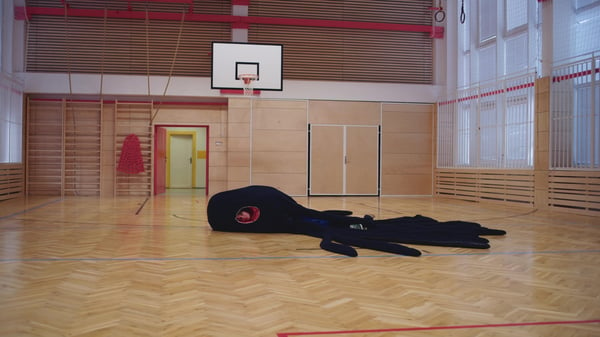
Instead of students, the building was temporarily inhabited by creatures created by the artist, and the footage is accompanied by Koťátková’s gentle, sensitive, yet critical voiceover (letter to the school). It is complemented by the echoes of children’s voices and quotes from the school rules, serving as a reminder of how strongly the elementary school environment shaped us. What memories do we carry into adulthood from the spaces of gyms, locker rooms, cafeterias, desks, and “in front of blackboards”? 
As we can see in the program of Tranzit, Havránek´s theoretical interest is not closely concerned with the autonomous position of visual art but he always reflects its broader global and political context.
They are often presented as condescending patrons of arts, who have decided to put aside a couple of their millions and contribute to public welfare and the promotion of exquisite culture. However, their seemingly good intentions should be seen with view to the context of the troubled political and economic past of our (and not only our) country. We should know how they acquired their property and what social or ecological damage they caused while amassing their fortune.
Ondřej Doskočil knows the weight of inherited political layers of the black metal genre as well as of the problems contained in musealisation and sensation craving colonization of subcultures by marketing ideology. As an insider and a musician he can also distinguish, untangle and give voice to the symbol systems inside of this extreme metal subgenre that would otherwise not speak to uninvolved people at all, or that would not even be heard over the all-encompassing noise. The format of the mobile phone shot "exhibition walkthrough" could confuse while detecting what is the medium he refers to.
Milan Mikuláštík can hardly be defined solely as a curator. He is well- known above all as a distinctive artist, member of the duo MINA (together with Jan Nálevka) and the group Guma Guar, which he co-founded in 2003. His cooperation with this group as well as his own works – often critical and dealing with political structures of the globalized world – later lead to a similarly focused curator´s work.