collaboration 83 results

collaboration

"The installation of the exhibitions will be entrusted to the artists. I see it as a second choice besides the fact that artists teach. "
In the course of the 1990s Jiří Příhoda experimented with video-projections and became known as the first artist on the Czech art scene expressing himself through sculptural-architectural transformations of exhibition spaces.
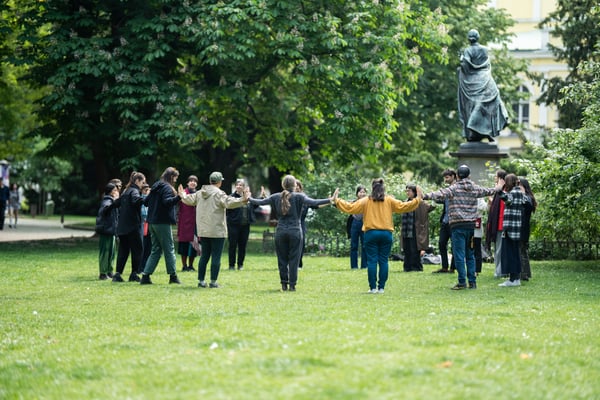
They look at D'EPOG, D'EPOG looks at them. They are peeking together. It is open to participation, it likes to collaborate, it invites many artists from different disciplines. It holds workshops every summer. It is not afraid of anyone and anything; when it is afraid, it shares and overcomes its fear. It's still working on itself. It is non-transmissible although contagious. It is rare and ordinary, it is non-instantaneous and it is always fully living in the present, it is love, freedom, joy, surprise, endurance test, therapy, shared hyperempathy, reptile fantasy, livefull kid, endless party. It's WOW.
The colony in Ostrava called Bedřiška has belonged among the so-called socially excluded localities for a long time. However, Bedřiška does not show any features that most probably come to your mind when we speak about excluded localities. The people are happy to live there, they regard the place as their home and they try to keep their houses as well as public spaces in good order and tidy.
Anton Vidokle is the type of artist who might not seem to be a very prolific author, at least not in the classical, material sense of art production. Vidokle is interested in art as a means to learn as much as possible about the world we live in, to explore it.
Conceptualized by Zbyněk Baladrán, Vít Bohal, Dustin Breitling and Václav Janoščík, the conference brings together theorists, artists and organizers who collaborate and elaborate on their visions in order to discover junctures of overlap for thinking about the emancipatory potentials of the future.
We know and repeatedly analyze a host of issues with commercial social media and digital labour, but little attention is paid to efforts at building alternatives, such as community-run social media and other forms of de-platformization.
Against the totality of networks and corporately owned social media, what are workable strategies and ethical approaches that allow for alternative ways for our social life to emerge?
The mini-symposium “Bauhaus and Functionalism” examines the reception and interpretation of the emergence of Functionalism in Czechoslovakia in the interwar period and connections with Bauhaus in Germany. The leading theorist of the modernist avant-garde Karel Teige and his teaching at the Bauhaus are ideal examples of networking between these countries.
Her activities are interwoven with a complex web of collective bodies of various transient groups or platforms. Since 2009 she has been a member of A.M.180., a team already behind the cult festival of contemporary music Creepy Teepee, taking place every year in the medieval landscape of Kutna Hora. Like the festival itself, is not just a spectacle of monolithic music projects, but also a place for performances and visual arts, as well gallery A.M.180, where Timková works as co-curator, is a place of hybrid cultural activities.
Former Dutch government architect Liesbeth van der Pol lead the discussion together with architect Viktória Mravčáková from the Slovak organization Spolka. They discussed the durability and if the architecture today lead or do not lead to sustainable environment.
What futures do plants make possible? From colonial extraction to regenerative practice, from taxonomy to kinship, plants have always mediated the terms of human life.